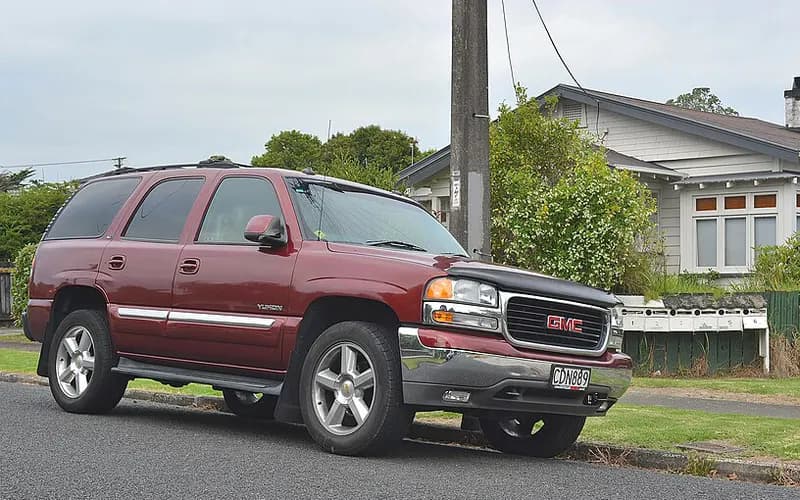
GMC Yukon 2000–2006
Common on this vehicle:Gauge or instrument faultNoiseWarning lightCorrosion or rustLeakReduced brakingAir conditioning or heaterVibration or shudder
There are 3,002 records on the 2000–2006 GMC Yukon (Owner complaint: 1,328, Recall: 35, Manufacturer communication: 1,639). The documents describe 149 known issues; those with the most records under them are Gauges stick or flutter (177), Brake pipe corrosion (157), ABS activation at low speed (63).
Possible causes
153 causes not drawn
- Voltmeter fluctuates between 12 and 14 volts (Regulated Voltage Control, normal)4
- CHECK OIL LEVEL message stays on after an oil change or top-off until the engine cools1
- Brake Light: failed2
- Hydro-boost brake assist and power steering share one hydraulic supply (four campaigns)11
- Brake pedal moves or self applies at full steering lock (Hydro-Boost)10
- ABS light with C0265/C0201/U1041 or no communication with brake module (EBCM ground G110)2
- Brake pedal pushrod retainer missing - recall 05V-1031
- Cosmetic brake rotor corrosion: burnish, do not resurface1
- Front right-hand brake pipe contact with body cross sill - recall 00V-3451
- DIC “Reduced Brake Power” message and reduced vacuum boost1
- Service Brake Booster message on a Hydroboost vehicle with DTC C0136 (instrument cluster not SPS programmed)1
- Stability System Disabled / Service Stability message with DTC C0455 (bent terminals at the steering wheel position sensor)1
- Stability System Disabled message and unwanted StabiliTrak activation (tire wear or mismatched tires)1
- Violent steering wheel shake or vibration at road speed (brake booster)1
- ABS lamp with DTC C0265 (EBCM motor relay circuit) after EBCM replacement1
- Buzz at the accelerator pedal on the first acceleration after start (Supplemental Brake Assist self-test, normal)1
- Electronic Brake Control Module: failed, electrical fault15
- Brake Rotor: corroded, design or manufacturing12
- Engine fuel rail crossover tube retainer screws may break (5.3L RPO L59) - recall 04V-3765.3L only2
- Aftermarket part (not the vehicle as built): Fram G3727 replacement fuel filter connector - recall 06E-0431
- Fuel gauge reads low or drops to empty in Park / Neutral (normal characteristic)1
- Fuel Pump: failed, corroded15
- Fuel Line: corroded, failed9
- Fuel Pump Wiring: overheated, electrical fault5
- Fuel Tank: leaking, design or manufacturing4
- 4L80-E / 4L85-E planetary gear whine in first and second gear1
- Service 4WD indicator and DTC B2725 (transfer case shift control switch)4WD / AWD only1
- Transfer case service light, New Venture Gear transfer case (replace the encoder motor sensor and reprogram the TCCM)1
- Electronic transfer case stops shifting with no DTC (shift abuse lock out mode, normal)1
- Transfer case speed sensor connector locks bend on disconnect (improved connector)1
- 4L60-E / 4L65-E clunk on 2-3 upshift or 3-2 downshift (normal condition)1
- Grind / ratchet noise when shifting into Park in 4LO (characteristic)1
- Transmission: failed, clogged or contaminated15
- Rear Axle: failed, worn5
- Tire scrub noise on low speed turns (steering rod / centerlink installed backwards)1
- RPO DL3 power folding mirror loose, moves or shakes after being folded by hand (cycle it electrically)2
- Door manual lock lever disengages from the door trim panel (lock lever replacement)2
- Driver's seatback moves during braking (recliner replacement)2
- Front floor carpet wet or musty odor (rear door water deflector replacement)2
- Headliner sagging (hook and loop patch detached; reattach with epoxy)2
- Factory trailer hitch receiver bent, broken or weld failure2
- Bench seat (RPO AE7) center console armrest hinges broken (replace the lid, not the console assembly)1
- Rattle from the center of the dash (cowl insulator clip)1
- Center console cupholder and ashtray lid will not close (Denali; latch pulled out of its retainer)1
- Door sags or is hard to open or close (worn or corroded hinge pins and bushings)1
- Snap or popping noise from the front of the vehicle (slot the front crossmember mounting holes)1
- Front seat adjuster switch knob loose or missing (replace only the switch cover)1
- Headliner or roof rattle (roof drain channel)1
- Stains on the rear bumper step pad (treat with Armor-Dillo, do not replace)1
- Broken latch of the rear cupholder in the center console (replace the latch only)1
- Rear door upper hinge welds out of specification (FMVSS 214) - recall 03V-0371
- Second-row rearward folding head restraint pinch points - recall 02V-2531
- Side access door noise (door check link replacement)1
- Double vision or ghost image in the driver's auto dimming outside mirror (normal)1
- Rear Window Glass: broken, loose or misadjusted14
- Liftgate Glass Hinge: broken, failed12
- Seat: loose or misadjusted, broken11
- Power Window: failed, electrical fault10
- Mirror Glass: broken, loose or misadjusted5
- Seat Back: loose or misadjusted5
- Remote keyless entry and front passenger door window, lock, mirror inoperative (reprogram the Passenger Door Module)14
- Passlock theft deterrent: starts then stalls / no-start with security lamp4
- Rear seat audio and/or rear HVAC controls inoperative (replace the RSA, not the console)3
- Trailer brakes applied whenever headlamps or park lamps are on (brake controller jumper harness)3
- Ground Ring Terminal: loose or misadjusted3
- Adjustable pedals do not recall preset positions and/or front heated seats turn off after 30 seconds (brake pedal position switch)2
- CD slow to play, CHECK CD error, CD stuck or clock resets to 12:00 (reprogram the radio, do not replace it)2
- Intermittent stall, misfire or crank no start (Ignition 1 feed wire broken near C148/C149)2
- No audio out of the speakers at times (radio reprogram or amplifier replacement)2
- Starter keeps cranking after the key is released (PCM-controlled automatic crank, normal)5.3L only2
- Generator whine in the audio system (new ground for radio and amplifier)1
- Intermittent battery drain from a sticking A/C compressor relay1
- Intermittent MIL, service lamps/messages or DTCs from connector fretting corrosion1
- Positive battery cable contact with steering shaft universal joint (Denali) - Transport Canada 20010921
- Memory seat recalls to a more-forward position than set (memory seat module software)1
- Navigation radio returned from the Electronic Service Center: no navigation and CD ERROR message1
- No crank with a blown Ign A fuse (circuit 142 pinched at the steering column support bracket)1
- Poor radio reception from a loose radio antenna mast1
- Radio shows a disc error when a media disc is inserted (unsupported disc format or damaged disc)1
- No audio and no radio display, or radio clock resets (2004; radio set-up with the Tech 2)1
- Red radio theft LED does not flash (manufacturer's counter not reset at assembly)1
- Rear wiper jumps when the fog lamps are turned on (auxiliary ground to rear washer pump)1
- Reduced Engine Power from throttle body connector crimp, broken wire or grounds1
- Seat heater or memory power seat inoperative (memory seat control module)1
- Conversion equipment (not the vehicle as built): Southern Comfort running board courtesy lights overheating - recall 03V-0941
- Turn signal flashes fast (export flasher relay installed)1
- DRLs or auto headlamps will not disable with the headlamp switch (Canada, RPO Z49; normal)1
- Hum or fan noise from the navigation radio (internal cooling fan, normal)1
- Radio volume lower at the same setting after reprogramming or replacement (new audio calibration, normal)1
- Replacement headlamp switch has no LED indicators and sets DTC B0951 (2003, normal)1
- Battery: leaking, broken5
- Exhaust pop or ping noise (replace the heat shield, not the exhaust system)13
- P0420 / P0430 on a new or just-replaced catalytic converter (break-in not completed)5
- Purge Solenoid: failed1
- Oxygen Sensor: failed2
- Intake manifold gasket leak (cold idle misfire, lean codes)10
- Single-cylinder misfire (P0300-P0308) and/or chirp, squeak or tick at camshaft speed: worn cam lobe / lifter, valve or valve spring7
- Increased accelerator pedal effort / throttle body sticks (clean and adjust, do not replace)4.8L, 5.3L, 6.0L only5
- Castech cylinder head porosity crack (gradual coolant loss)4.8L, 5.3L only5
- Oil leak after cold start from frozen PCV system (rear main seal)5
- DTCs P2108, P1516 and U0107 (do not replace the TAC module)4
- Rear bank knock sensor corrosion from water intrusion (P0332)4.8L, 5.3L, 6.0L only3
- Lean hesitation, sag or stumble at -6 to +20°C coolant temperature (PCM reprogram)4.8L, 5.3L, 6.0L only2
- Accessory drive belt whine (power steering pump pulley repositioned)1500 only1
- Crankshaft position sensor may work intermittently or fail (8.1L V8) - recall 07V-5218.1L only1
- Engine vibration or noise at idle felt in the steering wheel or seat (reprogram the PCM)1
- Higher than expected engine oil consumption (PCV valve replacement)4.8L, 5.3L, 6.0L only1
- P0300 after engine repairs: injector connectors crossed (cylinders 5-7 / 6-8)1
- Slight roughness at idle with no DTCs (possible characteristic)1
- Throttle body carbon build-up: idle surge, reduced engine power, throttle DTCs (high mileage)1
- HVAC blower motor resistor module / connector overheating4
- Engine compartment noise with A/C on and A/C inoperative (auxiliary rear A/C: suction hose and compressor)3
- Rear HVAC ticking noise, no rear temperature or mode control, DTC B0434 / B3764 (revised auxiliary HVAC control module)2
- No passenger compartment air filter (not available from the 2003 model year; normal)2
- Climate Control Module: failed, software2
- A/C blows warm at extended idle (6.0L: auxiliary electric cooling fan)6.0L only1
- Blower motor inoperative after blower control module replacement (auto HVAC)1
- HVAC actuator clicking / ticking noises (recalibrate the HVAC control module, do not replace actuators)1
- Loss of HVAC mode or temperature control (wiring harness rerouted)1
- Passenger side colder or warmer than the driver's side (HVAC case to cowl seal)1
- Insufficient heat from the rear heater in extreme cold (tee coupling replacement)1
- Seat Heater: overheated, electrical fault6
- Air Conditioning Compressor: failed3
- Encoder Motor: electrical fault, failed2
- OnStar System: failed, software6
- OnStar cannot configure the vehicle (118 error) after the 15-08-44-001 upgrade2
- Some OnStar features no longer work (2G cellular sunset; the module is not broken)2
- No response when the OnStar button is pressed (DTC B2476): button assembly test values1
- Red OnStar LED and DTC B2455 after Canada upgrade bulletin 15-08-44-001 (audio and microphone drain wires shorted)1
- Digital Radio Receiver: failed1
- CD Player: failed, software3
- Autoride (Z55) Service Ride Control / Service Suspension System message4
- Wheel: corroded, loose or misadjusted4
- Vehicle body tilt or lean left / right (torsion bar front suspension)3
- Aluminum Wheel Bead Seat: corroded2
- Aftermarket part (not the vehicle as built): Federal-Mogul National / Carquest replacement wheel hub assembly retention nut - recall 07E-1062WD only1
- Grease seen at front hub bearing seals (normal purge, do not replace)1
- Creak or squeak noise from the rear lower control arm bushings (do not replace the propshaft)1
- Upper control arm bracket alignment (dowel) pin missing at front end alignment1
- Wheel Bearing: failed, worn3
- Tire recall (not the vehicle as built): Firestone Wilderness LE tread separation - recall 01T-0011500 only4
- Tire and loading information label lists inaccurate vehicle capacity weight (FMVSS 110) - recall 05V-5521
- Bolt: broken4
- Seat Belt Buckle: failed, clogged or contaminated3
- Air bag sensing diagnostic module (SDM) anomaly - recall 02V-1782
- Second row seat belt retractor does not lock automatically for a child restraint2
- Air bag lamp on with DTC B0092 (passenger presence system sensor harness)1
- AIR BAG indicator on with side impact module DTCs (connector CPA replacement)1
- 2nd/3rd row outboard seat belt retractor internal crack - recall 01V-1591
- 2nd row center seat belt routing (lap belt fit) - recall 05V-1631
- SIR lamp on and inside mirror temperature/compass display inoperative (open air bag fuse, circuit 1139 shorted to ground)1
- Air bag (SIR) lamp on with DTC B1001 after BCM or SDM replacement1
- Coolant leak at the rear of the vehicle (auxiliary heater hose quick connector)1
The documents say what to doOnly records name itThe size of a node, the width of a link and the numbers are records matching this search, not likelihoods.
FaultCrate・GMC Yukon 2000–2006
Candidate cause (the documents say what to do)
Brake pipe (brake line) corrosion and rupture
The pipes' steel-copper construction is vulnerable to galvanic corrosion if exposed to the environment.
NHTSA found the failures came with general excessive corrosion over most of the pipe assembly and appear to be expected wear-out of the coating in severe-corrosion states.
How to tell
Brake warning / Service Brake System
What to do
- In the joint inspections, scaling or flaking corrosion was taken as indicating the onset of metal loss and given the second lowest ranking (2); a leaking or previously repaired pipe was the lowest (1).
- GM noted that pipes with excessive flaking corrosion can only be fully evaluated, including remaining service life, by removing them, cleaning off the corrosion and sectioning them to assess remaining wall thickness.
- The inspections found no specific location where corrosion was visually more severe and no pattern between vehicles.
- Service records of incident vehicles also indicate that repairs are not isolated to a specific location or brake pipe.
- GM recommends replacing the entire set of pipes whenever any pipe leaks or is corroded enough to need replacement.
- On June 28, 2013 GM released 66 new part numbers for servicing brake pipes in 1999-2007 GMT800 pickups and utility vehicles.
Caution: Analysis of repair records indicates that consumers often elect to repair only the failed circuit.
What is needed
- Parts and materials
- The entire set of brake pipes (whenever any pipe leaks or is corroded enough to need replacement; GM's recommendation)
- GM brake pipe kit (a complete set of pre-formed and pre-flared pipes, for when the entire brake pipe assembly is replaced)
- Labor time
- Kit procedure: 4.5 to 6.0 hours, depending on the vehicle's configuration (labor time guideline of the October 2014 TSB)
- Forming and flaring replacement tubing to fit the vehicle: approximately 8.5 hours (base time estimate)
- Special tools
- Not stated
- Scan tool
- Not stated
Only what the technical documents state. "Not stated" does not mean not needed.
In the records
- Brake Line: replaced 27(says it was fixed: 3, result not stated: 24)
- Brake Line: repaired 4(result not stated: 4)
- Brake Rotor: replaced 2(result not stated: 2)
See the evidence (1 technical documents, 157 records)
Passages of the technical documents
NHTSA's investigation covered 1999-2003 GM C/K pickups and SUVs in salt-belt states.
Products: 1999-2003 GM C/K pickup trucks and SUVs in Salt Belt states
NHTSA ODI 2015-04-08
The GMT800 platform includes 1999-2007 Silverado and Sierra 1500, 2500 and 3500 pickup trucks; 2000-2006 Suburban, Tahoe and Yukon; and 2002-2006 Escalade and Avalanche.
The GMT800 platform includes the following vehicles: 1999-2007 Chevrolet Silverado and GMC Sierra 1500, 2500 and 3500 series pick-up trucks; 2000-2006 Chevrolet Suburban, Chevrolet Tahoe and GMC Yukon sport utility vehicles; and 2002-2006 Cadillac Escalade and Chevrolet Avalanche sport-utility vehicles.
NHTSA ODI 2015-04-08
Corroded brake lines may rupture during a brake application, reducing brake effectiveness.
Brake line corrosion may result in rupture during brake application, resulting in reduced brake effectiveness.
NHTSA ODI 2015-04-08
The pipes' steel-copper construction is vulnerable to galvanic corrosion if exposed to the environment.
The steel-copper construction is vulnerable to galvanic corrosion if exposed to the environment.
NHTSA ODI 2015-04-09
Records
- Brake line failure recurring within 12 months Owner complaint 2016-07-16
A cause or a result a complaint states is the owner’s view or what a dealer told them, not an established fact.
Put together by FaultCrate from public records and technical documents. The cause and the repair are for the workshop to decide with the vehicle in front of it. Counts are records, not failure rates.