
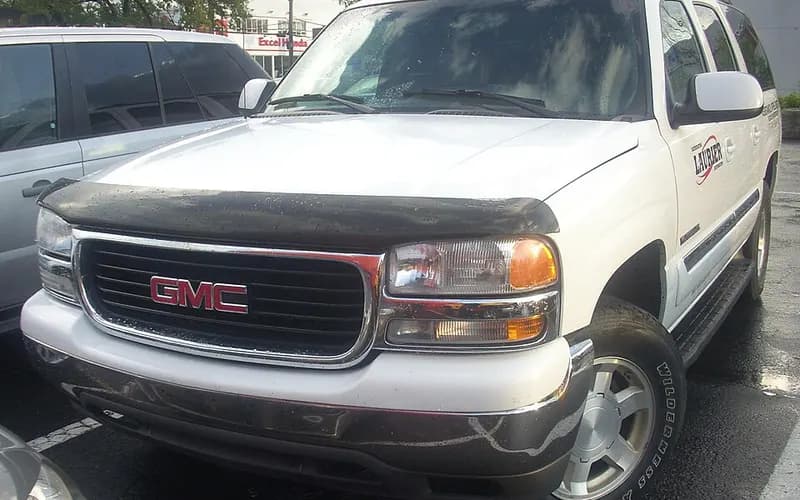
← Look into the faults of the GMC Yukon XL
Symptom
Noise: possible causes and documented repairs — 2000–2006 GMC Yukon XL
Of the records of the 2000–2006 GMC Yukon XL, 145 state “Noise” (Owner complaint: 66, Recall: 3, Manufacturer communication: 76). The technical documents say how to deal with 35 of its possible causes. They are listed by the number of matching records, most first.
Narrow it by model year, engine and more
Causes the technical documents say how to deal with (35)
Steering intermediate shaft clunk
15 matching records
A clunking noise under the hood that can be felt in the steering wheel and/or steering column.
Intermediate steering shaft clunk noise or stick-slip.
What to do
- When properly lubricated, there should be 13 mm (1/2 inch) of grease showing on the shaft splines.
- Replace the upper intermediate steering shaft assembly.
- There are significant differences between the car and truck procedures: the lubricant is applied to a different part of the steering system and uses a different lubrication kit, 26098419.
- On the affected trucks, remove the intermediate steering shaft from the vehicle and remove the spacer clip.
4 more steps ·All steps, part numbers and sources (4 sources) →
Single-cylinder misfire (P0300-P0308) and/or chirp, squeak or tick at camshaft speed: worn cam lobe / lifter, valve or valve spring
5 matching records
Customers may complain of an SES light, engine misfire and/or engine noise.
A verified noise is not eliminated by canceling fuel injectors and occurs at camshaft speed (half of crankshaft speed).
How to tell
What to do
- If pressing on the valve side of the rocker changes the noise, a lifter and/or cam lobe concern on that cylinder is most likely.
- The misfiring/ticking cylinder should have less cam lobe lift than comparison cylinders if a worn lifter roller and/or cam lobe is the cause.
- During the noise, press with a wooden hammer handle on the rocker arms at the valve side, push rod side, and side of the rocker to find which one is making noise.
- Measure the cam lobe lift at the push rod side of the rocker arm.
8 more steps ·All steps, part numbers and sources (6 sources) →
Snap or popping noise from the front of the vehicle (slot the front crossmember mounting holes)
4 matching records
What to do
- Slot the left side mounting holes on the front crossmember.
Engine compartment noise with A/C on and A/C inoperative (auxiliary rear A/C: suction hose and compressor)
3 matching records
Noise in the engine compartment with the A/C on; A/C system inoperative.
What to do
- The condition is noise in the engine compartment with the A/C on, or the A/C system inoperative; the correction is to install the redesigned rear A/C suction hose and replace the compressor.
Unwanted ABS activation at low speed (front wheel speed sensor mounting corrosion)
2 matching records
These vehicles may have a condition permitting corrosion to occur between the front hub/bearing assembly and the wheel speed sensor.
With the brakes applied between about 6 km/h (3.7 mph) and 16 km/h (10 mph), the corrosion may cause unwanted ABS activation.
What to do
- The reading should be at least 350 mV AC; if it is less, the wheel speed sensor must be replaced.
- If the sensor's mounting surface is warped or bent, the sensor must be replaced.
- Dealers remove the sensor, clean its mounting surface on the bearing, apply rust inhibitor and grease, reinstall it and check peak-to-peak output voltage.
- The passage heading states that the repair is cleaning the wheel speed sensor mounting surface.
2 more steps ·All steps, part numbers and sources (4 sources) →
Brake pipe (brake line) corrosion and rupture
2 matching records
The pipes' steel-copper construction is vulnerable to galvanic corrosion if exposed to the environment.
NHTSA found the failures came with general excessive corrosion over most of the pipe assembly and appear to be expected wear-out of the coating in severe-corrosion states.
How to tell
What to do
- In the joint inspections, scaling or flaking corrosion was taken as indicating the onset of metal loss and given the second lowest ranking (2); a leaking or previously repaired pipe was the lowest (1).
- GM noted that pipes with excessive flaking corrosion can only be fully evaluated, including remaining service life, by removing them, cleaning off the corrosion and sectioning them to assess remaining wall thickness.
- The inspections found no specific location where corrosion was visually more severe and no pattern between vehicles.
- Service records of incident vehicles also indicate that repairs are not isolated to a specific location or brake pipe.
6 more steps ·All steps, part numbers and sources (4 sources) →
Hydro-boost brake assist and power steering share one hydraulic supply (four campaigns)
2 matching records
Some vehicles were built with an out-of-specification hydro-boost housing relief valve bore.
The hydraulic brake booster pressure accumulator may crack and separate from the hydro-boost assembly during normal operating conditions.
What to do
- Perform the "Power Steering System Test" found in SI and make any necessary repairs based on system diagnosis.
- To tell whether a 670 gear box is fitted, inspect the mounting bolts that attach the stub shaft housing; a 670 gear box has only 3 mounting bolts.
- The PI document instructed technicians to diagnose the vehicle using the Power Steering Test Procedures if an owner complained about difficulty steering during "parking lot type maneuvers"; if the vehicle passed this test, no work was required, as GM viewed this as a normal phenomenon.
- Dealers replace the hydro-boost relief valve.
8 more steps ·All steps, part numbers and sources (7 sources) →
Parking brake linings worn out prematurely, parking brake does not hold (PBR single-shoe drum-in-hat)
2 matching records
ODI is aware of over 600 complaints of premature parking brake wear-out in all MY 1999-2002 C/K 1500 trucks, regardless of transmission type; most involved vehicles with 20,000-60,000 miles (= 32,187–96,561 km), or 15-41 months in service.
Most complaints (over 90%) concerned a worn out or inoperative parking brake system, usually discovered during a service visit or mandatory state safety inspection.
What to do
- On complaint vehicles examined in the field, wear occurred earlier and to a greater extent on the driver's side parking brake unit and was largely localized at the tip of one of the linings.
- Bulletin 01-05-26-001 "Park Brake - Low Effort Apply System Description" (Mar 2001) describes a park brake test procedure.
- A revised clip designed to exert less force on the shoe went into MY 2003 production and into the service part stream. Installing the newer clip and replacing worn linings has been shown to remedy the defect.
- The closing report lists a bulletin of Aug 2004 as 02-05-26-001B "Brakes - Parking Brake Shoe Retainer Clip Availability", announcing a new retainer clip service kit for DIH-equipped vehicles.
5 more steps ·All steps, part numbers and sources (3 sources) →
4L80-E / 4L85-E planetary gear whine in first and second gear
1 matching record
The 4L80E/4L85E may have planetary gear whine noise in first and second gear.
The noise is typically louder in first gear than in second.
What to do
- Compare the vehicle with an identically built vehicle (same GVWR) before attempting any repairs.
- The correct end play is between 0.127-0.508 mm (0.005-0.020 in).
- If the noise is judged abnormal and the transmission was built after 9-01-03, perform the Rear Unit End Play Check (SI Document ID # 52027).
- If end play is out of specification, inspect and replace the output planetary gear set as necessary.
2 more steps ·All steps, part numbers and sources (2 sources) →
Accessory drive belt whine (power steering pump pulley repositioned)
1 matching record
The accessory drive belt whines.
What to do
- For accessory drive belt whine, the correction is to reposition the power steering pump pulley.
Generator whine in the audio system (new ground for radio and amplifier)
1 matching record
Generator whine is heard in the audio system.
What to do
- The correction is to install a new ground for the radio and amplifier and/or replace the radio.
CD slow to play, CHECK CD error, CD stuck or clock resets to 12:00 (reprogram the radio, do not replace it)
1 matching record
Customers may comment on a long CD load-to-play time, the CD ejecting with a CHECK CD error message, or the CD not returning to the previous track after an ignition cycle.
The clock may reset to 12:00, or a CD may be stuck, not play or not eject, with no clicking noise or mechanical operation.
What to do
- Be sure the Tech 2 is updated with the latest software version.
- Reprogram the radio with the updated software calibration, released with TIS satellite data update version 2.0, available February 7, 2005.
- Load the new software calibration.
Rattle from the center of the dash (cowl insulator clip)
1 matching record
A rattle type noise comes from the center of the dash.
What to do
- The condition is a rattle type noise coming from the center of the dash; the correction is to remove the cowl insulator clip and insulate the mounting stud.
RPO DL3 power folding mirror loose, moves or shakes after being folded by hand (cycle it electrically)
1 matching record
The result is that the mirror may move and/or shake.
These mirrors must always be moved electrically; a mirror folded inward by hand and moved back outboard by hand will not latch into the detent.
What to do
- If the mirror shows these conditions, cycle it inboard and back outboard with the electric controls; this makes the mirrors click into the proper detents.
- The "Do This" column says to cycle the mirror.
Exhaust pop or ping noise (replace the heat shield, not the exhaust system)
1 matching record
What to do
- Replace the heat shield.
Aftermarket part (not the vehicle as built): Federal-Mogul National / Carquest replacement wheel hub assembly retention nut - recall 07E-106
1 matching record
How to tell
What to do
- The recalled part numbers are 515020, 515021, 515025, 515053, 515054, 515059 and 515060.
- On 2x4 vehicles, raise the vehicle on an approved hoist first; the hub assembly is good if a yellow, green or blue paint mark is seen on the grease cap on the inboard side of the steering knuckle.
- If the paint mark is not present, remove the wheel and the brake rotor and clean rust from the hub assembly face to check for the date code stamping.
- If a round yellow sticker is present on the box label, the part is good.
2 more steps ·All steps, part numbers and sources (2 sources) →
Grease seen at front hub bearing seals (normal purge, do not replace)
1 matching record
The factory grease fill of the front bearing/hub assembly exceeds what is required for bearing lubrication over the life of the vehicle.
Some grease purges through the self-venting seals in the initial drive period and helps form a barrier against contamination.
What to do
- Replace the bearing only for visible seal damage, endplay over 0.005 in (0.13 mm), rough rotation or abnormal noise.
- If desired, grease that has migrated away from the immediate seal area can be wiped off.
Fuel pressure regulator buzz / hum after replacement (check fuel pump feed voltage drop and connector crimps)
1 matching record
Some vehicles may have a hum / buzz noise at idle after fuel pressure regulator replacement.
Engineering introduced a redesigned fuel pump connector for service in December 2004 (bulletin 04-06-04-088C).
What to do
- If the vacuum line is removed from the regulator, the noise may change or stop completely.
- Check the power and ground feeds to the fuel pump for voltage drops, key on engine off, all the way from the battery posts.
- Other possible voltage drop points include the UBEC, fuel pump relay, the frame ground and the battery cable grounds.
- If excessive resistance is found at the crimps, replace the crimp-and-seal splice sleeves for the affected circuits.
Headliner or roof rattle (roof drain channel)
1 matching record
There is a headliner or roof rattle.
What to do
- The condition is a headliner or roof rattle; the correction is to replace the roof drain channel with the new design channel.
HVAC actuator clicking / ticking noises (recalibrate the HVAC control module, do not replace actuators)
1 matching record
The condition is clicking/ticking noises from an HVAC actuator.
What to do
- Recalibrate the HVAC control module(s).
Power steering pump whine between idle and 2000 rpm
1 matching record
The whine is most commonly heard between idle and 2000 rpm and comes from the power steering pump.
A new design power steering pump was introduced which will help improve or eliminate this noise concern.
What to do
- Dealers report that flushing and refilling with Lucas Power Steering Fluid with Conditioners reduced or eliminated the noise; GM Engineering has not evaluated the product.
- Install the latest design GM power steering pump.
- The fluid is Lucas PN 10442, a synthetic base fluid sold in pint containers at most auto parts stores; most applications need 6 to 8 pints to flush and fill the system.
Whine noise from the rear axle (tuned torsional damper propeller shaft)
1 matching record
There is a whine noise from the rear axle.
What to do
- The subject says to diagnose, and to replace the rear shaft with a rear propeller shaft that has a tuned torsional damper.
Rear HVAC ticking noise, no rear temperature or mode control, DTC B0434 / B3764 (revised auxiliary HVAC control module)
1 matching record
The concerns are an intermittent ticking or clicking noise from the rear HVAC system, being unable to control the rear system temperature, and being unable to change the rear system modes.
A defaulted door stays at the default position until the code is cleared; clearing the code lets it operate properly until overtravel occurs again.
How to tell
What to do
- The overtravel DTCs are B0434 for the auxiliary (rear) temperature door and B3764 for the auxiliary (rear) mode door.
- Replace the auxiliary (rear) HVAC control module; it contains a new calibration that compensates for the actuator overtravel and the hunting, clicking and ticking noises.
- For all 2003-06 with CJ2 and C69, the auxiliary HVAC control module is part number 15832319.
- The second design rear blower control module is 89024926 for Tahoe, Yukon and Escalade (short wheelbase) and 89018846 for Suburban, Yukon XL and Escalade ESV (long wheelbase).
Creak or squeak noise from the rear lower control arm bushings (do not replace the propshaft)
1 matching record
Owners may comment of a creak or squeak type noise on acceleration, deceleration, over bumps, in turns or on garage shifts; it may sound like it comes from the front or the rear of the vehicle.
The noise, felt or heard using Chassis Ears, may seem to come from along the entire frame side rail or the body mount areas.
What to do
- To help isolate the noise to the control arm bushing, spray penetrating oil (WD-40 or equivalent) on the bushing-to-control-arm area.
- If the noise is eliminated or reduced, replace the control arm assembly.
Side access door noise (door check link replacement)
1 matching record
There is a noise from the front and rear side access doors.
What to do
- The condition is front and rear side access door noise; the correction is to replace the door check link.
Tire scrub noise on low speed turns (steering rod / centerlink installed backwards)
1 matching record
The steering rod (centerlink) can be installed backwards on all trucks and utilities with recirculating ball type steering that do not use a steering dampener.
The idler and pitman attaching holes are tapered in only one direction.
What to do
- To determine the correct installation, compare with a like vehicle; correctly installed, the steering rod curves to the rear, outboard of the idler/pitman attachment holes and inboard of the inner tie rods.
- Installed incorrectly, the curved portion of the rod between the idler/pitman holes and the inner tie rods curves toward the front of the vehicle.
- Remove and correctly reinstall the steering rod (centerlink).
4L60-E / 4L65-E clunk on 2-3 upshift or 3-2 downshift (normal condition)
1 matching record
Some vehicles may have a clunk noise on a 2-3 upshift or a 3-2 downshift.
On a 2-3 upshift the 2-4 band releases and the 3-4 clutch applies; the shift timing can cause a momentary torque reversal of the output shaft that results in a clunk.
What to do
The technical documents state no check or repair for it (a caution only).
Hum or fan noise from the navigation radio (internal cooling fan, normal)
1 matching record
Customers may comment on a hum or fan running type noise from the navigation radio.
The navigation radio has an internal cooling fan to cool its internal components.
What to do
The technical documents state no check or repair for it (a caution only).
Radio volume lower at the same setting after reprogramming or replacement (new audio calibration, normal)
1 matching record
A new Audio Calibration, part number 10364319, was released to enhance low end volume control resolution.
The calibration does not change the upper end of the volume control; the volume gets as loud as with the old calibration.
What to do
The technical documents state no check or repair for it (a caution only).
Pitman Arm: design or manufacturing
1 matching record
Tire recall (not the vehicle as built): Firestone Wilderness LE tread separation - recall 01T-001
No matching record (stated by the technical documents)
Tread separation can occur due to a lack of adhesion to the first steel belt.
Tread belt separation may be noticed by irregular wear, noise or vibration.
What to do
- Firestone announced that replacement tires are available at no cost to the customer.
Oil pump pickup (screen) O-ring cut: engine tick / lifter noise
No matching record (stated by the technical documents)
Customers may report an engine tick that has likely been present since new and is typically noticed within the first 161-322 km (100-200 mi).
The noise may be present at cold start, appear to diminish, and then return as the engine warms to operating temperature.
What to do
- Inspect the O-ring seal and replace it as necessary.
- The O-ring for C/K trucks is part number 12563963.
Rear bank knock sensor corrosion from water intrusion (P0332)
No matching record (stated by the technical documents)
Customers may report mild to severe engine ping (spark knock), usually worse during acceleration, and/or an illuminated MIL.
The technician may find DTC P0332 set.
How to tell
What to do
- If P0327 and P0332 set at the same time, inspect for poor connections at the two-wire knock sensor harness located at the left rear side of the intake manifold near the top, just under the cover.
- Check the resistance of the knock sensors including the harness before reinstalling the intake manifold.
- Replace the rear bank knock sensor and build an RTV dam around the sensor to divert water away from it.
Engine knock on cold start (carbon on piston)
No matching record (stated by the technical documents)
The noise is usually more noticeable on initial start-up below 10°C (50°F) and may be more pronounced on the first cold start after a long trip.
The noise may be caused by an interaction between carbon formed on the piston, the piston motion and the cylinder wall.
What to do
The technical documents state no check or repair for it (a caution only).
Grind / ratchet noise when shifting into Park in 4LO (characteristic)
No matching record (stated by the technical documents)
In 4LO the gear reduction makes the transmission output shaft turn faster than the parking pawl will hold.
The grind/ratchet noise lasts approximately one second.
What to do
The technical documents state no check or repair for it (a caution only).
Causes only records name
Not in the technical documents: named as the cause in records. A cause written in a complaint is the owner’s judgment or what a dealer said, not a confirmed fact.
Related symptoms, trouble codes and warning displays
What the technical documents state together with the faults above.
Put together by FaultCrate from public records and technical documents. The cause and the repair are for the workshop to decide with the vehicle in front of it. Counts are records, not failure rates.