
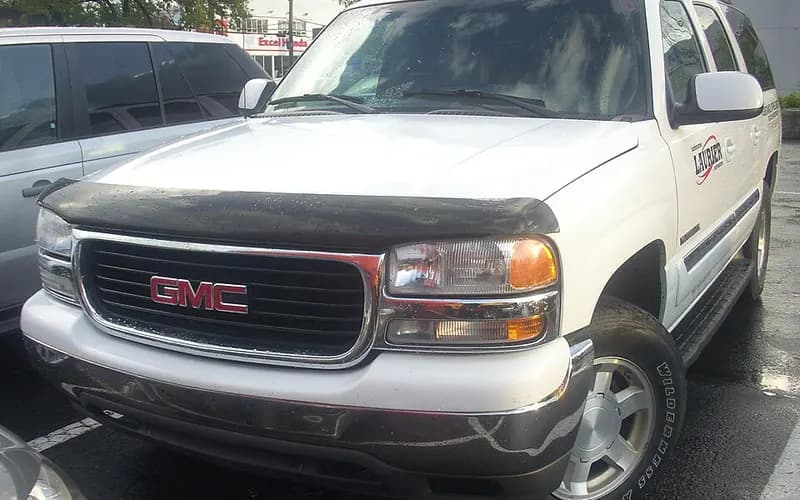
BrakesModel years 2000–2002ManufacturerGovernment
Unwanted ABS activation at low speed (front wheel speed sensor mounting corrosion)
Recall 05V-379 / GM 05068C: 2000-2002 GMC Yukon, Yukon XL (and Silverado/Sierra/Tahoe/Suburban/Avalanche) located in the listed severe-corrosion (salt belt) areas. NHTSA's index of GM bulletin 03-05-25-007 (same cleaning repair) lists Yukon 2001-2006.
FaultCrate・Unwanted ABS activation at low speed (front wheel speed sensor mounting corrosion)
Corrosion may form between the front hub/bearing assembly and the wheel speed sensor; if the brakes are applied at more than 6 km/h (3.7 mph) but less than 16 km/h (10 mph), it may cause an unwanted ABS activation, and where stopping distance is limited a crash could occur. As GM explained it, the condition can occur if corrosion forms under the wheel speed sensor and moves the sensor away from the integral toothed ring.
How to decide
Reuse the sensor if its mounting surface is flat; replace it if warped or bent, or if it reads under 350 AC mV
Watch out
Pull the sensor straight out: prying breaks the sensor body off in the bore
Labor time
0.8 hours to inspect and clean (GM's labor time for the recall claim)
Parts
Rust penetrating lubricant 89022217 and wheel bearing lubricant 01051344
Check6
- The condition sets no ABS codes and does not light the ABS warning lamp (NHTSA's investigation record).NHTSA
- The owner of a 2002 Tahoe writes that the dealer could not reproduce the fault in a few miles of driving and, after checking the ABS, told her there was no trace of it having activated (Car Talk Community).2002 Chevy Tahoe・Car Talk Community
- Check the mounting surface of the removed sensor for flatness against the edge of a metal machinist's scale or other straight edge, in several positions and directions (at least 3). The surface must be flat for the sensor to mount correctly on the hub.NHTSA
- After refitting, measure the output with a digital volt meter (DVM) across the terminals of the disconnected connector while turning the bearing at about one revolution per second; the minimum reading should be at least 350 AC mV.NHTSA
- In a question about a 2004 Tahoe (4WD), one answerer explains how he settles the shim count: he gauges the depth from the sensor opening to the tone ring with a snug-fitting wooden rod, sets it against the sensor's length, and adds or removes shims (2CarPros).2004 Chevrolet Tahoe 4WD(後の投稿に 2002 Silverado 2500、99 Tahoe)・2CarPros
- Incidents were counted in vehicles outside the recall's states too; GM and ODI said they were continuing to monitor the problem in the states not included in the recall (NHTSA's investigation).NHTSA
Decide9
If the sensor's mounting surface is flat, the sensor is reused; if it is warped or bent, the sensor must be replaced.NHTSA
- If the reading after refitting is less than 350 AC mV, the sensor must be replaced, and the measurement repeated after the new sensor is installed.NHTSA
- GM's correction is to inspect, clean and treat the affected area; in some cases the front wheel speed sensor may require replacement, which GM says very few vehicles will need.NHTSA
- GM's procedure is done on both front wheel speed sensors.NHTSA
- The mechanics answering a question about a 2004 Tahoe (4WD) also advise pulling both front sensors and cleaning their mounts, because both sides can be at fault even when the scan tool names only one (2CarPros).2004 Chevrolet Tahoe 4WD(後の投稿に 2002 Silverado 2500、99 Tahoe)・2CarPros
- The recall covers 1999-2002 Silverado and Sierra, 2000-2002 Tahoe, Suburban, Yukon and Yukon XL, and 2002 Avalanche that have at any time been registered in the listed severe corrosion areas.NHTSA
- Not all vehicles within the recall's VIN breakpoints may be involved, and GM asks dealers to confirm eligibility through GMVIS before beginning the repair.NHTSA
- GM bulletin 02-05-25-006 also gives cleaning the wheel speed sensor mounting surface as the fix for ABS activation at low speeds (the list of bulletins in GM TechLink).GM TechLink
- Bulletin 02-05-25-006 names 1995-2001 Suburban, Tahoe, Yukon, XL and others, and the list ends "with 4WD or AWD" (the list of bulletins in GM TechLink).GM TechLink
Steps17Front Wheel Speed Sensor Corrosion
Prepare
- 1Raise the vehicle on a hoist and support it, and remove both front wheels.
- 2Put a large C-clamp over the top of the caliper housing against the back of the outboard pad, tighten it slowly until the pistons are pushed completely into their bores, and remove the clamp.
Remove
- 3Remove the two bolts holding the caliper mounting bracket to the knuckle, take the caliper and bracket off as an assembly and support it with heavy mechanic's wire or equivalent. The caliper need not come off the bracket; do not disconnect the flexible brake hose from the caliper.
- 4Mark the rotor's position on the bearing hub, remove the rotor retaining push nuts from the wheel studs (if equipped), and remove the rotor.
- 5Remove the bolt holding the sensor to the bearing hub and pull the sensor straight out of the bore. Do not pry it with a screwdriver or other device: prying will break the sensor body off in the bore.
Check the sensor
- 6Check the mounting surface of the sensor head for flatness against the edge of a metal machinist's scale or other straight edge, in at least 3 positions or directions. If it is flat, the sensor is reused: go on to the cleaning. If not, the sensor is replaced.
- 7To replace the sensor, remove the harness mounting clips from the knuckle, upper control arm and frame, and disconnect its connector from the vehicle wiring harness. Connect the new sensor's connector to the vehicle harness and attach its harness to the frame, upper control arm and knuckle.
Clean and treat
- 8Temporarily plug the sensor hole in the bearing hub so that no debris gets in while cleaning.
- 9Clean the sensor mounting surface on the bearing hub with a wire brush, sandpaper, emery cloth, scotch brite or equivalent until all rust and corrosion is removed. Blow the debris off the hub surface with compressed air, and wipe the sensor and O-ring with a clean shop towel.
- 10Spray two thin coats of the specified rust penetrating lubricant (corrosion inhibitor) on the whole sensor mounting surface of the hub, letting it dry 3-5 minutes between coats. While it dries, do the same work on the opposite front wheel, from compressing the caliper pistons through spraying the inhibitor (the bulletin's Steps 3-20).
- 11When the inhibitor is dry to the touch (about 10 minutes), apply a light coat of the specified grease to the whole sensor mounting surface of the hub and to the sensor and O-ring.
Install and measure
- 12Remove the temporary plug, fit the sensor in the hub and install the bolt. Make sure the sensor is seated flat against the hub, and tighten the bolt to 18 N·m (13 lb ft).
- 13Disconnect the front wheel speed sensor connector, put a DVM across its terminals and turn the bearing at about one revolution per second. The reading should be at least 350 AC mV; if less, replace the sensor (the replacement work above) and measure again after the new sensor is installed.
Reassemble
- 14Clean any rust or foreign material from the mating surfaces of the rotor and flange; if the rotor was removed with the jack screw method, remove all raised nicks or marks from the hub flange first. Align the rotor to its original position, install it, and install the caliper and bracket assembly.
- 15Before installing the bracket bolts, remove all traces of the original adhesive patch, clean the threads with brake parts cleaner or equivalent and let them dry, and apply threadlocker. Tighten to 175 N·m (129 lb ft) on 1500 Series vehicles and 300 N·m (221 lb ft) on 2500 Series vehicles.
- 16Install the wheel and tighten the wheel nuts to 190 N·m (140 lb ft). Finish the opposite front wheel from the greasing on, and lower the vehicle.
- 17With the engine off, gradually apply the brake pedal to about 2/3 of its travel and slowly release it; wait 15 seconds and repeat until a firm pedal is obtained, which properly seats the caliper pistons and brake pads.
The service procedure of GM's recall bulletin 05068C (March 2008; NHTSA recall 05V-379), summarized by stage of the work. It repairs the corrosion where the front wheel speed sensor mounts on the front wheel bearing assembly. It covers the vehicles the bulletin's Models line names (1999-2002 Silverado and Sierra, 2000-2002 Tahoe, Suburban, Yukon and Yukon XL, 2002 Avalanche) that are located in the severe corrosion areas it lists; not all vehicles within its VIN breakpoints may be involved. The document covers model years up to 2002. That this vehicle is among the Front Wheel Speed Sensor Corrosion is from NHTSA.Open Recall Bulletin 05068C
Cautions and risks6
- Do not pry the sensor out with a screwdriver or other device: prying will break the sensor body off in the bore. Pull it straight out.NHTSA
- Whenever the caliper is off its mount with the flexible brake hose still connected, support it with heavy mechanic's wire or equivalent; otherwise the hose bears the caliper's weight, which may damage it and in turn cause a brake fluid leak.NHTSA
- Whenever the rotor has been separated from the bearing flange, clean any rust or foreign material from the mating surfaces; failing to do so may increase the rotor's lateral runout.NHTSA
From the field
- In questions about a 2001 Silverado (2WD) and a 2004 Tahoe (4WD) (Car Talk Community, 2CarPros), ABS activation just before a stop or at low speed was happening after the front hubs with built-in sensors, or the left front sensor, had been renewed.2001 Chevy Silverado 2WD・Car Talk Community
- On the 2004 Tahoe (4WD), the lamp came on or stayed off depending on how many spacers were fitted under the sensor.2001 Chevy Silverado 2WD・Car Talk Community
- A thread about a 2001 Silverado likewise says the sensor can break on removal (Car Talk Community).2001 Chevy Silverado 2WD・Car Talk Community
What it needs
- Parts
- Front wheel speed sensor (when its mounting surface is not flat, or when it reads less than 350 AC mV after refitting). Very few vehicles will need one; if required, order the appropriate part from GMSPO.NHTSA
- Materials
- GM 89022217 Lubricant, Rust Penetrating (will service 50+ vehicles) and GM 01051344 Lubricant, Wheel Bearing (will service 25+ vehicles).NHTSA
- Brake parts cleaner (or equivalent) and threadlocker for the caliper bracket bolts.NHTSA
- NHTSA's investigation record names the rust inhibitor applied to the mounting surface in the recall work as Zinc-X.NHTSA
- Tools
- A large C-clamp, heavy mechanic's wire (to hang the caliper), a metal machinist's scale or other straight edge, a wire brush, sandpaper, emery cloth, scotch brite or equivalent, compressed air, a temporary plug for the sensor hole, and a digital volt meter (DVM).NHTSA
- Time
- GM's labor time for the recall claim: 0.8 hours to inspect the wheel speed sensors (cleaning included), 0.9 hours to inspect and replace one or both sensors (cleaning included); add 0.1 hours to either for vehicles with 8-lug nut wheels.NHTSA
- GM's customer letter puts the actual service correction time at approximately 1 hour (the dealer will likely need the vehicle longer because of service scheduling).NHTSA
- Cost seen
- Vehicles subject to the recall are serviced by dealers at no charge, regardless of mileage, age of vehicle or ownership (GM's bulletin).NHTSA
- FieldA thread about a 2001 Silverado gives $90 for a sensor and $115 plus shipping, bought online, for a bearing and hub with built-in sensor (Car Talk Community). A post says the repair for rust under the sensors on a 2002 Silverado 2500 cost $228.00 (2CarPros).2001 Chevy Silverado 2WD・Car Talk Community
Part numbers printed in the document
89022217Look up at RockAuto (aftermarket candidates) ↗Search the web ↗
01051344Look up at RockAuto (aftermarket candidates) ↗Search the web ↗
The numbers are as the document prints them. The name and the replacing number are what the pages of GMPartsGiant, a reseller of genuine parts and not GM, state. Aftermarket equivalents are not checked here (the links only search by number). Confirm the fit for the vehicle (VIN) before ordering.
Only what the documents and the pages read state; what is not listed is not thereby not needed.
If left
- Unwanted activation can increase stopping distances in low-speed braking, which could result in a crash.→ increased stopping distance at low speed
In the records
- Wheel Speed Sensor: replaced 3(says it was fixed: 1, result not stated: 2)
- Hub Assembly: replaced 2(says it held for a while: 1, result not stated: 1)
- Wheel Speed Sensor: cleaned 2(says it held for a while: 1)
- ABS: repaired 1(says it did not fix it: 1)
Applies to
- The recall covers 1999-2002 Chevrolet Silverado, 2000-2002 Chevrolet Tahoe and Suburban, 2002 Chevrolet Avalanche, 1999-2002 GMC Sierra, and 2000-2002 GMC Yukon and Yukon XL located in the listed severe-corrosion areas.
- The condition is more likely in environmentally corrosive areas.
- The recall was launched only in the listed salt-belt states and the District of Columbia.
- GM notified ODI on August 29, 2005 that it was recalling certain model year 1999 through 2002 C/K pickup trucks and sport utility vehicles for ABS wheel speed sensor corrosion (Recall 05V-379).
- GM's recall covers approximately 804,000 vehicles registered in 14 "Salt-Belt" states: Connecticut, Illinois, Indiana, Massachusetts, Maine, Michigan, New Hampshire, New Jersey, New York, Ohio, Pennsylvania, Rhode Island, Vermont and West Virginia.
- In November 2004 GM had already recalled approximately 150,000 model year 1999-2002 C/K model trucks in eastern Canada for the same condition.
- ODI determined that 840 of the complaints, 244 of the crashes and 16 of the injuries identified in the investigation occurred in the states covered by GM's recall.
See the evidence (4 documents, 22 passages)
| Document | Publisher | Date |
|---|---|---|
| [1]Recall Bulletin 05068C: Front Wheel Speed Sensor Corrosion ↗ | ManufacturerGeneral Motors | 2008-03-01 |
| [2]Recall 05V-379: ABS unwanted activation ↗ | GovernmentNHTSA | — |
| [3]ABS activation at low speeds (clean wheel speed sensor mounting surface) ↗ | ManufacturerNHTSA manufacturer-communications index | 2009-05-01 |
| [4]ODI investigation PE05020: Unwanted Low-Speed ABS Activation ↗ | GovernmentNHTSA ODI | 2005-09-13 |
Applies toThe recall covers 1999-2002 Chevrolet Silverado, 2000-2002 Chevrolet Tahoe and Suburban, 2002 Chevrolet Avalanche, 1999-2002 GMC Sierra, and 2000-2002 GMC Yukon and Yukon XL located in the listed severe-corrosion areas.
MODELS: 1999-2002 CHEVROLET SILVERADO 2000-2002 CHEVROLET TAHOE, SUBURBAN 2002 CHEVROLET AVALANCHE 1999-2002 GMC SIERRA 2000-2002 GMC YUKON, YUKON XL LOCATED IN THE SEVERE CORROSION AREAS LISTED BELOW— [1] bulletin p.1
Applies toThe condition is more likely in environmentally corrosive areas.
THIS CONDITION IS MORE LIKELY TO OCCUR IN ENVIRONMENTALLY CORROSIVE AREAS.— [2]
Applies toThe recall was launched only in the listed salt-belt states and the District of Columbia.
THIS RECALL WILL BE LAUNCHED IN THE "SALT BELT" STATES OF CONNECTICUT, DELAWARE, ILLINOIS, INDIANA, IOWA, MARYLAND, MASSACHUSETTS, MAINE, MICHIGAN, MINNESOTA, MISSOURI, NEW HAMPSHIRE, NEW JERSEY, NEW YORK, OHIO, PENNSYLVANIA, RHODE ISLAND, VERMONT, WEST VIRGINIA, WISCONSIN AND THE DISTRICT OF COLUMBIA ONLY.— [2]
Why it happensThese vehicles may have a condition permitting corrosion to occur between the front hub/bearing assembly and the wheel speed sensor.
These vehicles may have a condition permitting corrosion to occur between the front hub/bearing assembly and the wheel speed sensor.— [1] bulletin, Condition
First signsWith the brakes applied between about 6 km/h (3.7 mph) and 16 km/h (10 mph), the corrosion may cause unwanted ABS activation.
If the brakes are applied while the vehicle is traveling at a speed of greater than 6 km/h (3.7 mph) but less than 16 km/h (10 mph), the corrosion may cause an unwanted anti- lock brake system (ABS) activation.— [1] bulletin, Condition
If leftUnwanted activation can increase stopping distances in low-speed braking, which could result in a crash.
THIS CAN CAUSE INCREASED STOPPING DISTANCES DURING LOW-SPEED BRAKE APPLICATIONS, WHICH COULD RESULT IN A CRASH.— [2]
RepairDealers remove the sensor, clean its mounting surface on the bearing, apply rust inhibitor and grease, reinstall it and check peak-to-peak output voltage.
DEALERS ARE TO REMOVE THE WHEEL SPEED SENSOR AND THOROUGHLY CLEAN THE WHEEL SPEED SENSOR MOUNTING SURFACE ON THE BEARING, APPLY RUST INHIBITOR TO THE CLEANED SURFACE, GREASE THE MOUNTING SURFACE, REINSTALL THE WHEEL SPEED SENSOR, AND CHECK THE PEAK-TO-PEAK OUTPUT VOLTAGE TO ENSURE THE WHEEL SPEED SIGNAL IS WITHIN SPECIFICATIONS.— [2]
How to confirmThe reading should be at least 350 mV AC; if it is less, the wheel speed sensor must be replaced.
The minimum reading should be at least 350 ACmV’s. If the reading is less than 350 ACmV’s, the wheel speed sensor must be replaced.— [1] bulletin, step 24
CautionDo not pry the sensor out of the bore; prying breaks the sensor body off in the bore.
DO NOT use a screwdriver or other device to try to pry the sensor out of the bore. Prying will cause the sensor body to break off in the bore.— [1] bulletin, step 9-10
How to confirmIf the sensor's mounting surface is warped or bent, the sensor must be replaced.
If the mounting surface on the sensor is warped or bent, the sensor must be replaced.— [1] bulletin, step 10-11
RepairThe passage heading states that the repair is cleaning the wheel speed sensor mounting surface.
ANTILOCK BRAKE (ABS) ACTIVATION AT LOW SPEEDS (CLEAN WHEEL SPEED SENSOR MOUNTING SURFACE).— [3]
Applies toGM notified ODI on August 29, 2005 that it was recalling certain model year 1999 through 2002 C/K pickup trucks and sport utility vehicles for ABS wheel speed sensor corrosion (Recall 05V-379).
In a letter dated August 29, 2005, GM notified ODI that it was recalling certain model year 1999 through 2002 C/K pickup trucks and sport utility vehicles to correct a problem with Anti-Lock Brake system (ABS) wheel speed sensor corrosion that may result in unwanted ABS activation and extended stopping distances during low-speed braking (Recall 05V-379).— [4]
Applies toGM's recall covers approximately 804,000 vehicles registered in 14 "Salt-Belt" states: Connecticut, Illinois, Indiana, Massachusetts, Maine, Michigan, New Hampshire, New Jersey, New York, Ohio, Pennsylvania, Rhode Island, Vermont and West Virginia.
GM's recall covers approximately 804,000 vehicles currently registered in the following 14 "Salt-Belt" states: Connecticut, Illinois, Indiana, Massachusetts, Maine, Michigan, New Hampshire, New Jersey, New York, Ohio, Pennsylvania, Rhode Island, Vermont, and West Virginia.— [4]
Applies toIn November 2004 GM had already recalled approximately 150,000 model year 1999-2002 C/K model trucks in eastern Canada for the same condition.
In November 2004, GM notified ODI that it was recalling approximately 150,000 model year 1999- 2002 C/K model trucks in eastern Canada to correct a condition in the antilock brake system (ABS) that may result in unwanted ABS activation and increased stopping distances during low-speed brake applications.— [4]
Why it happensGM indicated that the condition can occur if corrosion forms under the wheel speed sensor and moves the sensor away from the integral speed-sensor toothed ring.
GM indicated that the condition can occur if corrosion forms under the wheel speed sensor and moves the sensor away from the integral speed-sensor toothed ring.— [4]
CautionThe condition does not set any ABS codes and does not illuminate the ABS warning lamp.
The condition does not set any ABS codes nor does it illuminate the ABS warning lamp.— [4]
First signsStopping distances during low-speed brake applications (between 3.7 and 10 mph (= 16.1 km/h)) may increase because the ABS wheel speed sensor signal is lost.
stopping distances during low-speed (between 3.7 and 10 mph) brake applications may increase due to loss of ABS wheel speed sensor signal resulting from corrosion build-up on sensor mounting surfaces.— [4]
RepairThe recall procedure is to remove the sensor, clean the mounting surface, apply a rust inhibitor (Zinc-X) to the surface and reinstall the sensor; the sensor is replaced if necessary.
The recall procedure will involve removing the sensor, cleaning the mounting surface, applying a rust inhibitor (Zinc-X) to the surface, and reinstalling the sensor. If necessary, the sensor will be replaced.— [4]
RepairGM's earlier recall procedure in Canada also included greasing the mounting surfaces and verifying that the wheel speed signal output voltages were within specification.
GM's recall procedure involved removing the wheel speed sensors, cleaning the sensor mounting surfaces on the bearings, applying Zinc-X to the cleaned surfaces, greasing the mounting surfaces, reinstalling the speed sensors, and verifying that the wheel speed signal output voltages were within specification.— [4]
Applies toODI determined that 840 of the complaints, 244 of the crashes and 16 of the injuries identified in the investigation occurred in the states covered by GM's recall.
ODI's analysis determined that 840 of the complaints, 244 of the crashes, and 16 of the injuries identified in this investigation occurred in those states.— [4]
CautionIncidents were also counted outside the recall states: 168 incidents and 31 crashes among 2,406,000 vehicles in the remaining 30 states, which GM and ODI continued to monitor.
The statistics in the remaining 30 states are 2,406,000 vehicles, 168 incidents (7.0 per 100,000 vehicles), 31 crashes, and one injury. GM and ODI are continuing to monitor the problem experience in states that are not included in the recall.— [4]
CautionThis preliminary evaluation has been closed; the Action line names Recall 05V-379.
this preliminary evaluation has been closed. Recall 05V-379.— [4]
Put together by FaultCrate from public records and technical documents. The cause and the repair are for the workshop to decide with the vehicle in front of it. Counts are records, not failure rates.
Records under this issue 52
Owner complaint 49Recall 2Manufacturer communication 1
Look into the records of this issue (52)List the records (40 that can be opened)
Records whose recall number, document number or text matches. Each line says why it matched.
- ABS activation at low speeds in Canadian Atlantic provincesRecall 2004-11-05・text contains "wheel speed sensor"
- ABS activation recall in pickup trucks and SUVsRecall —・recall number matches
- ABS activation at low speeds (bulletin 02-05-25-006)Manufacturer communication 2002-12-01・text contains "Wheel Speed Sensor"
- Vehicle jumps and hesitates when brake pedal depressedOwner complaint 2017-08-09・text contains "WHEEL SPEED SENSOR"
- Antilock brakes engage when braking regardless of needOwner complaint 2017-01-11・text contains "WHEEL SPEED SENSOR"
- Anti-lock brake system engaged without prompting while driving, preventing timely stopOwner complaint 2015-12-28・tied by reading the record: “WHILE DRIVING 25 MPH, THE ANTI-LOCK BRAKE SYSTEM ENGAGED WITHOUT BEING PROMPTED AND CAUSED THE VEHICLE NOT TO STOP IN A TIMELY MANNER.”
- ABS activates during low speed with no slip conditionsOwner complaint 2015-01-08・text contains "ABS KICKS IN"
- ABS activates without reason when braking on clean, dry roadsOwner complaint 2014-04-23・tied by reading the record: “I TRIED TO STOP AND WHEN I APPLIED THE BRAKES THE ABS ACTIVATED WITHOUT ANY REASON. THE ROADS WERE CLEAN AND DRY.”
- Antilock brake sensors malfunctioning with extended stopping distancesOwner complaint 2012-10-16・tied by reading the record: “THE ORIGINAL RECALL WAS COMPLETED IN 2006, ACCORDING TO GMC THEY ONLY CLEANED THE PARTS AND DID NOT REPLACE THEM. AS A RESULT THERE IS SEVERE CORROSION ON THE ANTILOCK BRAKE SENSOR CAUSING INCREASED STOPPING DISTANCES THAT COULD CAUSE AN ACCIDENT.”
- ABS engages and lifts brake pedal while slowing to a stopOwner complaint 2012-01-19・text contains "ABS ENGAGES"
- ABS system activating unexpectedly during low-speed stopsOwner complaint 2011-08-03・text contains "ABS ACTIVATION"
- ABS system engages while braking, concerns about stopping distanceOwner complaint 2011-06-20・tied by reading the record: “THERE WAS A RECALL ON GMC YUKON XL 2500 SERIES ABS SYSTEM CAMPAIGN ID # 05V379000 WHERE THE ABS SYSTEM WILL ENGAGE WHILE BRAKING CAUSING INCREASED BRAKING DISTANCE AND POTENTIAL CRASHES. THE PROBLEM OCCURS IN THE 1500 SERIES AS WELL WHY WAS THERE NOT A RECALL FOR THIS SERIES WHICH I HAVE AND HAVE THE SAME PROBLEM WITH?”
- ABS brake system issue on 2000 Yukon XLOwner complaint 2011-03-07・tied by reading the record: “NHTSA CAMPAIGN ID NUMBER: 05V379000 PE05020 NHTSA ACTION NUMBER: PE05020 COMPONENT: SERVICE BRAKES, HYDRAULIC:ANTILOCK POTENTIAL NUMBER OF UNITS AFFECTED: 1,353,718 MY 2000 YUKON XL IS HAVING THIS PROBLEM.”
- Loss of braking action at low speeds, intermittentOwner complaint 2011-01-05・tied by reading the record: “VEHICLE WAS TAKEN TO A REPAIR SHOP AND DIAGNOSED WITH AN ABS SENSOR FAILURE AT LOW SPEED ON THE LEFT FRONT WHEEL.”
- Brake kickback at low speed near stoppingOwner complaint 2010-03-10・tied by reading the record: “WHEN THE VEHICLE IS AT A LOW SPEED NEAR STOPPING THE BRAKE KICKS BACK AS IF THE ABS BECOMES ACTIVATED AND THE STOPPING DISTANCE IS INCREASED.”
- Unwanted ABS activation causing increased stopping distance at low speedOwner complaint 2009-11-28・tied by reading the record: “UNWANTED ANTILOCK BRAKE SYSTEM (ABS) ACTIVATION WHICH RESULTS IN INCREASED STOPPING DISTANCE DURING LOW SPEED BRAKE APPLICATION.”
- ABS brake system activates on dry pavement at low speedsOwner complaint 2009-11-22・tied by reading the record: “THE ABS BRAKE SYSTEM ACTIVATES ON DRY PAVEMENT WHEN BRAKES ARE APPLIED AT LOW SPEEDS, RESULTING IN A LONGER THAN NORMAL STOPPING DISTANCE.”
- ABS activates without warning while slowing downOwner complaint 2009-09-22・tied by reading the record: “WHILE DRIVING AT 25 MPH AND SLOWING DOWN TO MAKE A STOP THE ABS BEGINS TO ACTIVATE WITHOUT WARNING”
- ABS brakes activating on dry roads at slow speeds before stoppingOwner complaint 2009-08-05・tied by reading the record: “ABS BRAKES ACTIVATING ON DRY ROADS AT SLOW SPEEDS JUST BEFORE STOPPING.”
- ABS activated at low speed on dry pavement, vehicle advanced beyond intended stopping positionOwner complaint 2009-03-03・tied by reading the record: “WHILE COMING TO A STOP, AT LOW SPEED ON DRY PAVEMENT MY VEHICLE'S ANTILOCK BRAKE SYSTEM (ABS) ACTIVATED”
- ABS unwanted activation due to corrosion between front hub assembly and wheel speed sensor during brakingOwner complaint 2009-02-03・text contains "WHEEL SPEED SENSOR"
- Unwanted antilock brake activation when brake pedal is depressedOwner complaint 2008-10-15・tied by reading the record: “WHEN THE BRAKE PEDAL WAS DEPRESSED, THE CONTACT EXPERIENCED UNWANTED ANTILOCK BRAKE ACTIVATION.”
- Front shuddering and brake ineffectiveness at low speedsOwner complaint 2008-07-16・tied by reading the record: “UPON APPLYING MY BRAKES AT LOW SPEEDS (UNDER 10MPH) ON MY 2001 YUKON XL, THERE IS SHUDDERING FROM THE FRONT AND AT TIMES THE BRAKES SEEM TO BECOME INEFFECTIVE. IT IS AS IF THE ABS IS PUMPING THE BRAKES, BUT IT IS OCCURRING ON DRY PAVEMENT.”
- ABS brake system malfunctioning for third timeOwner complaint 2008-01-20・tied by reading the record: “THE ABS BRAKE SYSTEM ACTIVATES ON DRY PAVEMENT AT SLOW SPEEDS, RESULTING IN A LONGER THAN NORMAL STOPPING DISTANCE.”
- ABS engaged unexpectedly at low speed and caused jerkingOwner complaint 2007-07-24・tied by reading the record: “WHILE DRIVING 5 MPH OR LESS, THE ABS ENGAGED WITHOUT WARNING AND CAUSED THE VEHICLE TO JERK.”
- Brake system failed and brake pedal vibrated at 5 MPHOwner complaint 2006-12-06・tied by reading the record: “DT*: THE CONTACT STATED THE BRAKE SYSTEM FAILED WHEN SPEED WAS REDUCED TO 5 MPH AND THE BRAKE PEDAL VIBRATED BADLY.”
- ABS light came on; braking issue at low speed; hub bearing bolts replacedOwner complaint 2006-10-19・tied by reading the record: “WHILE DRIVING AT APPROXIMATELY 7 MILES PER HOUR, I TRIED TO STOP FOR A LIGHT AND NEARLY HIT CAR IN FRONT OF ME. BRAKES RUMBLED TO A HALT, FORTUNATELY.”
- ABS engages at low speeds with grinding noise and hard brake pedalOwner complaint 2006-05-11・tied by reading the record: “THE CONTACT STATED THE ABS SYSTEM ENGAGES AT LOW SPEEDS OF APPROXIMATELY 5-10 MPH.”
- Anti-lock brakes activating every time slowing to stop, recurring after repairOwner complaint 2006-01-18・tied by reading the record: “I FILED A COMPLAINT WITH THE NHTSA IN 2005 FOR MY ANTI LOCK BRAKES ACTIVATING EVERY TIME I SLOW DOWN TO STOP.”
- Defective anti-lock brake system: car does not stop at low speedsOwner complaint 2005-12-16・tied by reading the record: “THE CAR DOES NOT STOP WHEN YOU ARE TRAVELING AT LOW SPEEDS.”
- ABS system engaging at slow speedsOwner complaint 2005-12-14・tied by reading the record: “2001 GMC YUKON ABS SYSTEM ENGAGING AT SLOW SPEEDS.”
- ABS brake pulsing at low speeds after sensor replacementOwner complaint 2005-12-02・tied by reading the record: “WELL IN EARLY JULY I HAD NO PROBLEMS WITH MY VEHICLE. SOMETIME IN LATE JULY I STARTED GETTING THE PULSING OF THE BRAKES.”
- ABS activating at low speed under 15 mphOwner complaint 2005-10-04・tied by reading the record: “LOW SPEED ABS COMING ON EVERY TIME BRAKE PEDAL IS USED UNDER 15 MPH.”
- Anti-lock brakes activating at slow speedsOwner complaint 2005-09-27・tied by reading the record: “ANTI-LOCK BRAKES START ACTIVATING AT SLOW SPEEDS.”
- Anti-lock brakes activate at about 5 mph continuouslyOwner complaint 2005-09-11・tied by reading the record: “MY ANTI LOCK BRAKES ACTIVATE AT ABOUT 5 MPH CONTINUALLY .”
- ABS chattering at slow speeds requiring hard brake pedal pressureOwner complaint 2005-08-31・tied by reading the record: “WHEN I BRAKE AT SLOW SPEEDS IN MY 2001 GMC YUKON XL, THE ANTILOCK BRAKE SYSTEM CAUSES A CHATTERING”
- ABS sensor failure; vehicle continues forward when braking with brake pedal vibrationOwner complaint 2005-08-22・tied by reading the record: “WHEN BRAKING TO A STOP ,THE VEHICLE CONTINUES TO MOVE FORWARD FARTHER THAN WHAT IS NORMALLY EXPECTED WITH A VIBRATING IN THE BRAKE PEDAL.”
- ABS brakes resist at low speed (1-10 MPH)Owner complaint 2005-07-26・tied by reading the record: “1)ABS BRAKES RESIST BETWEEN 1 AND 10 MPH; USUALLY AT OR AROUND 3 TO 5 MPH; CONSISTENTLY AND ONLY AT THESE LOW RATES OF SPEED”
- ABS pump activated but vehicle did not stop during parking maneuverOwner complaint 2005-07-26・tied by reading the record: “TURNED INTO A PARKING SPACE GOING ABOUT 4 MPH PUT ON THE BRAKES, ABS STARTED PUMPING AND THE CAR DID NOT STOP.”
- ABS engages at low speedsOwner complaint 2005-07-23・tied by reading the record: “ABS BREAKS ON AT LOW SPEEDS”