
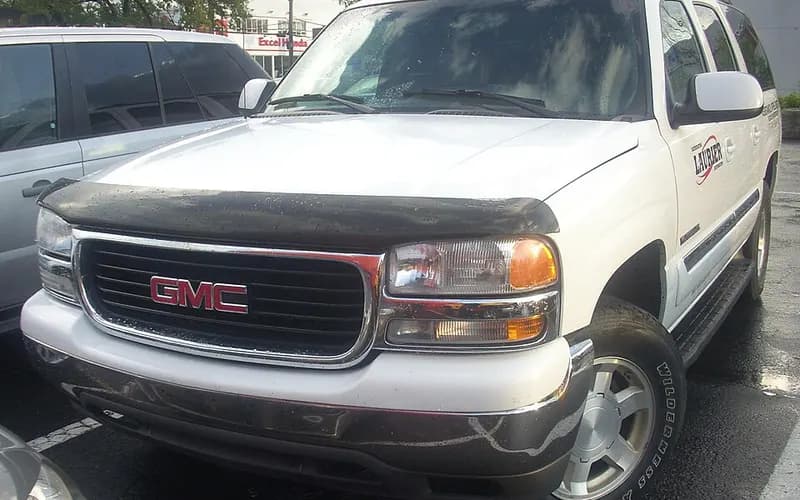
← Look into the faults of the GMC Yukon XL
Symptom
Shifting fault: possible causes and documented repairs — 2000–2006 GMC Yukon XL
Of the records of the 2000–2006 GMC Yukon XL, 13 state “Shifting fault” (Owner complaint: 4, Manufacturer communication: 9). The technical documents say how to deal with 5 of its possible causes. They are listed by the number of matching records, most first.
Narrow it by model year, engine and more
Causes the technical documents say how to deal with (5)
Steering intermediate shaft clunk
1 matching record
A clunking noise under the hood that can be felt in the steering wheel and/or steering column.
Intermediate steering shaft clunk noise or stick-slip.
What to do
- When properly lubricated, there should be 13 mm (1/2 inch) of grease showing on the shaft splines.
- Replace the upper intermediate steering shaft assembly.
- There are significant differences between the car and truck procedures: the lubricant is applied to a different part of the steering system and uses a different lubrication kit, 26098419.
- On the affected trucks, remove the intermediate steering shaft from the vehicle and remove the spacer clip.
4 more steps ·All steps, part numbers and sources (4 sources) →
4L60-E burnt 3-4 clutch pack
No matching record (stated by the technical documents)
Low line pressure and/or leaks of 3rd gear oil are the root cause of most 3-4 slipping.
Small leaks at several points in the circuit can add up to enough pressure loss to allow slipping.
What to do
- Test the 3rd accumulator checkball capsule for leakage; a leaking capsule is a leading cause of 3-4 clutch failure.
- Whenever a burnt clutch pack is found, inspect all three circuits methodically to find and eliminate all leaks.
- Thicker heavy-duty backing plates that eliminate clutch pack flex are available in the aftermarket.
4L60-E slip or no forward engagement right after input housing replacement (service part 17803687)
No matching record (stated by the technical documents)
A few transmissions may slip or not engage any forward gear immediately after the input housing is replaced.
The input housing from GM Service Parts may have an incorrectly drilled input shaft.
What to do
- Inspect the 3-4 clutch and forward clutch oil feed passages for leakage between circuits.
- With the Input Housing (621) completely assembled, apply regulated compressed air to the 3-4 clutch feed hole and the forward clutch feed hole one at a time.
- Air should not leak out of the 3-4 clutch feed hole when air is applied to the forward clutch feed hole, and not out of the forward clutch feed hole when air is applied to the 3-4 clutch feed hole.
- Order new housing part number 19125752.
1 more step ·All steps, part numbers and sources (2 sources) →
4L60-E / 4L65-E TCC regulator valve bore wear (P1870 converter clutch slip)
No matching record (stated by the technical documents)
Continuous oscillation of the regulator valve in PWM and EC3 units wears the bore over time so that apply pressure exhausts.
This often sets code P1870 and/or P0894 because of excess TCC slip.
How to tell
What to do
- As the regulator bore wears, the duty cycle needed to keep slip in range increases.
- TCC problems can often be spotted before they set codes by monitoring duty cycle with a scan tool.
- Per Sonnax, a worn TCC regulator valve bore is restored by installing its TCC regulator and isolator valve kit 77754-04K or 77754-03K.
4L60-E / 4L65-E clunk on 2-3 upshift or 3-2 downshift (normal condition)
No matching record (stated by the technical documents)
Some vehicles may have a clunk noise on a 2-3 upshift or a 3-2 downshift.
On a 2-3 upshift the 2-4 band releases and the 3-4 clutch applies; the shift timing can cause a momentary torque reversal of the output shaft that results in a clunk.
What to do
The technical documents state no check or repair for it (a caution only).
Causes only records name
Not in the technical documents: named as the cause in records. A cause written in a complaint is the owner’s judgment or what a dealer said, not a confirmed fact.
Related symptoms, trouble codes and warning displays
What the technical documents state together with the faults above.
- Symptom
- Noise
Put together by FaultCrate from public records and technical documents. The cause and the repair are for the workshop to decide with the vehicle in front of it. Counts are records, not failure rates.