
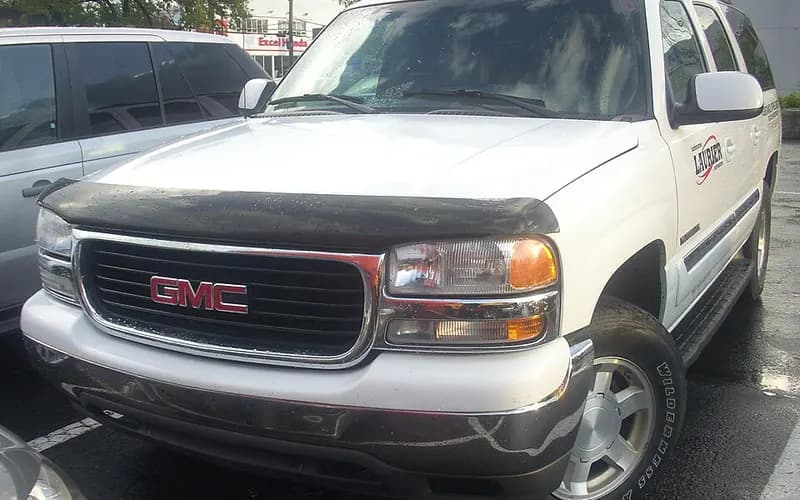
Transmission and drivelineModel years 1999–2007Manufacturer
4L80-E / 4L85-E planetary gear whine in first and second gear
1999-2007 GMC Sierra, Yukon XL (and Avalanche, Express, Silverado, Suburban, Savana) with 4L80E (RPO MT1) or 4L85E (RPO MN8)
FaultCrate・4L80-E / 4L85-E planetary gear whine in first and second gear
The 4L80E/4L85E automatic transmission may have a planetary gear whine in first and second gear, typically louder in first than in second. GM's PI PIP3259J says this whine can be characteristic of the 4L80E/4L85E, and that the vehicle should be compared to an identically built vehicle (same GVWR) before attempting any repairs.
How to decide
Built after 9-01-03: end play out of spec, gear set inspected/replaced as necessary; within, transmission replaced
Watch out
The whine can be characteristic: compare with an identically built vehicle (same GVWR) before any repair
Parts
The output planetary gear set (661, 650) and selective thrust washer (674), or the transmission assembly
Check8
- PI PIP3259J covers the 2002-2007 Chevrolet Avalanche and the 1999-2007 Chevrolet Silverado and Suburban and GMC Sierra and Yukon XL with the 4L80E (RPO MT1) or 4L85E (RPO MN8).GM
- PI PIP3259J also lists the Express and Savana, and does not list the GMC Yukon (other than the XL).GM
- The noise is a planetary gear whine in first and second gear, typically louder in first than in second.GM
- This whine can be characteristic of the 4L80E/4L85E. Before attempting any repairs, compare the vehicle to an identically built vehicle (same GVWR).GM
- If the vehicle is judged to have an abnormal amount of noise and the transmission was built after 9-01-03, perform the Rear Unit End Play Check (SI Document ID # 52027). The correct end play is 0.127-0.508 mm (0.005-0.020 in).GM
- When the transmission assembly is replaced, after flushing the oil cooler and lines, check the flow rate through the cooler by the service manual procedure. The November 2000 article gives at least 2 quarts (= 1.89 L) in 30 seconds as acceptable.GM TechLink 2000-11, general guidance (an article that names no model)
- The January 2003 article (on the J-45096 flow tester) says minimum flow rates vary with whether the cooler is aluminum or steel and with temperature, both to be determined before the flow test.GM TechLink 2003-01, general guidance (an article that names no model)
- Restrictions the flow test still shows in the cooler or its lines must be addressed before the repair is completed (the January 2003 article).GM TechLink 2003-01, general guidance (an article that names no model)
Decide3
If the rear unit end play is out of specification, inspect and replace the output planetary gear set (661 - Output Carrier Assembly and 650 - Sun Gear) as necessary.GM
If end play is within specification, replace the transmission assembly. Refer to bulletin 02-07-30-029A before ordering the transmission assembly.GM
- Set rear end play between .005" and .020" using the correct selective thrust washer (674), targeting .010"-.015".GM
Steps4Whine Noise In First And Second Gear
Compare
- 1Before attempting any repairs, compare the vehicle to an identically built vehicle (same GVWR). This whine can be characteristic of the 4L80E/4L85E.
Measure
- 2If the vehicle is judged to have an abnormal amount of noise and the transmission was built after 9-01-03, perform the Rear Unit End Play Check (SI Document ID # 52027). The correct end play is 0.127-0.508 mm (0.005-0.020 in).
Out of specification
- 3Inspect and replace the output planetary gear set (661 - Output Carrier Assembly and 650 - Sun Gear) as necessary. Set rear end play between .005" and .020" using the correct selective thrust washer (674), targeting .010"-.015".
Within specification
- 4Replace the transmission assembly. Refer to bulletin 02-07-30-029A before ordering the transmission assembly.
For this procedure only
- Bulletin 02-07-30-029A, to which the PI refers, is per GM TechLink the bulletin that explains which engine and transmission assemblies are involved, how to obtain pre-approval, and how to submit warranty claims.GM / GM TechLink 2002-10
The Recommendation/Instructions of GM's PI PIP3259J (December 2012; it superseded PIP3259H to update the recommended field), summarized in the order written. The PI has no numbered steps; its instructions are written in order as text. The Rear Unit End Play Check itself (SI Document ID # 52027) is not given here. From the check on, the instructions are for a vehicle judged to have an abnormal amount of noise with a transmission built after 9-01-03; the PI says nothing about transmissions built before that. It covers vehicles with the 4L80E (RPO MT1) or 4L85E (RPO MN8). That this vehicle is among the Whine Noise In First And Second Gear is from GM.Open PI PIP3259J
Cautions and risks5
- When the transmission assembly is replaced, flush the oil cooler and lines before running oil through the new transmission.GM TechLink 2000-11, general guidance (an article that names no model)
- A failed transmission often leaves metal or fiber particles in the cooler system, and a particle can make a valve hang or plug a passage, with disastrous results.GM TechLink 2000-11, general guidance (an article that names no model)
- Plugged coolers and line restrictions cause insufficient lubrication and elevated operating temperatures, which can lead to premature transmission failure.GM TechLink 2003-01, general guidance (an article that names no model)
From the field
- On 2CarPros, a poster with a 2005 2500HD Crew Cab writes that the loud whine in first and second was first reported at 16K miles (= 25,750 km) and that it remained after the first part of the service bulletin had been carried out.2003 Chevrolet Silverado 2500 4X4 / 2005 2500HD Crew Cab・2CarPros
- The same poster (2CarPros, a 2005 2500HD Crew Cab) writes that GM/Chevy replaced the 4L80e at 35,500 miles (= 57,132 km) (whether the noise was gone after the replacement is not stated).2003 Chevrolet Silverado 2500 4X4 / 2005 2500HD Crew Cab・2CarPros
What it needs
- Parts
- The output planetary gear set (661 - Output Carrier Assembly and 650 - Sun Gear): when end play is out of specification, inspected and replaced as necessary.GM
- The correct selective thrust washer (674): to set rear end play between .005" and .020" (target .010"-.015").GM
- The transmission assembly: when end play is within specification. Refer to bulletin 02-07-30-029A before ordering it.GM
- Tools
- J-45096 TransFlow, a transmission oil cooling system flusher and flow tester: air pressure forces clean transmission fluid through the cooler and lines, and its digital flow rate indicator is used for the flow test. The flush and flow test take 5-8 minutes.GM TechLink 2003-01, general guidance (an article that names no model)
Only what the documents and the pages read state; what is not listed is not thereby not needed.
If left
- This planetary gear whine can be characteristic of the 4L80E/4L85E.
In the records
- Output Planetary Gear Set: replaced 1
- Transmission: replaced 1
Applies to
- The bulletin covers 1999-2007 GMC Sierra and Yukon XL.
- It applies to vehicles with the 4L80E (RPO MT1) or 4L85E (RPO MN8).
See the evidence (2 documents, 11 passages)
| Document | Publisher | Date |
|---|---|---|
| [1]PIP3259J: Whine Noise In First And Second Gear ↗ | ManufacturerGeneral Motors | 2012-12-17 |
| [2]PIP3259J Whine Noise In First And Second Gear ↗ | ManufacturerGeneral Motors | — |
Applies toThe bulletin covers 1999-2007 GMC Sierra and Yukon XL.
1999-2007 GMC Sierra, Yukon XL— [1] Models
Applies toIt applies to vehicles with the 4L80E (RPO MT1) or 4L85E (RPO MN8).
with 4L80E (RPO MT1) or 4L85E (RPO MN8)— [1] Models
First signsThe 4L80E/4L85E may have planetary gear whine noise in first and second gear.
The 4L80E/4L85E automatic transmission may experience a condition of planetary gear whine noise in first and second gear.— [1] Condition
First signsThe noise is typically louder in first gear than in second.
The planetary gear noise is typically louder in first gear as compared to second.— [1] Condition
What it does not lead toThis planetary gear whine can be characteristic of the 4L80E/4L85E.
This planetary gear whine noise can be characteristic of the 4L80E/4L85E.— [1] Recommendation
How to confirmCompare the vehicle with an identically built vehicle (same GVWR) before attempting any repairs.
The vehicle should be compared to an identically built vehicle (same GVWR) for comparison before attempting any repairs.— [1] Recommendation
How to confirmThe correct end play is between 0.127-0.508 mm (0.005-0.020 in).
The correct end play is between 0.127-0.508 mm (0.005-0.020 in).— [1] Recommendation
RepairIf end play is out of specification, inspect and replace the output planetary gear set as necessary.
If end play is out of specification, inspect and replace the output planetary gear set (661 - Output Carrier Assembly and 650 - Sun Gear) as necessary.— [1] Recommendation
RepairIf end play is within specification, replace the transmission assembly.
If end play is within specification, replace the transmission assembly.— [1] Recommendation
How to confirmIf the noise is judged abnormal and the transmission was built after 9-01-03, perform the Rear Unit End Play Check (SI Document ID # 52027).
If it is determined that a vehicle has an abnormal amount of noise and the transmission was built after 9-01-03, perform the Rear Unit End Play Check (SI Document ID # 52027).— [2]
RepairSet rear end play between .005" and .020" using the correct selective thrust washer (674); target between .010" and .015".
Set rear end play between .005" - .020" using correct selective thrust washer (674). Target between .010"-.015".— [2]
Put together by FaultCrate from public records and technical documents. The cause and the repair are for the workshop to decide with the vehicle in front of it. Counts are records, not failure rates.
List the records (1 that can be opened)
Records whose recall number, document number or text matches. Each line says why it matched.
- Planetary Gear Whine Noise in First and Second GearManufacturer communication 2017-08-15・document number matches