
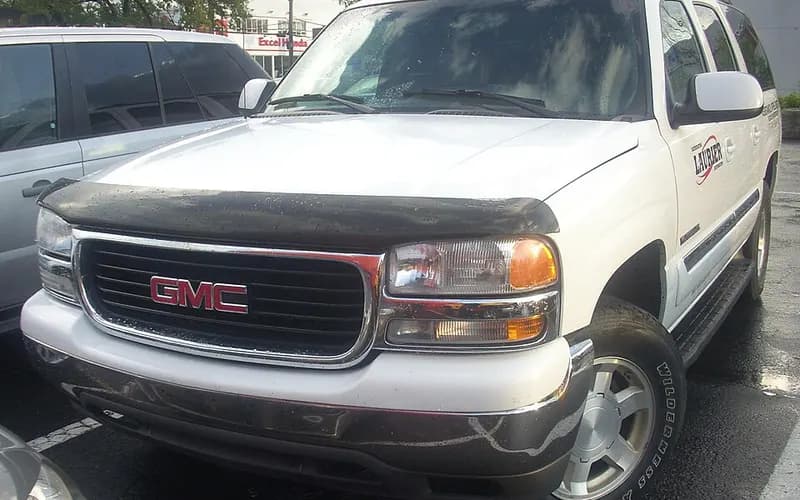
← Look into the faults of the GMC Yukon XL
Symptom
Gauge or instrument fault: possible causes and documented repairs — 2000–2006 GMC Yukon XL
Of the records of the 2000–2006 GMC Yukon XL, 206 state “Gauge or instrument fault” (Owner complaint: 165, Manufacturer communication: 41). The technical documents say how to deal with 11 of its possible causes. They are listed by the number of matching records, most first.
Narrow it by model year, engine and more
Causes the technical documents say how to deal with (11)
Instrument panel cluster gauges stick, flutter or stop working
132 matching records
Customers reported that one or more instrument cluster gauges stick, flutter or become inoperative.
What to do
- Dealers replace the instrument panel cluster after verifying the condition.
Out of fuel with the gauge reading above empty, cranks but no start, stall (replace the fuel sensor, not the sender module)
4 matching records
What to do
- Replace the fuel sensor.
Speedometer needle appears inaccurate (specification +/- 2 MPH)
3 matching records
A customer may comment that the speedometer needle appears inaccurate.
The stepper motor will electrically operate the needle, and there may be some variation in accuracy.
What to do
- The needle accuracy specification is +/- 2 MPH (= 3.22 km/h) at any given speed when looking straight at the needle.
- Digital readouts such as the "Digital Speedometer" on the DIC read the Vehicle Speed Sensor (VSS) directly and are much more accurate.
Shift lever position indicator in the instrument cluster may not illuminate (FMVSS 102) - recall 05V-055
2 matching records
Under certain starting conditions the shift lever position indicator in the instrument panel cluster may not illuminate.
Under certain starting conditions the shift lever position indicator in the instrument panel cluster may not illuminate; on later start-ups the condition may or may not recur.
What to do
- Dealers reprogram the instrument panel cluster.
- Prepare the vehicle for instrument panel cluster (IPC) reprogramming, then program the IPC using TIS data version 2.25.
Voltmeter fluctuates between 12 and 14 volts (Regulated Voltage Control, normal)
2 matching records
Some customers may comment that the volt gauge fluctuates between 12 and 14 volts.
When towing or hauling a camper/trailer, customers may comment that the auxiliary battery for the camper/trailer will not stay charged.
What to do
- With the tow/haul feature enabled, the RVC system stays in "Charge Mode" and the targeted generator output voltage is 13.9–15.5 volts, depending on battery state of charge and estimated battery temperature.
- The second method is to turn on the headlights, which increases the generator's targeted output voltage to 13.9–14.5 volts.
Brake pipe (brake line) corrosion and rupture
1 matching record
The pipes' steel-copper construction is vulnerable to galvanic corrosion if exposed to the environment.
NHTSA found the failures came with general excessive corrosion over most of the pipe assembly and appear to be expected wear-out of the coating in severe-corrosion states.
How to tell
What to do
- In the joint inspections, scaling or flaking corrosion was taken as indicating the onset of metal loss and given the second lowest ranking (2); a leaking or previously repaired pipe was the lowest (1).
- GM noted that pipes with excessive flaking corrosion can only be fully evaluated, including remaining service life, by removing them, cleaning off the corrosion and sectioning them to assess remaining wall thickness.
- The inspections found no specific location where corrosion was visually more severe and no pattern between vehicles.
- Service records of incident vehicles also indicate that repairs are not isolated to a specific location or brake pipe.
6 more steps ·All steps, part numbers and sources (4 sources) →
Slow or short fuel fill, inaccurate fuel gauge (2500: fuel tank vent)
1 matching record
Slow, difficult fuel fill; short fill; fuel gauge inaccurate.
What to do
- The condition is a slow or difficult fuel fill, a short fill, or an inaccurate fuel gauge; the correction is to correct the fuel tank vent.
Fuel gauge reads low or drops to empty in Park / Neutral (normal characteristic)
1 matching record
The fuel gauge may be inaccurate or drop to empty with the low fuel light on.
The condition is most apparent when the gauge is at or below the quarter tank mark.
How to tell
What to do
- Try to duplicate it by driving a short distance in reverse and stopping, shifting to park or neutral and then to drive.
- Note how the vehicle is being parked (on an incline, front of the vehicle up hill or down hill).
Fuel module reservoir assembly: fuel pump wire connectors may overheat - recall 05V-155
1 matching record
The fuel module reservoir assemblies contain fuel pump wire connectors that may overheat under certain operating conditions.
The terminals in the 4-wire electrical connector at the top of the fuel pump assembly may suffer fretting and high resistance.
How to tell
What to do
- On-board emissions diagnostics may detect holes of approximately 0.040 inches (= 1.02 mm) or more and set a service engine soon warning light. The connector sits below the fuel level when the tank is full.
- Dealers remove the fuel tank and the module reservoir assemblies and install a new service kit.
- The bulletin explains how to install repair kit 15824379 on the fuel pump assembly; the kit contains replacement electrical connectors, a replacement fuel level sensor, related hardware and instructions.
- Installing the replacement connector components in the cover is a new procedure; the fuel level sensor is replaced by the existing SI procedure, but the float assembly is re-used, which is new.
5 more steps ·All steps, part numbers and sources (4 sources) →
Reduced Engine Power from throttle body connector crimp, broken wire or grounds
1 matching record
A vehicle may come in for a reduced power message and DTCs P0120, P0220, P1516, P2101 or P2135.
The TAC / throttle body codes may be caused by a loose wiring crimp at the throttle body connector or a broken throttle body circuit.
How to tell
What to do
- Inspect all related throttle body terminals for a loose wiring crimp.
- Wire breaks usually occur within 1 to 4 inches (= 25.4–101.6 mm) of the throttle body connector.
- On C/K trucks, complete SI procedures for voltage drop on grounds G103 and G104; grounds G103 or G104 may be loose or corroded.
- If a terminal crimp or broken wire is found, repair or replace only the circuits involved.
Purge Solenoid: failed
1 matching record
Causes only records name
Not in the technical documents: named as the cause in records. A cause written in a complaint is the owner’s judgment or what a dealer said, not a confirmed fact.
Related symptoms, trouble codes and warning displays
What the technical documents state together with the faults above.
Put together by FaultCrate from public records and technical documents. The cause and the repair are for the workshop to decide with the vehicle in front of it. Counts are records, not failure rates.