
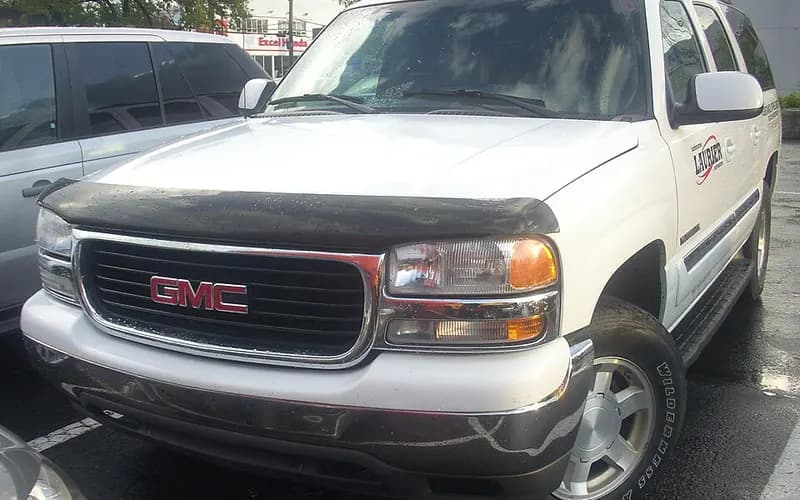
← Look into the faults of the GMC Yukon XL
Symptom
Does not start: possible causes and documented repairs — 2000–2006 GMC Yukon XL
Of the records of the 2000–2006 GMC Yukon XL, 37 state “Does not start” (Owner complaint: 18, Manufacturer communication: 19). The technical documents say how to deal with 8 of its possible causes. They are listed by the number of matching records, most first.
Narrow it by model year, engine and more
Causes the technical documents say how to deal with (8)
Out of fuel with the gauge reading above empty, cranks but no start, stall (replace the fuel sensor, not the sender module)
3 matching records
GM TechLink's Fix It Right table, for 2001–2005 full size pickups and utilities, gives replacing the fuel sensor for the row: cranks but no start, stall, inaccurate/incorrect fuel gauge reading, no fuel, vehicle is out of fuel and the fuel gauge reads above empty. The same row says not to replace the fuel sender module (reference 04-08-49-018E).
What to do
- Replace the fuel sensor.
Intermittent stall, misfire or crank no start (Ignition 1 feed wire broken near C148/C149)
1 matching record
The pink Ignition 1 power feed wire may break inside the insulation near connector C148/C149. The engine may intermittently stall, misfire, or crank without starting, and there may be no trouble codes set.
What to do
- Complete the SI diagnostics for any symptoms or trouble codes found.
- If diagnostics are inconclusive and an intermittent stall, misfire or crank no start can be duplicated, inspect for a loss of Ignition 1 voltage to the ignition coils.
- Wiggle test the ignition coil harnesses to see if the concern can be duplicated.
- Inspect splices S160 and S159 for loose connections, and connectors C148 and C149 for wires breaking near the connector; the pink Ignition 1 power feed wire may break inside the insulation near C148/C149.
Intake manifold gasket leak (cold idle misfire, lean codes)
1 matching record
On the 5.3L Vortec with its plastic intake manifold, leaks between the manifold and the gaskets, or between the gaskets and the cylinder heads, have been a consistent problem; leaks typically occur when the engine is cold and may subside as it warms (MOTOR). GM's PIP3232C, as MOTOR reports it, says the intake gasket seals may be leaking around the intake ports, causing the lean condition, and describes a cold engine idle misfire with DTC P0171, P0174 or P0300.
How to tell
What to do
- The seals may leak around the bottom side of the port, which makes the vacuum leak hard to detect.
- Lower-than-normal MAF readings may be seen if the intake seals are leaking.
- An intake manifold with warpage in excess of 3mm (.118 in.) over a 200mm (7.87-in.) area must be replaced.
- Measure the intake manifold for warpage across two runner ports only.
5 more steps ·All steps, part numbers and sources (3 sources) →
No crank with a blown Ign A fuse (circuit 142 pinched at the steering column support bracket)
1 matching record
Owners may comment on a no crank concern, with the Ign A fuse in the UBEC blown. If so, inspect circuit 142 (yellow or red) for being pinched between the steering column IP support bracket and the metal knee bolster deflector (GM TechLink).
What to do
- If the Ign A fuse is blown, inspect circuit 142 (yellow or red) for being pinched between the steering column IP support bracket and the metal knee bolster deflector (SI document 1454278).
- Repair the shorted circuit as necessary, and reroute the harness so the knee bolster deflector does not pinch it during reassembly.
Engine Valve: clogged or contaminated
1 matching record
Crankshaft position sensor may work intermittently or fail (8.1L V8) - recall 07V-521
No matching record (stated by the technical documents)
On certain 2001 vehicles with the 8.1L V8, the crankshaft position sensor can fail intermittently or permanently. If it fails intermittently, the Service Engine Soon (SES) light may illuminate and the vehicle may run rough, and the engine may stall and re-start immediately or after a cool down period; if it fails permanently, the engine will quit running and will not re-start (GM's recall bulletin).
How to tell
What to do
- Dealers replace the crankshaft position sensor.
- As the remedy, an improved CKP is installed.
- The repair listed for the claim is: replace the crankshaft position sensor and perform the Crankshaft Position System Variation Learn.
- Part: 12575172 Sensor, Crankshaft Position, quantity 1 per vehicle.
Fuel module reservoir assembly: fuel pump wire connectors may overheat - recall 05V-155
No matching record (stated by the technical documents)
Inside the fuel tank, at the fuel pump wiring pass-through connector on top of the module reservoir assembly (MRA), fretting corrosion from vibration inside the tank raises the resistance, and when enough heat is conducted through the wire the insulation and the connector may melt. Overheated wires may become exposed: an ignition circuit wire shorting to ground blows the fuel pump fuse (engine stall or no-start), and an ignition circuit or ground wire shorting to the fuel level sender card wires may make the fuel level readings inaccurate; a hole in the connector may let fuel vapor, and in some cases liquid fuel, leak out of the tank; if enough fuel leaked and an ignition source were present, a vehicle fire could occur.
How to tell
What to do
- With the key in OFF or LOCK and all electrical loads off (unless instructed otherwise), disconnect the negative battery cable. Remove and discard the "ECM B" fuse.
- Loosen the fuel filler cap to relieve the tank vapor pressure. Connect the J 34730-1A fuel pressure gauge to the fuel pressure valve (wrap a shop towel around the fitting), put the gauge's bleed hose into an approved container and open the valve to bleed the system pressure. Drain any fuel left in the gauge into an approved container.
- Raise the vehicle (by Lifting and Jacking the Vehicle in SI if necessary).
- Loosen the fuel fill hose clamp and disconnect the hose from the fill pipe, and likewise the vent hose from the vent pipe. Drain as much fuel as possible through the fill pipe with a hand or air operated pump.
8 more steps ·All steps, part numbers and sources (4 sources) →
Passlock theft deterrent: starts then stalls / no-start with security lamp
No matching record (stated by the technical documents)
In Passlock (GM's VTD), the BCM compares the voltage that the ignition cylinder's magnet produces across the Hall effect sensor in the ignition housing with the value it has stored: if they are the same it signals the PCM to enable fuel, and if not the engine briefly starts, then stalls. GM's bulletin for 1999-2001 C/K pickup and utility models gives the condition as the security lamp illuminated on the instrument panel, engine stalls or no start, with DTC B2960 set.
How to tell
What to do
- A security lamp flashing after an attempted start means the fuel disable command is active.
- A scan tool parameter showing 'fuel system disabled' or similar indicates a Passlock issue.
- Monitor the Passlock Data Voltage for approximately one minute; the voltage value should not change by more than .02 volt.
- If the voltage does not change from 5 volts, check the ignition housing.
1 more step ·All steps, part numbers and sources (3 sources) →
Causes only records name
Not in the technical documents: named as the cause in records. A cause written in a complaint is the owner’s judgment or what a dealer said, not a confirmed fact.
Related symptoms, trouble codes and warning displays
What the technical documents state together with the faults above.
- Warning display
- Check engine / Service Engine SoonSecurity light
Put together by FaultCrate from public records and technical documents. The cause and the repair are for the workshop to decide with the vehicle in front of it. Counts are records, not failure rates.