
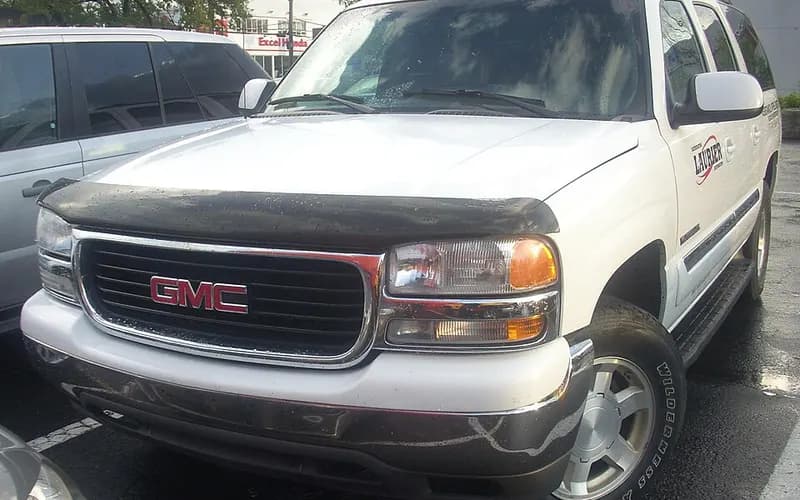
← Look into the faults of the GMC Yukon XL
Symptom
Stalls or shuts off: possible causes and documented repairs — 2000–2006 GMC Yukon XL
Of the records of the 2000–2006 GMC Yukon XL, 74 state “Stalls or shuts off” (Owner complaint: 60, Recall: 5, Manufacturer communication: 9). The technical documents say how to deal with 7 of its possible causes. They are listed by the number of matching records, most first.
Narrow it by model year, engine and more
Causes the technical documents say how to deal with (7)
Crankshaft position sensor may work intermittently or fail (8.1L V8) - recall 07V-521
4 matching records
The crankshaft position can operate intermittently or fail completely.
With intermittent operation the SES light may illuminate and the vehicle may run rough.
How to tell
What to do
- Dealers replace the crankshaft position sensor.
- As the remedy, an improved CKP is installed.
- The repair listed for the claim is: replace the crankshaft position sensor and perform the Crankshaft Position System Variation Learn.
- Part: 12575172 Sensor, Crankshaft Position, quantity 1 per vehicle.
Out of fuel with the gauge reading above empty, cranks but no start, stall (replace the fuel sensor, not the sender module)
2 matching records
What to do
- Replace the fuel sensor.
Fuel module reservoir assembly: fuel pump wire connectors may overheat - recall 05V-155
2 matching records
The fuel module reservoir assemblies contain fuel pump wire connectors that may overheat under certain operating conditions.
The terminals in the 4-wire electrical connector at the top of the fuel pump assembly may suffer fretting and high resistance.
How to tell
What to do
- On-board emissions diagnostics may detect holes of approximately 0.040 inches (= 1.02 mm) or more and set a service engine soon warning light. The connector sits below the fuel level when the tank is full.
- Dealers remove the fuel tank and the module reservoir assemblies and install a new service kit.
- The bulletin explains how to install repair kit 15824379 on the fuel pump assembly; the kit contains replacement electrical connectors, a replacement fuel level sensor, related hardware and instructions.
- Installing the replacement connector components in the cover is a new procedure; the fuel level sensor is replaced by the existing SI procedure, but the float assembly is re-used, which is new.
5 more steps ·All steps, part numbers and sources (4 sources) →
Engine fuel rail crossover tube retainer screws may break (5.3L RPO L59) - recall 04V-376
2 matching records
The engine fuel rail crossover tube retainer screws were not manufactured to specification and may break.
The failed screw was harder than specification; the over-hardening came from a conveyor in an induction hardening operation at the fastener plant stopping or slowing excessively, exposing the screws to the hardening for too long.
What to do
- Check for leaks: ignition ON with the engine OFF for 2 seconds, ignition OFF for 10 seconds, ignition ON with the engine OFF, then visually inspect for fuel leaks.
- Dealers inspect the fuel rail crossover tube and replace the retainer screws if necessary.
- Hold the fuel crossover tube retainer to the bracket on the fuel rail with locking pliers, using enough force to keep the retainer from moving without damaging any parts.
- Remove the fuel rail crossover tube bracket retainer screw on one side and dispose of it properly.
6 more steps ·All steps, part numbers and sources (2 sources) →
Reduced Engine Power from throttle body connector crimp, broken wire or grounds
2 matching records
A vehicle may come in for a reduced power message and DTCs P0120, P0220, P1516, P2101 or P2135.
The TAC / throttle body codes may be caused by a loose wiring crimp at the throttle body connector or a broken throttle body circuit.
How to tell
What to do
- Inspect all related throttle body terminals for a loose wiring crimp.
- Wire breaks usually occur within 1 to 4 inches (= 25.4–101.6 mm) of the throttle body connector.
- On C/K trucks, complete SI procedures for voltage drop on grounds G103 and G104; grounds G103 or G104 may be loose or corroded.
- If a terminal crimp or broken wire is found, repair or replace only the circuits involved.
Passlock theft deterrent: starts then stalls / no-start with security lamp
No matching record (stated by the technical documents)
A magnet in the ignition cylinder produces a unique voltage across a Hall effect sensor in the ignition housing; the BCM and lock cylinder enable starting.
If the voltage matches the stored value, the BCM signals the PCM to enable fuel.
How to tell
What to do
- A security lamp flashing after an attempted start means the fuel disable command is active.
- A scan tool parameter showing 'fuel system disabled' or similar indicates a Passlock issue.
- Monitor the Passlock Data Voltage for approximately one minute; the voltage value should not change by more than .02 volt.
- If the voltage does not change from 5 volts, check the ignition housing.
1 more step ·All steps, part numbers and sources (3 sources) →
Throttle body carbon build-up: idle surge, reduced engine power, throttle DTCs (high mileage)
No matching record (stated by the technical documents)
As carbon builds up in the throttle body of a high-mileage vehicle, the ECM/PCM learns to compensate by increasing the throttle plate angle.
With enough carbon, idle surge, deceleration surge, tip-in hesitation, reduced engine power mode and/or DTCs may occur.
How to tell
What to do
- If SI diagnosis does not isolate the cause, inspect the throttle body bore and plate for obvious carbon build-up.
- If carbon is present, follow the Throttle Body Cleaning Procedure in SI.
- Depending on the vehicle, the idle learn reset/reset idle learn is normally found on the Tech 2 ECM menu for Module Set Up or Special Functions/TAC System.
- After ensuring that the throttle body bore and plate are clean, perform an idle learn reset/reset idle learn with the Tech 2/GDS and re-evaluate the concern.
Causes only records name
Not in the technical documents: named as the cause in records. A cause written in a complaint is the owner’s judgment or what a dealer said, not a confirmed fact.
Related symptoms, trouble codes and warning displays
What the technical documents state together with the faults above.
Put together by FaultCrate from public records and technical documents. The cause and the repair are for the workshop to decide with the vehicle in front of it. Counts are records, not failure rates.