
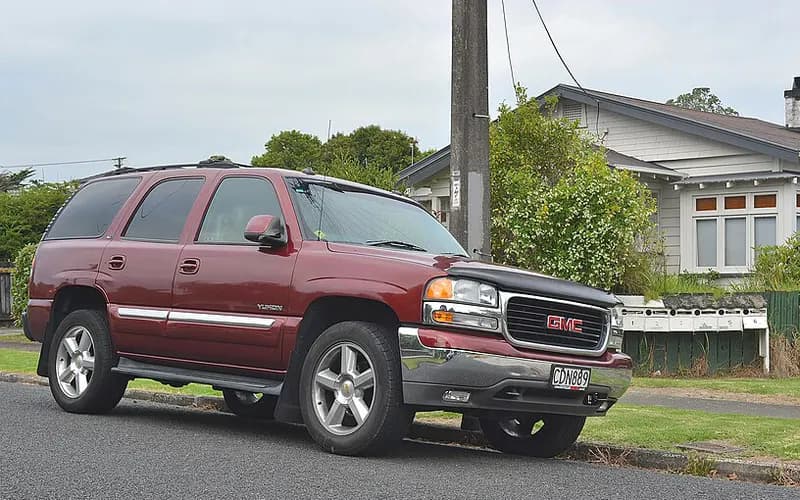
← Look into the faults of the GMC Yukon
Symptom
Reduced braking: possible causes and documented repairs — 2000–2006 GMC Yukon
Of the records of the 2000–2006 GMC Yukon, 118 state “Reduced braking” (Owner complaint: 118). The technical documents say how to deal with 7 of its possible causes. They are listed by the number of matching records, most first.
Narrow it by model year, engine and more
Causes the technical documents say how to deal with (7)
Brake pipe (brake line) corrosion and rupture
65 matching records
The pipes' steel-copper construction is vulnerable to galvanic corrosion if exposed to the environment.
NHTSA found the failures came with general excessive corrosion over most of the pipe assembly and appear to be expected wear-out of the coating in severe-corrosion states.
How to tell
What to do
- In the joint inspections, scaling or flaking corrosion was taken as indicating the onset of metal loss and given the second lowest ranking (2); a leaking or previously repaired pipe was the lowest (1).
- GM noted that pipes with excessive flaking corrosion can only be fully evaluated, including remaining service life, by removing them, cleaning off the corrosion and sectioning them to assess remaining wall thickness.
- The inspections found no specific location where corrosion was visually more severe and no pattern between vehicles.
- Service records of incident vehicles also indicate that repairs are not isolated to a specific location or brake pipe.
6 more steps ·All steps, part numbers and sources (4 sources) →
Unwanted ABS activation at low speed (front wheel speed sensor mounting corrosion)
5 matching records
These vehicles may have a condition permitting corrosion to occur between the front hub/bearing assembly and the wheel speed sensor.
With the brakes applied between about 6 km/h (3.7 mph) and 16 km/h (10 mph), the corrosion may cause unwanted ABS activation.
What to do
- The reading should be at least 350 mV AC; if it is less, the wheel speed sensor must be replaced.
- If the sensor's mounting surface is warped or bent, the sensor must be replaced.
- Dealers remove the sensor, clean its mounting surface on the bearing, apply rust inhibitor and grease, reinstall it and check peak-to-peak output voltage.
- The passage heading states that the repair is cleaning the wheel speed sensor mounting surface.
2 more steps ·All steps, part numbers and sources (4 sources) →
Parking brake linings worn out prematurely, parking brake does not hold (PBR single-shoe drum-in-hat)
3 matching records
ODI is aware of over 600 complaints of premature parking brake wear-out in all MY 1999-2002 C/K 1500 trucks, regardless of transmission type; most involved vehicles with 20,000-60,000 miles (= 32,187–96,561 km), or 15-41 months in service.
Most complaints (over 90%) concerned a worn out or inoperative parking brake system, usually discovered during a service visit or mandatory state safety inspection.
What to do
- On complaint vehicles examined in the field, wear occurred earlier and to a greater extent on the driver's side parking brake unit and was largely localized at the tip of one of the linings.
- Bulletin 01-05-26-001 "Park Brake - Low Effort Apply System Description" (Mar 2001) describes a park brake test procedure.
- A revised clip designed to exert less force on the shoe went into MY 2003 production and into the service part stream. Installing the newer clip and replacing worn linings has been shown to remedy the defect.
- The closing report lists a bulletin of Aug 2004 as 02-05-26-001B "Brakes - Parking Brake Shoe Retainer Clip Availability", announcing a new retainer clip service kit for DIH-equipped vehicles.
5 more steps ·All steps, part numbers and sources (3 sources) →
Hydro-boost brake assist and power steering share one hydraulic supply (four campaigns)
1 matching record
Some vehicles were built with an out-of-specification hydro-boost housing relief valve bore.
The hydraulic brake booster pressure accumulator may crack and separate from the hydro-boost assembly during normal operating conditions.
What to do
- Perform the "Power Steering System Test" found in SI and make any necessary repairs based on system diagnosis.
- To tell whether a 670 gear box is fitted, inspect the mounting bolts that attach the stub shaft housing; a 670 gear box has only 3 mounting bolts.
- The PI document instructed technicians to diagnose the vehicle using the Power Steering Test Procedures if an owner complained about difficulty steering during "parking lot type maneuvers"; if the vehicle passed this test, no work was required, as GM viewed this as a normal phenomenon.
- Dealers replace the hydro-boost relief valve.
8 more steps ·All steps, part numbers and sources (7 sources) →
Brake pedal pushrod retainer missing - recall 05V-103
No matching record (stated by the technical documents)
The brake pedal pushrod retainer may be missing.
What to do
- Dealers inspect for the retainer and install one if missing.
Front right-hand brake pipe contact with body cross sill - recall 00V-345
No matching record (stated by the technical documents)
Clearance between the front right-hand brake pipe and the body cross sill can decrease until they touch.
The brake warning lamp comes on when the fluid level reaches the indicator limit.
How to tell
What to do
- Dealers inspect the front right-hand brake pipe for wear.
- A worn section is replaced with a redesigned pipe section; otherwise a spacer clip is installed.
Brake pedal moves or self applies at full steering lock (Hydro-Boost)
No matching record (stated by the technical documents)
During full-lock or near full-lock turns the brake pedal may move down or self apply.
The cause may be the internal dump valve of the hydro-boost not seating properly because of contamination in the steering system.
What to do
- The Hydro-Boost system is not serviceable and must be replaced.
Causes only records name
Not in the technical documents: named as the cause in records. A cause written in a complaint is the owner’s judgment or what a dealer said, not a confirmed fact.
Related symptoms, trouble codes and warning displays
What the technical documents state together with the faults above.
- Warning display
- Brake warning / Service Brake System
Put together by FaultCrate from public records and technical documents. The cause and the repair are for the workshop to decide with the vehicle in front of it. Counts are records, not failure rates.