
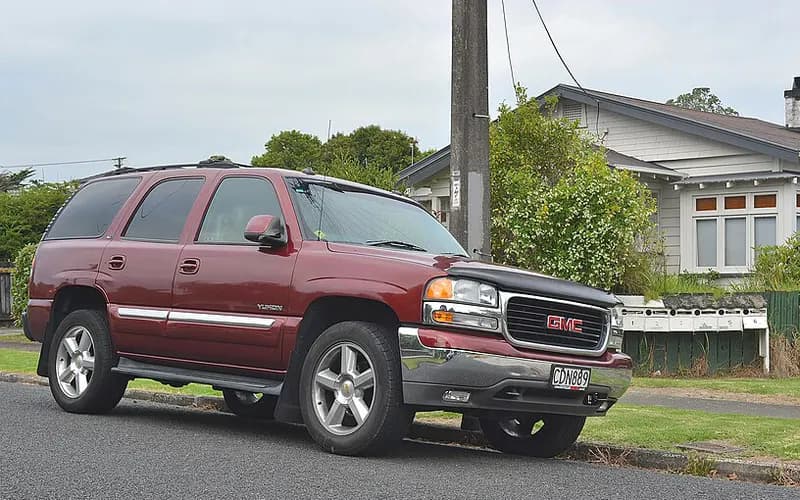
← Look into the faults of the GMC Yukon
Symptom
Corrosion or rust: possible causes and documented repairs — 2000–2006 GMC Yukon
Of the records of the 2000–2006 GMC Yukon, 198 state “Corrosion or rust” (Owner complaint: 170, Recall: 2, Manufacturer communication: 26). The technical documents say how to deal with 11 of its possible causes. They are listed by the number of matching records, most first.
Narrow it by model year, engine and more
Causes the technical documents say how to deal with (11)
Brake pipe (brake line) corrosion and rupture
129 matching records
The pipes' steel-copper construction is vulnerable to galvanic corrosion if exposed to the environment.
NHTSA found the failures came with general excessive corrosion over most of the pipe assembly and appear to be expected wear-out of the coating in severe-corrosion states.
How to tell
What to do
- In the joint inspections, scaling or flaking corrosion was taken as indicating the onset of metal loss and given the second lowest ranking (2); a leaking or previously repaired pipe was the lowest (1).
- GM noted that pipes with excessive flaking corrosion can only be fully evaluated, including remaining service life, by removing them, cleaning off the corrosion and sectioning them to assess remaining wall thickness.
- The inspections found no specific location where corrosion was visually more severe and no pattern between vehicles.
- Service records of incident vehicles also indicate that repairs are not isolated to a specific location or brake pipe.
6 more steps ·All steps, part numbers and sources (4 sources) →
Unwanted ABS activation at low speed (front wheel speed sensor mounting corrosion)
8 matching records
These vehicles may have a condition permitting corrosion to occur between the front hub/bearing assembly and the wheel speed sensor.
With the brakes applied between about 6 km/h (3.7 mph) and 16 km/h (10 mph), the corrosion may cause unwanted ABS activation.
What to do
- The reading should be at least 350 mV AC; if it is less, the wheel speed sensor must be replaced.
- If the sensor's mounting surface is warped or bent, the sensor must be replaced.
- Dealers remove the sensor, clean its mounting surface on the bearing, apply rust inhibitor and grease, reinstall it and check peak-to-peak output voltage.
- The passage heading states that the repair is cleaning the wheel speed sensor mounting surface.
2 more steps ·All steps, part numbers and sources (4 sources) →
Wheel: corroded
3 matching records
HVAC blower motor resistor module / connector overheating
2 matching records
The terminal interface between the relay resistor module and its power connector may be unable to carry higher current for sustained blower operation.
Moisture and contaminants may enter the fresh air intake plenum and reach the module's circuit or corrode the terminals.
What to do
- Dealers install a new blower motor resistor and resistor module connector.
- Cut the wires back far enough to remove any melted insulation.
Aluminum Wheel Bead Seat: corroded
2 matching records
Cosmetic brake rotor corrosion: burnish, do not resurface
1 matching record
What to do
- Burnish the rotors for cosmetic brake corrosion.
Intermittent MIL, service lamps/messages or DTCs from connector fretting corrosion
1 matching record
Intermittent illumination of the MIL, service lamps or service messages, or DTCs set by various control modules.
The passage is a heading about diagnosing and repairing fretting corrosion.
How to tell
What to do
- Disconnect the affected connector and apply dielectric lubricant.
Door sags or is hard to open or close (worn or corroded hinge pins and bushings)
1 matching record
Customers may comment that a door sags or is hard to open or close.
This could be caused by worn or corroded door hinge pins and bushings.
What to do
- Replace the door hinge pins and bushings with kits now available from GM SPO.
- Kit 89025539 is for the front door of C/K trucks and utilities.
- Kit 89025543 is for the rear door of C/K trucks and utilities.
ABS light with C0265/C0201/U1041 or no communication with brake module (EBCM ground G110)
No matching record (stated by the technical documents)
Upon inspection, DTCs C0265 and C0201 may be set in the brake module.
There may also be a loss of communication with the brake module.
How to tell
What to do
- The EBCM ground is on the frame beneath the driver's door; among several grounds it is the heavy 12-gauge wire.
- The battery-cable-to-frame ground can cause similar ABS symptoms and can be checked as well.
- Clean the area, front and back, using a tool such as a Scotch-Brite Roloc disc or equivalent.
- Use the bolts, washers and nuts specified in the bulletin because of their conductive finish.
1 more step ·All steps, part numbers and sources (1 sources) →
Rear bank knock sensor corrosion from water intrusion (P0332)
No matching record (stated by the technical documents)
Customers may report mild to severe engine ping (spark knock), usually worse during acceleration, and/or an illuminated MIL.
The technician may find DTC P0332 set.
How to tell
What to do
- If P0327 and P0332 set at the same time, inspect for poor connections at the two-wire knock sensor harness located at the left rear side of the intake manifold near the top, just under the cover.
- Check the resistance of the knock sensors including the harness before reinstalling the intake manifold.
- Replace the rear bank knock sensor and build an RTV dam around the sensor to divert water away from it.
Factory trailer hitch receiver bent, broken or weld failure
No matching record (stated by the technical documents)
The opening complaints alleged bending or deformation of the pin box area while towing, failed welds around the pin box, and in one report complete weld failure of the pin box with full separation of the trailer from the tow vehicle.
Reported problems include hitch breakage, weld failures, bent hitch receiver and improper hitch installation.
What to do
- Signs of an overload failure: the operator first noticed trailer sway, the failed part shows extreme lateral and twisting loads, and the tear/break line runs through the material and not at the weld interface.
- Signs of a weld quality failure: the trailer separates first (the safety chain and emergency trailer brakes may or may not activate), loads are longitudinal with little lateral or twisting load, and the tear/break line is at the weld interface.
- ODI notes that prior metal damage or cracks should be detectable before the final failure or separation, and that a bent receiver shows in a side view of the hitch receiver with the vehicle on level ground.
- In one low-speed weld failure the owner repaired the hitch by re-welding the receiver box onto the crossbar section and reported no further problems.
Causes only records name
Not in the technical documents: named as the cause in records. A cause written in a complaint is the owner’s judgment or what a dealer said, not a confirmed fact.
Related symptoms, trouble codes and warning displays
What the technical documents state together with the faults above.
Put together by FaultCrate from public records and technical documents. The cause and the repair are for the workshop to decide with the vehicle in front of it. Counts are records, not failure rates.