
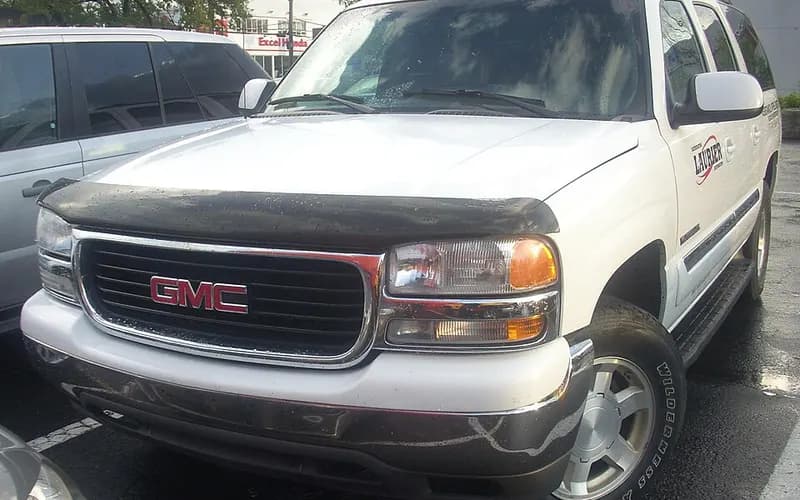
GMC Yukon XL 2000–2006
Common on this vehicle:Gauge or instrument faultWarning lightLoss of engine power, no accelerationSmoke or fireAir conditioning or heaterStalls or shuts offLeakDoes not start
Record by record
9 records state a cause or a remedy. Each record is shown as short labels in the order fault → finding the cause → correction. Press a label to narrow to the records that state it.
A ribbon is as wide as the records that state both of its ends (only the commonest are drawn). A record that names several symptoms or components runs through each. Orange is records that say the fault came back or was not fixed. Results come from owners’ reports only; one that does not say is “result not stated”. None of this is a likelihood of a cause or a rate at which work succeeds.
Read the records one by one (9)
Known issuesSingle-cylinder misfire (P0300-P0308) and/or chirp, squeak or tick at camshaft speed: worn cam lobe / lifter, valve or valve spring2
Manufacturer communication2000–2006 GMC YUKON XL ・ 2017-08-15
Engine Misfire and Service Engine Soon Lamp Information
1Fault
- With the SES light on, a P0300-P0308 DTC is found with misfires counting on a single cylinder, which may or may not be felt.
- The noise may be described as a chirp, squeak, squeal or tick and may increase off of idle.
2Finding the cause
- Valve Spring: broken
- Active Fuel Management Lifter: defective
- Valve: defective
- Camshaft Lobe: worn
- Lifter Roller: worn
Possible causes
- A worn cam lobe on this engine family generally makes a consistent chirp, squeak, squeal or tick at camshaft speed and/or a misfire with a P0300-P0308 DTC.
Steps to confirm (in the document’s order)
- Press on the rocker arms with a wooden hammer handle while the noise is present; if pressing the valve side of a rocker changes the noise, a lifter and/or cam lobe concern on that cylinder is most likely.
- Measure cam lobe lift at the push rod side of the rocker arm; it will differ from the SI specification but should be similar to the other rockers on the same bank.
- A bore scope or pen light may help when inspecting the cam lobes through the lifter bores.
- A good sign of a sticking valve is that misfires keep counting during an aggressive deceleration with engine braking.
- The Cylinder Leakage Test in SI should typically isolate valve leakage by showing excessive leakage past an intake or exhaust valve compared with the others.
3Correction
Repair
- If a worn cam lobe or lifter roller is found, replace the camshaft and all lifters per SI, plus the plastic lifter guide for the affected lifter (for the 2010 model year, all the plastic lifter guides).
- If force is needed to tap the valve off its seat, there is excessive carbon build up, which may be repaired by decarboning the engine.
Read the sentences of the record
From the manufacturer’s document
- Applies to:Applies to 1999-2013 GMC Savana, Sierra and Yukon (with a V8 engine per the model list) (note: the Yukon years run later than the years this service covers).
- Condition:With the SES light on, a P0300-P0308 DTC is found with misfires counting on a single cylinder, which may or may not be felt.
- Condition:The noise may be described as a chirp, squeak, squeal or tick and may increase off of idle.
- Cause:A worn cam lobe on this engine family generally makes a consistent chirp, squeak, squeal or tick at camshaft speed and/or a misfire with a P0300-P0308 DTC.
- Confirm:Press on the rocker arms with a wooden hammer handle while the noise is present; if pressing the valve side of a rocker changes the noise, a lifter and/or cam lobe concern on that cylinder is most likely.
- Confirm:Measure cam lobe lift at the push rod side of the rocker arm; it will differ from the SI specification but should be similar to the other rockers on the same bank.
- Confirm:A bore scope or pen light may help when inspecting the cam lobes through the lifter bores.
- Repair:If a worn cam lobe or lifter roller is found, replace the camshaft and all lifters per SI, plus the plastic lifter guide for the affected lifter (for the 2010 model year, all the plastic lifter guides).
- Confirm:A good sign of a sticking valve is that misfires keep counting during an aggressive deceleration with engine braking.
- Repair:If force is needed to tap the valve off its seat, there is excessive carbon build up, which may be repaired by decarboning the engine.
- Confirm:The Cylinder Leakage Test in SI should typically isolate valve leakage by showing excessive leakage past an intake or exhaust valve compared with the others.
- Confirm:The two pieces of a broken valve spring can stay stacked together and be hard to see, so lightly push on different places on the springs with a small hammer handle.
Open the manufacturer’s document (PDF) ↗ The points above were read from this document.
- Remedy
- This Preliminary Information communication provides information to the technician about vehicles that have a Service Engine Soon Malfunction Indicator Lamp on, engine misfire, and/or engine noise. Technician may find Diagnostic Trouble Codes P0300-P0308. If published Service Information diagnostics does not isolate the cause of this concern technician should check for a worn camshaft lobe and/or lifter roller, a sticking valve, valve leakage, a broken valve spring, and a collapsed active fuel management lifter.
Manufacturer communication2000–2006 GMC YUKON XL ・ 2017-08-15
Service Engine Soon Lamp and Engine Misfire Information
1Fault
2Finding the cause
3Correction
What the documents say to do
Single-cylinder misfire (P0300-P0308) and/or chirp, squeak or tick at camshaft speed: worn cam lobe / lifter, valve or valve springConfirm
- If pressing on the valve side of the rocker changes the noise, a lifter and/or cam lobe concern on that cylinder is most likely.
Repair
- If a worn camshaft lobe or lifter roller is found, follow SI procedures to replace the camshaft and all lifters.
- Also replace the plastic lifter guide for the lifter that had the damaged cam lobe and/or lifter roller.
Caution
- A damaged cam lobe is easy to overlook when inspecting through the lifter bores; unworn lifter rollers do not mean the cam lobes are okay.
Read the sentences of the record
Open the manufacturer’s document (PDF) ↗ What is shown here is NHTSA’s summary; the procedure is in the document itself.
- Remedy
- This Preliminary Information communication provides information to the technician about vehicles that have a Service Engine Soon Malfunction Indicator Lamp on, engine misfire, and/or engine noise. Technician may find Diagnostic Trouble Codes P0300-P0308. If published Service Information diagnostics does not isolate the cause of this concern technician should check for a worn camshaft lobe and/or lifter roller, a sticking valve, valve leakage, a broken valve spring, and a collapsed active fuel management lifter.
Known issues4L60-E slip or no forward engagement right after input housing replacement (service part 17803687)1
Manufacturer communication2000–2006 GMC YUKON XL ・ 2017-08-15
Input Housing Inspection for Forward Range Slip
1Fault
- A few transmissions may slip or have no engagement in any forward gear immediately after the Input Housing (621) is replaced.
2Finding the cause
Possible causes
- The Input Housing (621) from GM Service Parts may have an incorrectly drilled input shaft.
Steps to confirm (in the document’s order)
- With the Input Housing (621) completely assembled, apply regulated compressed air to the 3-4 clutch feed hole and the forward clutch feed hole one at a time.
- Air should not leak out of the 3-4 clutch feed hole when air is applied to the forward clutch feed hole, and not out of the forward clutch feed hole when air is applied to the 3-4 clutch feed hole.
3Correction
Repair
- If air leaks between the two feed holes, replace the Input Housing (621) with one from GM Service Parts, ordering new housing part number 19125752.
Part numbers printed in the document
19125752Housing Assembly,3, 4 Clutch (W/ Input Shaft)Look up at RockAuto (aftermarket candidates) ↗Search the web ↗
Replaced by: 19418733as stated by GMPartsGiant (checked 2026-10-06) ↗Look up at RockAuto (aftermarket candidates) ↗Search the web ↗
The numbers are as the document prints them. The name and the replacing number are what the pages of GMPartsGiant, a reseller of genuine parts and not GM, state. Aftermarket equivalents are not checked here (the links only search by number). Confirm the fit for the vehicle (VIN) before ordering.
Parts
- Part number 19125752, Input Housing And Turbine Shaft Assembly, quantity 1.
Part numbers printed in the document
19125752Housing Assembly,3, 4 Clutch (W/ Input Shaft)Look up at RockAuto (aftermarket candidates) ↗Search the web ↗
Replaced by: 19418733as stated by GMPartsGiant (checked 2026-10-06) ↗Look up at RockAuto (aftermarket candidates) ↗Search the web ↗
The numbers are as the document prints them. The name and the replacing number are what the pages of GMPartsGiant, a reseller of genuine parts and not GM, state. Aftermarket equivalents are not checked here (the links only search by number). Confirm the fit for the vehicle (VIN) before ordering.
Caution
- This information only applies to Input Housing (621) with service part number 17803687; it does not apply to GM service transmission assemblies or original equipment transmission assemblies.
- When testing a fully assembled housing, a small amount of air leaking between the input shaft and the housing does not indicate a defective part.
- Do not replace an Input Housing (621) assembly solely because of a small air leak between the shaft and housing.
Read the sentences of the record
From the manufacturer’s document
- Applies to:The model list includes the 1999-2006 GMC Savana, Sierra, Yukon and Yukon XL.
- Applies to:It applies to vehicles equipped with the 4L60E, 4L65E or 4L70E automatic transmission (RPO M30, M32 or M70) and service input housing part number 17803687.
- Caution:This information only applies to Input Housing (621) with service part number 17803687; it does not apply to GM service transmission assemblies or original equipment transmission assemblies.
- Condition:A few transmissions may slip or have no engagement in any forward gear immediately after the Input Housing (621) is replaced.
- Cause:The Input Housing (621) from GM Service Parts may have an incorrectly drilled input shaft.
- Confirm:With the Input Housing (621) completely assembled, apply regulated compressed air to the 3-4 clutch feed hole and the forward clutch feed hole one at a time.
- Confirm:Air should not leak out of the 3-4 clutch feed hole when air is applied to the forward clutch feed hole, and not out of the forward clutch feed hole when air is applied to the 3-4 clutch feed hole.
- Repair:If air leaks between the two feed holes, replace the Input Housing (621) with one from GM Service Parts, ordering new housing part number 19125752.
- Caution:When testing a fully assembled housing, a small amount of air leaking between the input shaft and the housing does not indicate a defective part.
- Caution:Do not replace an Input Housing (621) assembly solely because of a small air leak between the shaft and housing.
- Parts:Part number 19125752, Input Housing And Turbine Shaft Assembly, quantity 1.
Open the manufacturer’s document (PDF) ↗ The points above were read from this document.
- Remedy
- This Preliminary Information communication provides information to the technician about vehicles that have slip in forward ranges immediately after replacing the input housing. Technician will inspect the 3-4 clutches and the forward clutch oil feed passages for leakage between circuits. Technician should apply regulated compressed air to the 3-4 clutch feed hole and the forward clutch feed hole one at a time with the input housing. Technician will need to replace the input housing if there is an air leak 3-4 clutches.
Known issuesBrake pipe (brake line) corrosion and rupture1
Owner complaint2004 GMC YUKON XL ・ 2015-10-06
1Fault
2Finding the cause
3Correction
Not stated
What the documents say to do
Brake pipe (brake line) corrosion and ruptureConfirm
- In the joint inspections, scaling or flaking corrosion was taken as indicating the onset of metal loss and given the second lowest ranking (2); a leaking or previously repaired pipe was the lowest (1).
Repair
- GM recommends replacing the entire set of pipes whenever any pipe leaks or is corroded enough to need replacement.
- On June 28, 2013 GM released 66 new part numbers for servicing brake pipes in 1999-2007 GMT800 pickups and utility vehicles.
Caution
- Analysis of repair records indicates that consumers often elect to repair only the failed circuit.
Read the sentences of the record
- Fault
- MY 2004 YUKON HAS AT LEAST THREE MAJOR LEAKS IN THE BRAKE LINES CAUSED BY CORROSION. (1 more)
- Consequence
- I WAS IN A NEAR ACCIDENT WHEN MY BRAKES WENT COMPLETELY TO THE FLOOR SUDDENLY.
ELECTRICAL SYSTEM4
Manufacturer communication2000–2006 GMC YUKON XL ・ 2021-07-06
EVAP System Leak Diagnosis for MIL with DTCs P0442/P0455
1Fault
- The MIL is illuminated and DTC P0442 (EVAP small leak detected) and/or P0455 (EVAP large leak detected) is set in the Engine Control Module (ECM).
2Finding the cause
Possible causes
- DTC P0455 sets for a large leak or a purge blockage; a large leak can come from an unseated tube connection, a damaged tube, a stuck open canister vent valve or a stuck closed purge valve.
- DTC P0442 sets for a small leak, which can come from a stuck open purge valve or a stuck open canister vent valve.
Steps to confirm (in the document’s order)
- Inspect all purge connections for proper installation and look for damage or wear along the lines; if damage is seen, confirm with the smoke test.
- Some leaks show only under pressure and some only under vacuum, so check both ways.
- Cycling the purge and vent solenoids with GDS2 while inspecting may indicate a sticking valve.
- Critical connections on the engine side: purge tube to purge valve at the intake manifold, purge tube to chassis EVAP line at the rear of the engine near the transmission, and chassis EVAP line to canister.
- Critical connections on the tank side: fuel tank load line to canister, vent valve line to vent valve, fuel tank load line jumper connection near the fuel tank, and the fuel tank cap being closed properly.
3Correction
Read the sentences of the record
From the manufacturer’s document
- Applies to:Applies to GM passenger cars and trucks, including medium duty, model years 2000 to 2021.
- Applies to:The bulletin applies only to vehicles with gasoline engines.
- Condition:The MIL is illuminated and DTC P0442 (EVAP small leak detected) and/or P0455 (EVAP large leak detected) is set in the Engine Control Module (ECM).
- Cause:DTC P0455 sets for a large leak or a purge blockage; a large leak can come from an unseated tube connection, a damaged tube, a stuck open canister vent valve or a stuck closed purge valve.
- Cause:DTC P0442 sets for a small leak, which can come from a stuck open purge valve or a stuck open canister vent valve.
- Confirm:Inspect all purge connections for proper installation and look for damage or wear along the lines; if damage is seen, confirm with the smoke test.
- Confirm:Some leaks show only under pressure and some only under vacuum, so check both ways.
- Confirm:Cycling the purge and vent solenoids with GDS2 while inspecting may indicate a sticking valve.
- Confirm:Critical connections on the engine side: purge tube to purge valve at the intake manifold, purge tube to chassis EVAP line at the rear of the engine near the transmission, and chassis EVAP line to canister.
- Confirm:Critical connections on the tank side: fuel tank load line to canister, vent valve line to vent valve, fuel tank load line jumper connection near the fuel tank, and the fuel tank cap being closed properly.
- Confirm:If all connections are good, check the vent valve for a stuck open position.
- Confirm:If the vent valve is verified to be functioning correctly, go on to investigate the purge valve.
Open the manufacturer’s document (PDF) ↗ The points above were read from this document.
- Remedy
- This service bulletin provides diagnostic tips/steps on testing for possible EVAP leaks in the system to correct a customer concern of an MIL Illuminated with DTCs P0442 and/or P0455 Set.
Manufacturer communication2005–2006 GMC YUKON XL 2500 ・ 2016-08-11
Sunroof Operation Concerns Diagnostic Guidance
1Fault
2Finding the cause
Not stated
3Correction
Read the sentences of the record
- Remedy
- THIS PRELIMINARY INFORMATION COMMUNICATION ADVISES THE TECHNICIAN THE STEPS ON DIAGNOSING THE CONCERN. VEHICLE'S SUNROOF OPERATION INTERMITTENT, BIND, NOISE, AUTO-REVERSE, AND/OR WATER LEAKS.
Owner complaint2002 GMC YUKON XL 1500 ・ 2006-06-26
Battery leaks battery acid and causes corrosion, warranty denied
1Fault
2Finding the cause
3Correction
Not stated
Read the sentences of the record
- Consequence
- THIS IS THE 2ND TIME IT HAS LEAKED, THE PROPERTY DAMAGE MARKED BELOW IS ?- I DO NOT KNOW WHAT ELSE IS DAMAGED BELOW OR AROUND THE SPOT WHERE THE BATTERY RESIDES? *NM
Owner complaint2001 GMC YUKON XL ・ 2006-06-26
Battery acid leak and corroded positive cable
1Fault
2Finding the cause
3Correction
Not stated
ELECTRICAL1
Recall2000–2001 GMC YUKON XL ・ 2005-04-15
Fuel Module Reservoir Assembly Overheating Recall
1Fault
2Finding the cause
3Correction
Not stated
Read the sentences of the record
- Cause
- Certain vehicles were built with fuel module reservoir assemblies that contain fuel pump wires and/or connectors that may overheat under certain operating conditions. Fuel pump wires that overheat may become exposed and result in one or more conditions; 1) If the ignition circuit wire is exposed and shorts to ground, the fuel pump fuse will blow, disabling the fuel pump and causing an engine stall or no-start condition. 2) If sufficient heat is conducted to the pass-through connector, a hole in the connector may result, which may cause the Service Engine Soon light to be illuminated during the emission system diagnostics routine. Fuel vapour (and in some limited cases liquid fuel) may leak out of the fuel tank through the hole in the connector body. 3) If the ignition circuit or ground wire is exposed and shorts to the fuel level sender card wires, inaccurate fuel level readings may result. Correction: Dealers will affect repairs.