
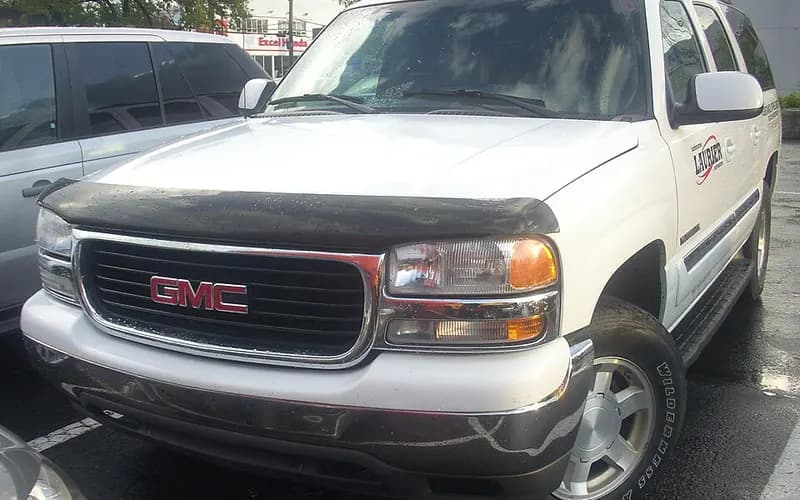
Suspension, wheels and tiresModel years 1999–2006Manufacturer
Vehicle body tilt or lean left / right (torsion bar front suspension)
GMC Yukon Models 1999 - 2006 with torsion bar front suspension (and Escalade, Avalanche, Silverado Classic, Suburban, Tahoe, Sierra Classic, HD models)
FaultCrate・Vehicle body tilt or lean left / right (torsion bar front suspension)
A complaint that the body of a vehicle with torsion bar front suspension leans left or right. GM's PI follows the same steps whether the lean appears at the front, the rear or both ends: generally the vehicle's stance can be adjusted with the torsion bar adjuster bolts, but in certain cases other changes may be needed.
How to decide
A left-to-right P/R height difference of 1/2 inch (12 mm) or less is within specification; no repair is suggested
Watch out
Before measuring: a level surface, tire pressures per the label, and the weight of a full tank
Parts
If Z height cannot correct it: the rear leaf spring (when both carry the same color code) or shims
Check2
- Quantify the lean by measuring the fender wheel-opening heights front and rear. The front is called P height and the rear R height; each is the distance from the ground to the highest point of the wheel-opening, through the center of the wheel. They are related to, but distinct from, trim height (Z and D height).GM
- The P and R heights are not set at the factory, nor is a specification given for them; still, they are the most direct and repeatable measurement of what a customer would perceive as a leaning condition.GM
Decide2
If the left-to-right difference in P and/or R height is 1/2 inch (12 mm) or less, no repairs are suggested, the vehicle being within specification. If it exceeds 1/2 inch (12 mm), follow one of the three diagnostics, depending on which height is off.GM
- The correction may be one of several repairs described in the diagnostic tips. For vehicles repaired under warranty, use the warranty labor operation that fits the actual cause and repair.GM
Steps24Diagnostic Tips: Vehicle Body Tilt or Lean
Before measuring
- 1Put the vehicle on a level surface, such as an alignment rack, and remove the rack's floating pins.
- 2Set the tire pressures to the pressure on the certification label (Label - Vehicle Certification). Check the fuel level and add weight if necessary to simulate a full tank.
- 3Empty the rear storage compartment for proper weight distribution, and close the doors and hood.
Measure and sort
- 4Measure P and R height on both sides the same way (from the ground to the highest point of the wheel-opening, through the center of the wheel).
- 5If the left-to-right difference is 1/2 inch (12 mm) or less, the vehicle is within specification and no repairs are suggested. If it exceeds that, follow one of the three diagnostics below.
Diagnostic 1: both P and R differ by more than 1/2 inch side to side
- 6Check Z height and D height (Trim Height Inspection Procedure).
- 7Z height out of spec and D height delta over 1/2 inch: adjust Z height until it is within spec and the P and R height deltas are under 1/2 inch (12 mm).
- 8Z height within spec but D height delta over 1/2 inch: adjust Z height, staying within its tolerance, to bring the P and R deltas under 1/2 inch.
- 9If this is not possible, check the front eye of the rear leaf springs for matching color-coded tape or paint. Both sides should be the same color: if not, switch the springs side to side; if so, replace the leaf spring on the lower side only. Recheck Z, D, P and R heights.
- 10Z height out of spec but D height delta under 1/2 inch: adjust Z height until it is within spec and the P and R deltas are under 1/2 inch; if this is not possible, shim the front fenders and box as needed.
- 11Z height within spec and D height delta under 1/2 inch: adjust Z height, within tolerance, until the P and R deltas are under 1/2 inch; if this is not possible, shim the body and/or pick-up box until they are.
Diagnostic 2: P within 1/2 inch side to side, R differs by more than 1/2 inch
- 12Check Z height and D height (Trim Height Inspection Procedure).
- 13Z height out of spec and D height delta over 1/2 inch: adjust Z height until it is within spec and the P and R deltas are under 1/2 inch (12 mm).
- 14Z height within spec but D height delta over 1/2 inch: adjust Z height, staying within its tolerance, to bring the P and R deltas under 1/2 inch.
- 15If this is not possible, check the color code at the front eye of the rear leaf springs: if they differ, switch the springs side to side; if they match, replace the lower side's spring only. Recheck Z, D, P and R heights.
- 16Z height within spec and D height delta under 1/2 inch: shim the body and/or pick-up box until the P and R heights are within 1/2 inch (12 mm) side to side.
Diagnostic 3: P differs by more than 1/2 inch side to side, R within 1/2 inch
- 17Check Z height and D height (Trim Height Inspection Procedure).
- 18Z height out of spec and D height delta over 1/2 inch: adjust Z height to spec and recheck P, R and D heights.
- 19Z height within spec and D height delta under 1/2 inch: adjust Z height, staying within tolerance, until both the P and the R delta are under 1/2 inch (12 mm); if this is not possible, add fender shims as necessary to bring the P and R deltas under 1/2 inch.
- 20Z height out of spec and D height delta under 1/2 inch: adjust Z height until it is within spec and the P and R deltas are under 1/2 inch.
- 21If this isn't possible, check D height with Z height in spec; if the D delta is over 1/2 inch (12 mm), check the color code at the front eye of the rear leaf springs: if they differ, switch the springs side to side; if they match, replace the lower side's spring only.
- 22Recheck Z, D, P and R heights.
- 23Z height within spec and D height delta over 1/2 inch: shim the front fenders to get the P height delta under 1/2 inch (12 mm).
Finish
- 24After all adjustments are done, perform a front-end alignment and check headlight aim.
For this procedure only
- The PI asks that the process be followed thoroughly, step by step, but says that if the condition is resolved before every step is completed, the remaining steps need not be performed.GM
GM's PI (Preliminary Information) PIT3098G (March 2019): the measurement and the three diagnostics, summarized by stage. It covers vehicles with torsion bar front suspension; the PI says the diagnosis might be helpful if the vehicle shows the symptom. The revisions update model years; where characters of G's text are garbled, the same sentence is quoted from F (February 2018). Silverado and Sierra follow the table's "Silverado Classic" and "Sierra Classic" rows (1999-2007). For 2007 and later Suburban and Yukon XL, the table lists only the 2007-2013 HD (Suburban HD, Yukon XL HD); 2014 and non-HD models are not listed. Z and D height are measured per the Trim Height Inspection Procedure the PI refers to. That this vehicle is among the Diagnostic Tips: Vehicle Body Tilt or Lean is from GM.Open PIT3098G
Cautions and risks3
- After torsion bar adjustment, swapping or replacing springs, or shimming, perform a front-end alignment and check headlight aim (the PI's last step).GM
- When moving Z height to even out the P and R heights, stay within the Z height tolerance.GM
- Before replacing a rear leaf spring, check the color code at the front eye of both springs: if they differ, switch them side to side; replace only the lower side's spring, and only when the colors match.GM
What it needs
- Parts
- Rear leaf spring (lower side only; when Z height adjustment cannot bring the P and R deltas within limits and both springs carry the same color code)GM
- Materials
- Shims (where Z height adjustment cannot correct it; depending on the diagnostic, at the front fenders and box, or the body and pick-up box)GM
- Tools
- A level surface such as an alignment rack (for measuring, and for the final front-end alignment)GM
Only what the documents and the pages read state; what is not listed is not thereby not needed.
Applies to
- The bulletin lists GMC Yukon Models 1999 - 2006.
- It applies to vehicles with torsion bar front suspension.
See the evidence (4 documents, 17 passages)
| Document | Publisher | Date |
|---|---|---|
| [1]PIT3098G: Diagnostic Tips: Vehicle Body Tilt or Lean ↗ | ManufacturerGeneral Motors | 2019-03-22 |
| [2]PIT3098G Diagnostic Tips: Vehicle Body Tilt or Lean ↗ | ManufacturerGeneral Motors | — |
| [3]PIT3098F Diagnostic Tips: Vehicle Body Tilt or Lean ↗ | ManufacturerGeneral Motors | — |
| [4]PIT3098E Diagnostic Tips: Vehicle Body Tilt Or Lean ↗ | ManufacturerGeneral Motors | — |
Applies toThe bulletin lists GMC Yukon Models 1999 - 2006.
GMC Yukon Models 1999 - 2006 All All All All— [1] Models
Applies toIt applies to vehicles with torsion bar front suspension.
With Torsion Bar Front Suspension— [1] Models
First signsThe procedure addresses complaints of the vehicle leaning left or right.
This procedure should be followed to diagnose and correct customer complaints of vehicle leaning left or right.— [1] Condition
RepairGenerally the stance can be adjusted with the torsion bar adjuster bolts.
Generally the vehicle's stance can be adjusted with the torsion bar adjuster bolts.— [1] Condition
How to confirmMeasure fender wheel-opening heights, front and rear, to quantify the lean.
Measure fender wheel-opening heights, front and rear, to quantify vehicle lean.— [1] Recommendations
How to confirmMake sure the vehicle is on a level surface such as an alignment rack.
Make sure the vehicle is on a level surface, such as an alignment rack.— [1] Recommendations
How to confirmThe front wheel-opening height is known as P height, and the rear wheel-opening height is known as R height.
The front wheel-opening height is known as P height, and the rear wheel-opening height is known as R height.— [2]
How to confirmP height and R height are the distance from the ground to the highest point on the wheel-opening, going through the center of the wheel.
They are the distance from the ground to the highest point on their respective wheel-opening, going through the center of their respective wheel.— [2]
How to confirmBefore measuring, check the fuel level and add weight if necessary to simulate a full tank.
Check the fuel level. Add additional weight if necessary to simulate a full tank.— [2]
How to confirmCheck Z height and D height; see Trim Height Inspection Procedure.
Check Z height and D height. See Trim Height Inspection Procedure.— [2]
How to confirmBefore measuring, set the tire pressures to the pressure shown on the certification label.
Set the tire pressures to the pressure shown on the certification label.— [3]
How to confirmIf the left-to-right difference in P and/or R height is 1/2 inch (12 mm) or less, the vehicle is within specification and no repair is suggested.
If the difference left to right, P and or R height is 1/2 inch (12 mm) or less no repairs are suggested as the vehicle is within specification.— [3]
RepairIf Z height is out of spec and the D height delta is greater than 1/2 inch (12 mm), adjust Z height until it is within spec and the P and R height deltas are less than 1/2 inch (12 mm).
If Z height is out of spec and D height delta is greater than 1/2 inch (12 mm), adjust Z height until it is within spec and P and R height deltas are less than 1/2 inch (12 mm).— [2]
RepairWhen Z height is within spec but the D height delta is greater than 1/2 inch (12 mm), adjust Z height within its tolerance to bring the P and R height deltas under 1/2 inch (12 mm). If this is not possible, check the front eye of the rear leaf spring for matching color-coded tape or paint; both sides should be the same color. If not, switch springs side to side; if so, replace the leaf spring on the lower side only.
1.3. If Z height is within spec but D height delta is greater than 1/2 inch (12 mm), adjust Z height to reduce P and R height deltas to less than 1/2 inch (12mm), staying within the Z height tolerance. If this is not possible, check front eye of rear leaf spring for matching color-coded tape or paint. Both sides should be the same color. If not, switch springs side to side. If so, replace leaf spring on lower side only.— [2]
RepairIf this is not possible, shim the body and/or pick-up box until the P and R height deltas are less than 1/2 inch (12 mm).
If this is not possible, shim body and/or pick-up box until P and R height deltas less than 1/2 inch (12 mm).— [2]
RepairAfter all adjustments are done, perform a front-end alignment and check headlight aim.
After all adjustments are done, perform a front-end alignment and check headlight aim.— [2]
CautionThe P and R heights are not set at the factory, and no specification is given for them.
The P and R heights are not set at the factory, nor is a specification given for them.— [4]
Put together by FaultCrate from public records and technical documents. The cause and the repair are for the workshop to decide with the vehicle in front of it. Counts are records, not failure rates.
List the records (1 that can be opened)
Records whose recall number, document number or text matches. Each line says why it matched.
- Vehicle Lean Preliminary InformationManufacturer communication 2017-08-15・text contains "vehicle lean"