
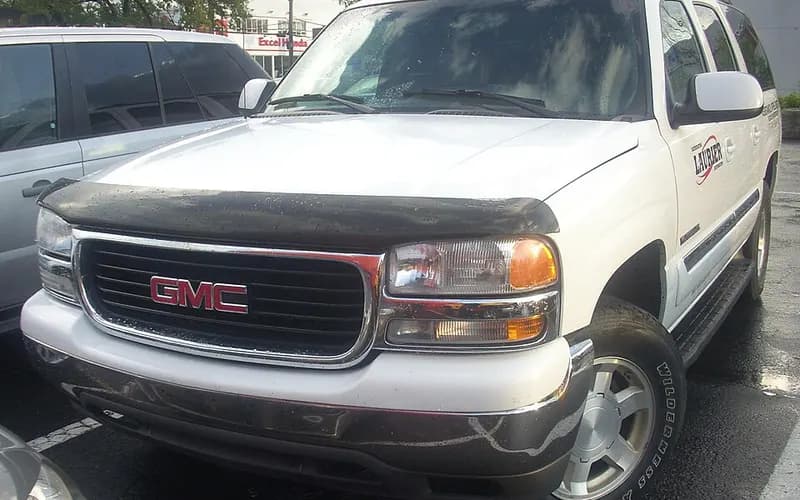
GMC Yukon XL 2000–2006
Common on this vehicle:Vibration or shudderNoiseCorrosion or rustTyre failure (blowout, tread separation)Warning lightLeakShifting faultGauge or instrument fault
Record by record
29 records state a cause or a remedy. Each record is shown as short labels in the order fault → finding the cause → correction. Press a label to narrow to the records that state it.
Symptom
Component named as the cause
How it is said to have ended
- result not stated3
A ribbon is as wide as the records that state both of its ends (only the commonest are drawn). A record that names several symptoms or components runs through each. Orange is records that say the fault came back or was not fixed. Results come from owners’ reports only; one that does not say is “result not stated”. None of this is a likelihood of a cause or a rate at which work succeeds.
Read the records one by one (12)
TIRES4
Owner complaint2002 GMC YUKON XL ・ 2009-07-20
Tire burst and separation with multiple cracks while driving
1Fault
2Finding the cause
3Correction
Read the sentences of the record
- Fault
- WAS DRIVING APPROX 60MPH (= 96.6 km/h) ON NEWLY PAVED 4 LANE HIGHWAY (US 31). (3 more)
- Remedy
- TO AVOID HAVING ANOTHER BLOWOUT/SEPARATION, QUICKLY REPLACED THAT TIRE AND RETURNED BOTH TO THE DEALER WHERE PURCHASED.
- Consequence
- DESTROYED THE WHEEL WELL COVERING.
Manufacturer communication2006 GMC YUKON XL 2500 ・ 2023-12-04(4 earlier editions of this document folded here)
Proper Wheel Installation and Wheel Torque Techniques
1Fault
- Vibration is felt in the steering wheel or the seat, centered at a frequency of 10-14 Hz, between 93-115 km/h (58-72 mph).
2Finding the cause
Possible causes
- Inappropriate wheel torque methods may leave the wheel and tire assembly offset when mounted, so that its mass orbits the axis of the hub and vibrates like a tire with high RFV or an imbalance.
- Improper torque may distort the brake rotor and cause variance in wheel mounting that can produce smooth road shake.
3Correction
Repair
- Remove the tire and wheel assemblies, index them at least two stud positions from the previous position, and re-install them.
- With the wheel off the ground, install all lug nuts hand tight using only a socket.
- Snug all lug nuts in a star or criss-cross pattern with a hand wrench.
- Lower the vehicle until there is just enough contact to provide resistance, then complete torquing to specification with a torque wrench.
Caution
- First order tire/wheel vibration may be misdiagnosed as tire/wheel assembly imbalance or excessive tire radial force variation.
- Do not use torque sticks or an impact driver to tighten wheel lug nuts.
Read the sentences of the record
From the manufacturer’s document
- Applies to:Applies to 2006-2015 GM passenger cars and light duty trucks.
- Condition:Vibration is felt in the steering wheel or the seat, centered at a frequency of 10-14 Hz, between 93-115 km/h (58-72 mph).
- Caution:First order tire/wheel vibration may be misdiagnosed as tire/wheel assembly imbalance or excessive tire radial force variation.
- Cause:Inappropriate wheel torque methods may leave the wheel and tire assembly offset when mounted, so that its mass orbits the axis of the hub and vibrates like a tire with high RFV or an imbalance.
- Cause:Improper torque may distort the brake rotor and cause variance in wheel mounting that can produce smooth road shake.
- Repair:Remove the tire and wheel assemblies, index them at least two stud positions from the previous position, and re-install them.
- Caution:Do not use torque sticks or an impact driver to tighten wheel lug nuts.
- Repair:With the wheel off the ground, install all lug nuts hand tight using only a socket.
- Repair:Snug all lug nuts in a star or criss-cross pattern with a hand wrench.
- Repair:Lower the vehicle until there is just enough contact to provide resistance, then complete torquing to specification with a torque wrench.
Open the manufacturer’s document (PDF) ↗ The points above were read from this document.
- Remedy
- Proper Wheel Installation and Wheel Torque Techniques
Manufacturer communication2006 GMC YUKON XL ・ 2022-01-03(1 earlier editions of this document folded here)
GM Original Equipment Tires: Vibration and Other Issues
1Fault
- Under certain circumstances a slight tire shake may be noticed within the first few miles/kilometers of operation.
- Until the tires warm up a slight shake may be felt, but it should subside quickly.
2Finding the cause
Possible causes
- When parked overnight or for a period of time, the tires may set (flat spot) and need a few miles/kilometers to reach normal operating temperature.
- Tires may be designed with a nylon overlay configuration to enhance integrity at high speeds.
Steps to confirm (in the document’s order)
- Before measuring tires on force variation equipment, drive the vehicle a minimum of 24 km (15 mi) to remove any flat spotting.
3Correction
Caution
- Do not attempt repairs or replace components for this temporary flat spotting condition.
Read the sentences of the record
From the manufacturer’s document
- Applies to:Applies to 2022 and prior GM passenger cars and light duty trucks.
- Condition:Under certain circumstances a slight tire shake may be noticed within the first few miles/kilometers of operation.
- Cause:When parked overnight or for a period of time, the tires may set (flat spot) and need a few miles/kilometers to reach normal operating temperature.
- Cause:Tires may be designed with a nylon overlay configuration to enhance integrity at high speeds.
- Condition:Until the tires warm up a slight shake may be felt, but it should subside quickly.
- Confirm:Before measuring tires on force variation equipment, drive the vehicle a minimum of 24 km (15 mi) to remove any flat spotting.
- Caution:Do not attempt repairs or replace components for this temporary flat spotting condition.
Open the manufacturer’s document (PDF) ↗ The points above were read from this document.
- Remedy
- This service bulletin provides information for dealers/technicians on Tire/Wheel Characteristics (Vibration, Balance, Shake, Flat Spotting) of GM Original Equipment Tires.
Owner complaint2003 GMC YUKON XL ・ 2004-07-13
Tire tread belt separation while driving 70 mph on interstate
1Fault
2Finding the cause
3Correction
Read the sentences of the record
- Fault
- WHILE DRIVING 70 MPH (= 112.7 km/h) ON THE INTERSTATE, DRIVER FELT A VIBRATION WITH 2003 YUKON XL. (1 more)
- Remedy
- SPARE TIRE WAS PUT ON AND VEHICLE WAS DRIVEN TO A LOCAL TIRE STORE TO HAVE ALL TIRES REPLACED. (1 more)
- Inspection
- THE DRIVER TOOK TIRES TO DEALERSHIP WERE VEHICLE WAS PURCHASED AND AFTER INSECTING THE TIRE THEY FOUND NO NAILS OR ANY OTHER REASON,(DRIVER'S FAULT THAT IS), AS TO WHY TIRE CAME APART WHILE DRIVING.
POWER TRAIN2
Manufacturer communication2000–2006 GMC YUKON XL ・ 2008-04-07
Eaton Locking Differential Chatter Shudder Noise on Turns (RPO G80)
1Fault
2Finding the cause
3Correction
Read the sentences of the record
- Remedy
- EATON LOCKING DIFFERENTIAL CHATTER SHUDDER NOISE ON TURNS, EQUIPPED WITH A LOCKING REAR DIFFERENTIAL RPO G80. *NJ UPDATED 7/17/2008. *PE
Manufacturer communication2000–2005 GMC YUKON XL DENALI ・ 2004-11-03
NVG149 NP3 Transfer Case Bind or Shudder on Turns
1Fault
2Finding the cause
3Correction
NVG149 NP3 TRANSFER CASE MAY EXHIBIT A BIND OR SHUDDER ON TURNS. *TC
Read the sentences of the record
- Remedy
- NVG149 NP3 TRANSFER CASE MAY EXHIBIT A BIND OR SHUDDER ON TURNS. *TC
WHEELS2
Manufacturer communication2006 GMC YUKON XL 2500 ・ 2024-05-01(5 earlier editions of this document folded here)
Tire Radial Force Variation (RFV) Service Bulletin
1Fault
- The most common ride concern involving tire radial force variation is shake on smooth roads at highway speed, 105-115 km/h (65-70 mph).
2Finding the cause
Possible causes
- Tire related smooth road highway speed shake can be caused by three conditions: imbalance, out of round and tire force variation.
Steps to confirm (in the document’s order)
- With the vehicle raised, center the wheels on the hub by loosening all wheel nuts and hand-tightening them while shaking the wheel, then torque to specification with a torque wrench, not a torque stick.
- If light brake application increases the pulsation felt in the steering wheel, go to the brake-induced pulsation diagnosis in the Brakes section of the service manual.
- A reading of 35 to 50 Hz typically indicates a first order propshaft vibration.
- Generally a reading between 10 and 20 Hz indicates a tire/wheel vibration.
- If vibration continues after 10 minutes of driving above 72 km/h (45 mph), temporary tire flat-spotting can be ruled out.
3Correction
Repair
- If the radial runout of a tire/wheel assembly is more than 0.040 in (1.02 mm), match mount the tire to the wheel to get below 0.040 in (1.02 mm).
Caution
- On the balancer always center the wheel by the pilot bore; never use the hub-cap bore, since it is not a precision machined surface.
Read the sentences of the record
From the manufacturer’s document
- Applies to:Applies to 2024 and prior GM passenger cars and light duty trucks.
- Condition:The most common ride concern involving tire radial force variation is shake on smooth roads at highway speed, 105-115 km/h (65-70 mph).
- Cause:Tire related smooth road highway speed shake can be caused by three conditions: imbalance, out of round and tire force variation.
- Confirm:With the vehicle raised, center the wheels on the hub by loosening all wheel nuts and hand-tightening them while shaking the wheel, then torque to specification with a torque wrench, not a torque stick.
- Confirm:If light brake application increases the pulsation felt in the steering wheel, go to the brake-induced pulsation diagnosis in the Brakes section of the service manual.
- Confirm:A reading of 35 to 50 Hz typically indicates a first order propshaft vibration.
- Confirm:Generally a reading between 10 and 20 Hz indicates a tire/wheel vibration.
- Confirm:If vibration continues after 10 minutes of driving above 72 km/h (45 mph), temporary tire flat-spotting can be ruled out.
- Caution:On the balancer always center the wheel by the pilot bore; never use the hub-cap bore, since it is not a precision machined surface.
- Confirm:Assembly radial force variation guide: P-Metric tires on light trucks, 24 lbs (11 kg) or less.
- Confirm:Assembly radial force variation guide: LT-tires on light trucks, 35 lbs (16 kg) or less.
- Repair:If the radial runout of a tire/wheel assembly is more than 0.040 in (1.02 mm), match mount the tire to the wheel to get below 0.040 in (1.02 mm).
Open the manufacturer’s document (PDF) ↗ The points above were read from this document.
- Remedy
- This service bulletin provides information for dealers/technicians on Tire Radial Force Variation (RFV).
Manufacturer communication2006 GMC YUKON XL 2500 ・ 2023-06-05(6 earlier editions of this document folded here)
Vibration After Tire Mounting / Wheel Slip Prevention
1Fault
2Finding the cause
Possible causes
- Vibration shortly after tires are mounted may be caused by the tires slipping on the wheels, which moves the imbalance point of the tire away from the weight location.
- Wheel slip is most common on clear coated or chrome wheels with very smooth bead seat areas, but may also occur on other alloy or steel wheels.
- One reason is an excessive amount of lubricant, or lubricant applied in the wrong locations.
Steps to confirm (in the document’s order)
- Put a temporary mark on the tire at the valve stem and drive: slip of less than one inch is probably not contributing; slip greater than one inch with a ride disturbance felt may be causing the vibration.
3Correction
Repair
- On the wheel, lubricate the safety humps, leave the rim flanges dry and lubricate the drop center area only for difficult to mount tires.
- Complete the mounting within 10 minutes of applying the mounting lubricant.
- Inflate the tires to 275 kPa (40 psi) when mounting, then reduce to the desired operating pressure.
- After rebalancing and fitting, park the vehicle for one hour to let the lubricant evaporate.
Caution
- This test is only effective if the vehicle was serviced within the last couple of hours.
- Do not use products containing silicone, alcohol, petroleum based products, solvents or corrosives for cleaning or lubrication.
- The vehicle should not be driven aggressively (hard acceleration or braking) for up to 24 hours after tire mounting, so the lubricant can dry.
Read the sentences of the record
From the manufacturer’s document
- Applies to:Applies to 2024 and prior GM passenger cars and trucks.
- Cause:Vibration shortly after tires are mounted may be caused by the tires slipping on the wheels, which moves the imbalance point of the tire away from the weight location.
- Cause:Wheel slip is most common on clear coated or chrome wheels with very smooth bead seat areas, but may also occur on other alloy or steel wheels.
- Cause:One reason is an excessive amount of lubricant, or lubricant applied in the wrong locations.
- Confirm:Put a temporary mark on the tire at the valve stem and drive: slip of less than one inch is probably not contributing; slip greater than one inch with a ride disturbance felt may be causing the vibration.
- Caution:This test is only effective if the vehicle was serviced within the last couple of hours.
- Caution:Do not use products containing silicone, alcohol, petroleum based products, solvents or corrosives for cleaning or lubrication.
- Repair:On the wheel, lubricate the safety humps, leave the rim flanges dry and lubricate the drop center area only for difficult to mount tires.
- Repair:Complete the mounting within 10 minutes of applying the mounting lubricant.
- Repair:Inflate the tires to 275 kPa (40 psi) when mounting, then reduce to the desired operating pressure.
- Repair:After rebalancing and fitting, park the vehicle for one hour to let the lubricant evaporate.
- Caution:The vehicle should not be driven aggressively (hard acceleration or braking) for up to 24 hours after tire mounting, so the lubricant can dry.
Open the manufacturer’s document (PDF) ↗ The points above were read from this document.
- Remedy
- This service bulletin provides information for dealers/technicians on Vibration Shortly After Tires are Mounted/Preventing Vibration from Wheel Slip (Tire Sliding on Wheel).
ENGINE AND ENGINE COOLING1
Manufacturer communication2004–2006 GMC YUKON XL 2500 ・ 2023-11-22(1 earlier editions of this document folded here)
Vibration Analysis Worksheet Service Bulletin
1Fault
2Finding the cause
Steps to confirm (in the document’s order)
- When diagnosing vibration, use the worksheet together with the Vibration Analysis - Road Testing procedure in the service information.
- Place the sensor where the vibration is felt: on the seat track for a seat complaint, on the steering column for a steering wheel complaint.
- Moving the sensor to other areas, look for the same Hz reading with the greatest amplitude.
- If a system balance was attempted and the vibration remains, check ring gear backlash at each tooth; readings should not vary more than 0.050 mm (0.002 in).
- Aluminum wheel/tire runout measured on the vehicle: maximum 0.030 in (.762 mm).
3Correction
Read the sentences of the record
From the manufacturer’s document
- Applies to:Applies to 2024 and prior GM passenger cars and trucks.
- Confirm:When diagnosing vibration, use the worksheet together with the Vibration Analysis - Road Testing procedure in the service information.
- Confirm:Place the sensor where the vibration is felt: on the seat track for a seat complaint, on the steering column for a steering wheel complaint.
- Confirm:Moving the sensor to other areas, look for the same Hz reading with the greatest amplitude.
- Confirm:If a system balance was attempted and the vibration remains, check ring gear backlash at each tooth; readings should not vary more than 0.050 mm (0.002 in).
- Confirm:Aluminum wheel/tire runout measured on the vehicle: maximum 0.030 in (.762 mm).
- Confirm:Hub mounting surface runout: maximum 0.005 in (0.132 mm).
- Confirm:Wheel stud runout: maximum 0.010 in (0.254 mm).
Open the manufacturer’s document (PDF) ↗ The points above were read from this document.
- Remedy
- This service bulletin provides a vibration analysis worksheet the technician can use in conjunction with the appropriate Vibration Analysis-Road testing procedure when diagnosing vibration concerns.
SERVICE BRAKES, HYDRAULIC1
Owner complaint2002 GMC YUKON XL 1500 ・ 2009-08-11
Left front wheel nearly fell off after toll booth exit
1Fault
2Finding the cause
3Correction
Read the sentences of the record
- Fault
- THE LEFT FRONT WHEEL NEARLY FELL OFF OUR 2002 YUKON 1500 SLT. (9 more)
- Remedy
- MY HUSBAND STOPPED REPEATEDLY TO RETIGHTEN THE BOLTS.
- Consequence
- WE NEARLY WENT OFF THE ROAD.
STRUCTURE1
Manufacturer communication2000–2006 GMC YUKON XL ・ 2017-08-15
Preliminary Information - Vibration Diagnosis Using Pico Oscilloscope
1Fault
- Customer vibration complaints are among the most challenging to diagnose and repair accurately.
2Finding the cause
Steps to confirm (in the document’s order)
- Drive the vehicle to verify the condition and record a Pico data file of the concern.
- Review the Pico file and use it to help determine the root cause or component.
3Correction
Repair
- Repair the vehicle using the Pico information together with any published information relevant to the vibration frequency observed.
Caution
- Without knowing the vibration frequency, repair attempts are just spinning wheels.
- Component level vibrations such as blower motor, brake pulsation or shudder on turns do not require a Pico file; the requirement is for vehicle level vibration complaints.
Read the sentences of the record
From the manufacturer’s document
- Applies to:Applies to all 2000 and newer GM vehicles.
- Condition:Customer vibration complaints are among the most challenging to diagnose and repair accurately.
- Caution:Without knowing the vibration frequency, repair attempts are just spinning wheels.
- Confirm:Drive the vehicle to verify the condition and record a Pico data file of the concern.
- Confirm:Review the Pico file and use it to help determine the root cause or component.
- Repair:Repair the vehicle using the Pico information together with any published information relevant to the vibration frequency observed.
- Caution:Component level vibrations such as blower motor, brake pulsation or shudder on turns do not require a Pico file; the requirement is for vehicle level vibration complaints.
Open the manufacturer’s document (PDF) ↗ The points above were read from this document.
- Remedy
- This Preliminary Information communication provides information to the technician about vibration complaints that are one of the most challenging complaints to accurately diagnose and repair. Technician will need to use Pico Oscilloscope Diagnostic Kit to effectively diagnosis vehicles. Technician should drive the vehicle will using the Pico Oscilloscope to record data. After the data is recorded it should be reviewed to determine the root cause of the concern. If a repair attempt made the concern better but not eliminated or had no affect at all, and are requesting assistance from General Motors Technical Assistance Center record another Pico file and save it to the computer. After the new Pico Oscilloscope data has been saved email the data to General Motors Technical Assistance Center in the subject line include ?Vibration? ?Business Associate Code? and the last 8 of the Vehicle Identification Number.
SUSPENSION1
Manufacturer communication2002–2006 GMC YUKON XL ・ 2003-04-09
Tire Bead Splits and Wheel Vibration Service Communication
1Fault
2Finding the cause
3Correction
Read the sentences of the record
- Remedy
- TIRE SLOWLY GOES FLAT AND/OR EXCESSIVE WHEEL VIBRATION CAUSED BY BEAD SPLITS (REPLACE WHEELS WITH NEW HEAVY DUTY RIM VERSION) *TT *AR UPDATED 4/11/08. *NJ
Showing 12 of the 29 you can open. Narrow the search to see the rest.
1 owner complaints have no classified sentences yet, so their causes and repairs are not picked out. Their text is in the list of records.