
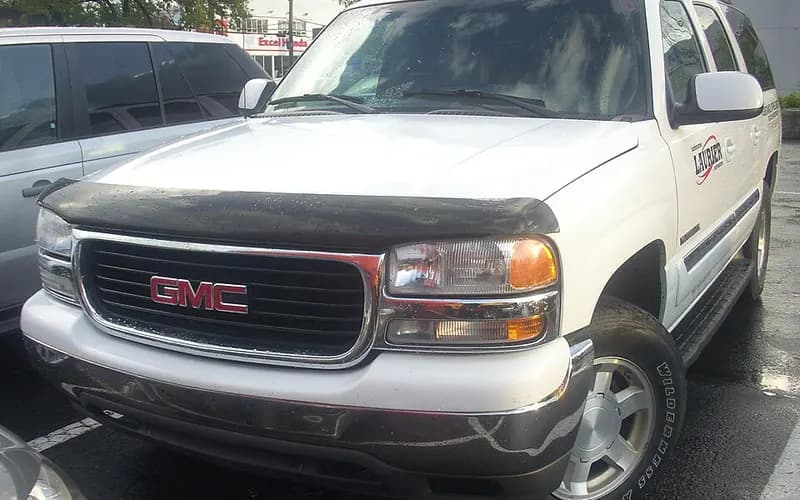
Heating and air conditioningModel years 2003–2006ManufacturerGovernment
HVAC blower motor resistor module / connector overheating
2003-2006 GMC Yukon, Yukon XL (and Avalanche, Suburban, Tahoe; 2003-2007 Silverado, Sierra) with manual HVAC (RPO CJ3) or heavy duty heater (C42). GM Special Coverage 10240A; Transport Canada recall 2011074.
FaultCrate・HVAC blower motor resistor module / connector overheating
The terminal interface between the relay resistor module and the connector that powers it may be unable to carry the higher current of sustained blower operation, and moisture and other contaminants (such as road de-icing materials) entering the fresh air intake plenum may reach the module's circuit or corrode the terminals. The module or the connector could then overheat, and the blower may not work on certain settings or at all, possibly with a burning smell or smoke; Transport Canada says these warning signs could, in certain instances, be leading indicators of an impending vehicle fire.
How to decide
If any symptom is present, replace both connector and resistor (even a connector replaced before)
Watch out
Duraseal splice sleeves only (others may not keep out moisture or give a good electrical connection)
Labor time
GM warranty labor time 0.6 (T5817, replace HVAC module connector and resistor)
Parts
Connector 15862656 and resistor 89019088 / 89019089
Check4
- Determine whether one or more of these symptoms is present: the blower may not work on certain or all speed settings; a burning plastic smell or smoke may be present in the vehicle; the blower may run continually with the ignition OFF. If required, refer to the HVAC diagnostic information in SI.NHTSA
- In a 2CarPros question on a 2006 Silverado (the black wire gets hot and melts), the responder says the black wire is the ground and tells the asker to check the connector for a corroded, damaged or pushed-in pin, whether the wire was earlier replaced with a lighter gauge, and ground G200 near the A-pillar.2006 Chevrolet Silverado (4.3L V6, 2WD)・2CarPros
- The asker on 2CarPros with a 2003 Tahoe writes that the blower would not turn off or change speed and that the battery went dead unless the 40 amp fuse under the hood was pulled, and later that there was no separate relay: relay and resistors were one unit under the dash.2003 Chevrolet Tahoe (V8, 4WD)・2CarPros
- When testing for individual circuit faults, include terminal inspections, such as the connection surfaces and the terminal tension, at both the harness and the component or module.GM TechLink 2007-11, general guidance (an article that names no model)
Decide1
If one or more of the symptoms is present, replace both the resistor module connector and the blower motor resistor. The connector is replaced even if it was replaced in an earlier repair (GM's procedure).NHTSA
Steps8Resistor Module Connector and Blower Motor Resistor Replacement
Prepare
- 1Remove the blower fuses (Htr A/C and HVAC 1), and lower the close-out panel enough to reach the resistor module connector.
Remove
- 2Disconnect the connector from the resistor module. The connector is replaced even if it was replaced in an earlier repair.
- 3Remove the tape from the harness to expose the wiring, and cut the wires back far enough from the connector to eliminate any melted insulation.
Install
- 4Use the old connector as a map for splicing the wires to the new connector.
- 5Crimp with the correct tool from terminal repair kit J 38125, and use only Duraseal splice sleeves.
- 6Splice sleeves other than Duraseal may not protect the splice from moisture or provide a good electrical connection.
- 7Install the new connector, using the yellow splice sleeves provided with it, then install the new blower motor resistor.
Check and reassemble
- 8Reinstall the fuses and test that the blower motor works on all speeds. Reinstall the hush panel / close-out panel.
The replacement procedure (Resistor Module Connector and Blower Motor Resistor Replacement) of GM's Special Coverage 10240A (January 2012), summarized by stage of the work. The bulletin covers 2003-2006 Avalanche, Suburban, Tahoe, Yukon and Yukon XL and 2003-2007 Silverado and Sierra equipped with manual HVAC (CJ3) or a heavy duty heater (C42); model years 2000-2002 are not included. GM refers to this procedure when one or more of the bulletin's symptoms is present. The document covers model years from 2003. That this vehicle is among the Resistor Module Connector and Blower Motor Resistor Replacement is from NHTSA.Open Bulletin 10240A
Cautions and risks8
- Use only Duraseal splice sleeves, and crimp with the correct tool from terminal repair kit J 38125: other sleeves may not protect the splice from moisture or provide a good electrical connection.NHTSA
- Inside the DuraSeal crimp and seal splice, the metal tube is knurled, giving a low-resistance junction with the wires when the splice is properly crimped (the crimper jaws in the Terminal Repair Kit are color-coded).GM TechLink 2004-06, general guidance (an article that names no model)
- After crimping the DuraSeal splice, heat it with the Ultratorch and heat deflector until it shrinks and adhesive bubbles out the end.GM TechLink 2004-06, general guidance (an article that names no model)
- When heated, the nylon shrinks and the adhesive melts, sealing tightly against the wire insulator and providing strain relief.GM TechLink 2004-06, general guidance (an article that names no model)
From the field
- A blower motor taking too much current is named by a 2CarPros responder (2006 Silverado, a black wire that heats up and melts) as one possible cause alongside a bad connection.2006 Chevrolet Silverado (4.3L V6, 2WD)・2CarPros
- A Car Talk replier (2005 Sierra, no air from the vents) names a blower motor taking too much current as what in some cases melts the connectors at the motor or at the resistor.2006 Chevrolet Silverado (4.3L V6, 2WD)・2CarPros
- In a Car Talk thread on a 2003 Tahoe (blower runs only on setting 5), repliers write that a motor that turns stiffly often burns out the resistor.2006 Chevrolet Silverado (4.3L V6, 2WD)・2CarPros
- The asker on 2CarPros with a 2004 Silverado (manual A/C) writes that after replacing the melted resistor together with its connector the blower ran only on setting 5 and the resistor and wires became extremely hot; the responder answers that a motor drawing too much current is possible but not very common.2004 Chevrolet Silverado (5.3L V8, 4WD)・2CarPros
What it needs
- Parts
- Resistor module connector 15862656 (Connector, SW-Pwr St Adjr); quantity 1 in the parts table.NHTSA
- Blower motor resistor: the parts table lists 89019088 (Resistor, Blo Mot (A/C & Htr)) and 89019089 (Resistor, Blo Mot (Heater Only)), quantity 1 each.NHTSA
- Materials
- Splice sleeves: the yellow ones provided with the connector; no splice sleeves other than Duraseal.NHTSA
- DuraSeal crimp and seal splices come in three sizes, each for a specific wire gauge: pink 12089189 (18–20 gauge), blue 12089190 (14–16 gauge), yellow 12089191 (10–12 gauge). They are in tray 1 of the J-38125 Terminal Repair Kit.GM TechLink 2004-06, general guidance (an article that names no model)
- Tools
- The correct crimping tool from terminal repair kit J 38125.NHTSA
- The Ultratorch with heat deflector (to heat the DuraSeal splice until it shrinks and adhesive bubbles out the end).GM TechLink 2004-06, general guidance (an article that names no model)
- Time
- GM warranty labor time: 0.6 (T5817, "Replace HVAC Module Connector and Resistor").NHTSA
- Cost seen
- GM's Special Coverage 10240A (January 2012) made this repair free of charge for 10 years or 150,000 miles (240,000 km), whichever occurs first, from the date the vehicle was originally placed in service, regardless of ownership.NHTSA
- FieldFor the price of the part, a 2011 post in the 2CarPros thread on the 2003 Tahoe gives $45 for a resistor and $66 for a module, and a 2023 reply in the Car Talk thread on the 2005 Sierra gives under $30 for the resistor.2003 Chevrolet Tahoe (V8, 4WD)・2CarPros
Part numbers printed in the document
15862656Look up at RockAuto (aftermarket candidates) ↗Search the web ↗
89019088Look up at RockAuto (aftermarket candidates) ↗Search the web ↗
89019089Look up at RockAuto (aftermarket candidates) ↗Search the web ↗
12089189Look up at RockAuto (aftermarket candidates) ↗Search the web ↗
12089190Look up at RockAuto (aftermarket candidates) ↗Search the web ↗
12089191Look up at RockAuto (aftermarket candidates) ↗Search the web ↗
The numbers are as the document prints them. The name and the replacing number are what the pages of GMPartsGiant, a reseller of genuine parts and not GM, state. Aftermarket equivalents are not checked here (the links only search by number). Confirm the fit for the vehicle (VIN) before ordering.
Only what the documents and the pages read state; what is not listed is not thereby not needed.
If left
- The relay resistor module or wiring connector could overheat and the HVAC blower may not function on certain blower settings or may be inoperative.→ loss of blower speeds / blower inoperative
- These warning signs could in some cases be leading indicators of an impending vehicle fire.→ vehicle fire
In the records
- Blower Resistor: replaced 1(result not stated: 1)
- Power Connector: replaced 1(result not stated: 1)
Applies to
- The special coverage applies to 2003-2006 GMC Yukon and Yukon XL (and the other listed trucks) with manual HVAC (CJ3) or heavy duty heater (C42).
- The special coverage covers the condition for 10 years or 150,000 miles (240,000 km), whichever occurs first, from the in-service date, regardless of ownership.
See the evidence (2 documents, 12 passages)
| Document | Publisher | Date |
|---|---|---|
| [1]Bulletin 10240A: Special Coverage Adjustment - HVAC Blower Not Fully Functional or Inoperative ↗ | ManufacturerGeneral Motors | 2012-01-01 |
| [2]Recall 2011074: HVAC blower motor resistor module overheating | GovernmentTransport Canada | 2011-02-21 |
Applies toThe special coverage applies to 2003-2006 GMC Yukon and Yukon XL (and the other listed trucks) with manual HVAC (CJ3) or heavy duty heater (C42).
MODELS: 2003-2006 Chevrolet Avalanche, Suburban Tahoe 2003-2007 Chevrolet Silverado 2003-2006 GMC Yukon, Yukon XL 2003-2007 GMC Sierra Equipped with Manual HVAC (CJ3) or Heavy Duty Heater (C42)— [1] p.1
Why it happensThe terminal interface between the relay resistor module and its power connector may be unable to carry higher current for sustained blower operation.
the interface between the electrical terminals of the relay resistor module and the wiring connector that powers the module may be incapable of conducting higher current levels for sustained periods of blower motor operation.— [1] Condition
Why it happensMoisture and contaminants may enter the fresh air intake plenum and reach the module's circuit or corrode the terminals.
In addition, moisture and other contaminants may enter the fresh air intake plenum and contact the internal circuit of the module or corrode the terminals.— [1] Condition
If leftThe relay resistor module or wiring connector could overheat and the HVAC blower may not function on certain blower settings or may be inoperative.
If any of these were to occur, the relay resistor module or wiring connector could overheat and the HVAC blower may not function on certain blower settings or may be inoperative.— [1] Condition
First signsThis may be accompanied by a burning smell or smoke.
This may be accompanied by a burning smell or smoke.— [1] Condition
First signsThe blower may run continually with the ignition off.
The HVAC blower may run continually with the ignition in the OFF position— [1] Service Procedure
RepairDealers install a new blower motor resistor and resistor module connector.
Dealers are to install a new blower motor resistor and resistor module connector.— [1] p.1
CautionThe connector must be replaced even if it was replaced in an earlier repair.
Connector replacement is required even if the connector was replaced on a previous service repair.— [1] Service Procedure step 3
RepairCut the wires back far enough to remove any melted insulation.
Cut the wires back far enough from the connector to eliminate any melted insulation on the wire.— [1] Service Procedure step 5
Applies toThe special coverage covers the condition for 10 years or 150,000 miles (240,000 km), whichever occurs first, from the in-service date, regardless of ownership.
This special coverage covers the condition described above for a period of 10 years or 150,000 miles (240,000 km), whichever occurs first, from the date the vehicle was originally placed in service, regardless of ownership.— [1] p.1
Why it happensRoad de-icing materials are among the contaminants that may enter the fresh air intake plenum.
moisture and other contaminants (such as road de-icing materials) may enter the fresh air intake plenum— [2]
If leftThese warning signs could in some cases be leading indicators of an impending vehicle fire.
These warning signs could, in certain instances, be leading indicators of an impending vehicle fire, which could result in property damage and/or personal injury.— [2]
Put together by FaultCrate from public records and technical documents. The cause and the repair are for the workshop to decide with the vehicle in front of it. Counts are records, not failure rates.
Records under this issue 5
Owner complaint 3Recall 1Manufacturer communication 1
Look into the records of this issue (5)List the records (5 that can be opened)
Records whose recall number, document number or text matches. Each line says why it matched.
- HVAC Blower Motor Resistor Module OverheatingRecall 2011-02-21・recall number matches
- General Motors HVAC Blower Service CampaignManufacturer communication 2011-06-27・document number matches
- Blower motor resistor failed; no air or heat for 3 yearsOwner complaint 2015-01-17・text contains "BLOWER MOTOR RESISTOR"
- Ventilation system malfunction with blower continuing to run when vehicle is offOwner complaint 2014-07-01・text contains "RESISTOR MODULE"
- Rear air conditioner malfunctionOwner complaint 2011-08-11・tied by reading the record: “THE CONTACT ALSO RECEIVED AN ADJUSTMENT OF SERVICE NOTICE FROM THE MANUFACTURER AND THE AIR CONDITIONER IN THE FRONT WAS REPAIRED, BUT NOT THE REAR. THE DEALER REPLACED THE POWER CONNECTER AND THE RESISTER BLOWER.”