
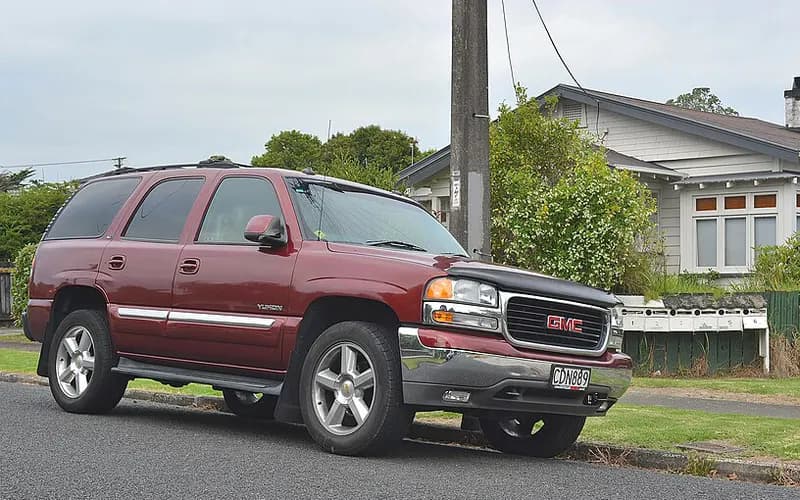
GMC Yukon 2000–2006
Common on this vehicle:Seat belt
Possible causes
The documents say what to doOnly records name itThe size of a node, the width of a link and the numbers are records matching this search, not likelihoods.
FaultCrate・GMC Yukon 2000–2006・2003
Candidate cause (the documents say what to do)
2nd row center seat belt routing (lap belt fit) - recall 05V-163
The 2nd row center seat belt routing may make it difficult to position the lap portion low around the hips, especially for smaller occupants.
The 3-point belt for this seating position was designed and validated for the 2003 model year GMT800 utilities and crew cab pick-ups without a loop on the seat around the lap belt webbing.
What to do
- In NHTSA's summary (from GM's notice), dealers cut open the guide loop, remove a portion of it, and fold over and secure the remaining two sides with a retainer.
- In GM's dealer bulletin, the correction: dealers eliminate the seat loop by removing the safety belt from the loop and stitching the loop closed.
- In GM's dealer bulletin: remove the nut retaining the rear center seat's lower seat belt anchor.
- In GM's dealer bulletin: remove the belt from the seat loop on the front of the seat back cushion.
- In GM's dealer bulletin: route the belt outside the seat loop and install it on the lower anchor stud, making sure the belt is not twisted.
- In GM's dealer bulletin: install the retaining nut to the anchor stud and tighten it to 53 N·m (39 lb ft).
Caution: Appropriate use of a child seat or booster seat, as recommended for small children, improves the fit for that group.
What is needed
- Parts and materials
- Retainer (to secure the folded remainder of the guide loop; the remedy in NHTSA's summary)
- Upholstery thread and needle (size 16 recommended; the procedure in GM's dealer bulletin)
- Labor time
- Not stated
- Special tools
- Not stated
- Scan tool
- Not stated
Only what the technical documents state. "Not stated" does not mean not needed.
In the records
- Guide Loop: repaired 1
See the evidence (2 technical documents, 1 records)
Passages of the technical documents
The 2nd row center seat belt routing may make it difficult to position the lap portion low around the hips, especially for smaller occupants.
ON CERTAIN CREW CAB PICKUP TRUCKS AND SPORT UTILITY VEHICLES, THE 2ND ROW CENTER OCCUPANT SEAT BELT ROUTING MAY MAKE IT DIFFICULT TO POSITION THE LAP PORTION OF THE SAFETY BELT LOW AROUND THE HIPS OF OCCUPANTS, ESPECIALLY SMALLER OCCUPANTS, SEATED IN THIS POSITION.
NHTSA 2005-04-22
Appropriate use of a child seat or booster seat, as recommended for small children, improves the fit for that group.
APPROPRIATE USE OF A CHILD SEAT OR BOOSTER SEAT, AS RECOMMENDED FOR SMALL CHILDREN, DOES IMPROVE THE FIT CONDITION FOR THIS USER GROUP.
NHTSA 2005-04-22
A lap belt that is not low and snug on the hips can ride up on the abdomen and expose the occupant to more risk of abdominal and internal organ injury.
A LAP PORTION OF THE SEAT BELT ROUTING THAT IS NOT LOW AND SNUG ON THE HIPS CAN ALLOW THE LAP BELT TO RIDE UP ON AN OCCUPANT'S ABDOMEN INSTEAD OF FITTING LOW AROUND THEIR HIPBONES, AND THEREFORE, CAN EXPOSE THEM TO MORE RISK OF ABDOMINAL AND INTERNAL ORGAN INJURY.
NHTSA 2005-04-22
In NHTSA's summary (from GM's notice), dealers cut open the guide loop, remove a portion of it, and fold over and secure the remaining two sides with a retainer.
DEALERS WILL CUT OPEN THE GUIDE LOOP, REMOVE A PORTION OF THE LOOP, AND THEN THE REMAINING TWO SIDES SHOULD BE FOLDED OVER AND SECURED WITH A RETAINER FREE OF CHARGE.
NHTSA 2005-04-22
Manufacturer’s documents
A cause or a result a complaint states is the owner’s view or what a dealer told them, not an established fact.
Put together by FaultCrate from public records and technical documents. The cause and the repair are for the workshop to decide with the vehicle in front of it. Counts are records, not failure rates.