
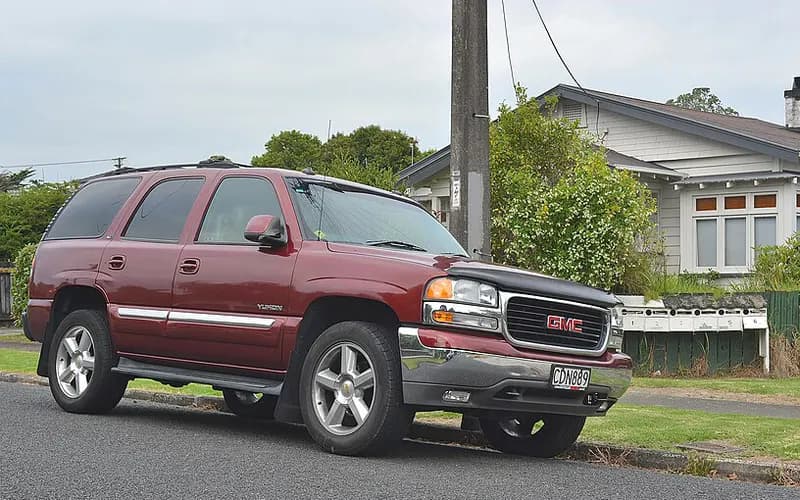
Airbags and seat beltsModel years 2003–2005ManufacturerGovernment
2nd row center seat belt routing (lap belt fit) - recall 05V-163
Certain crew cab pickup trucks and sport utility vehicles; the NHTSA record lists GMC Yukon 2003-2005. Model years come from the NHTSA record's product list held in the database, not from the recall text. The remedy differs by document: GM's notice (NHTSA's summary) cuts the loop open and secures it with a retainer; the dealer bulletin takes the belt out of the loop and stitches the loop closed. GM's notice and the dealer bulletin also name the Yukon XL (2003-2005).
FaultCrate・2nd row center seat belt routing (lap belt fit) - recall 05V-163
The seat loop in the second row center seating position may make it difficult to position the lap belt low around the hips, especially for smaller occupants. A lap belt that is not low and snug on the hips can ride up on the abdomen, may not properly restrain the occupant in an accident, and can expose them to more risk of abdominal and internal organ injury (GM's recall bulletin; NHTSA's summary).
How to decide
Take the belt out of the loop and stitch the loop closed (bulletin 05037)
Watch out
Install the belt untwisted and tighten the nut to 53 N·m
Parts
Upholstery thread of matched color and needle (size 16 recommended), obtained locally
Check4
- Involved are certain 2003-2005 Escalade, Escalade ESV, Escalade EXT, Avalanche, Silverado Crew Cab, Suburban, Tahoe, Sierra Crew Cab, Yukon and Yukon XL, and 2004-2005 H2.recall documents
- Of these, those built within the listed VIN breakpoints are involved. Not all vehicles within the breakpoints may be involved, so confirm through GMVIS before the work.recall documents
- The place to look is the seat loop on the front of the second row center seat back cushion, through which the lap belt runs.recall documents
- Background (GM's defect notice): when the 2nd row center seat got a 3-point belt for the 2003 model year, it was designed and validated without a loop on the seat surrounding the lap belt webbing; in December 2002, once regular production 2003 vehicles were available, the addition of the seat loop was noticed.recall documents
Decide4
GM's recall bulletin 05037 of July 2005 (the dealer procedure): eliminate the seat loop by removing the safety belt from the loop and stitching the loop closed. The steps are those of this bulletin.recall documents
- GM's defect notice of April 22, 2005 (and NHTSA's summary): cut open the guide loop, remove a portion of it, and fold over the remaining two sides and secure them with a retainer.recall documents / NHTSA
- GM's advance message to dealers of April 25, 2005: dealers will adjust the seat belt routing by modifying the guide loop.recall documents
- The repair is made at no charge. GM will not reimburse owners (the defect notice: owners would not know the condition exists before receiving the recall notice).recall documents
Steps8Service Procedure (second row center safety belt)
Prepare
- 1Note the position of the rear seats (step 1).
- 2Position the seats to reach the lower seat belt anchor stud for the rear center seat, and remove any cover necessary to reach the lower anchor point (steps 2 and 3).
Take the belt off
- 3Remove the nut retaining the rear center seat's lower seat belt anchor, and remove the anchor from the stud (steps 4 and 5).
- 4Remove the belt from the seat loop on the front of the seat back cushion (step 6).
Reinstall
- 5Route the belt outside of the seat loop and install it on the lower anchor stud; be sure the belt is not twisted (step 7).
- 6Install the retaining nut to the anchor stud and tighten it to 53 N·m (39 lb ft) (step 8).
Sew the loop closed
- 7With upholstery thread of an appropriate color and a needle (size 16 recommended), sew the retaining loop closed in the center: use a minimum of four complete loops of thread, use the existing upper stitching holes as guides, knot the thread and cut off the excess (step 9).
Restore
- 8Reposition the seats to the customer's original position noted in step 1 (step 10).
For this procedure only
- GM's dealer message of September 23, 2005: some technicians are using a sewing awl instead of a needle to complete the repair. Sewing awls are inexpensive and can be bought locally from a craft or fabric store, and reports indicate they let technicians apply more force or leverage, which can save labor time (an alternative method for the procedure).recall documents
The SERVICE PROCEDURE (steps 1 to 10) of GM's recall bulletin 05037 (July 2005), summarized. It covers certain 2003-2005 vehicles (2004-2005 for the H2; Crew Cab for the Silverado and Sierra) built within the listed VIN breakpoints; not all vehicles within the breakpoints may be involved (confirm through GMVIS before the work). The parts are obtained locally. The document covers model years 2003 to 2005. That this vehicle is among the Service Procedure (second row center safety belt) is from recall documents.Open Recall Bulletin 05037
Cautions and risks3
- In an accident, if the lap belt is not low and snug on the hips, it may not properly restrain the occupant and could increase the risk of abdominal injury.recall documents
- Appropriate use of a child seat or booster seat, as recommended for small children, improves the fit for that group (GM's defect notice).recall documents
- GM said it was not aware of a single incident in which the condition was alleged to have caused or contributed to an occupant injury, and recalled the vehicles as a precautionary measure (GM's defect notice).recall documents
What it needs
- Parts
- Upholstery thread of appropriately matched color, 1, and an upholstery needle (size 16 recommended), 1; both obtained locally (bulletin 05037).recall documents
- Tools
- A sewing awl in place of the needle (from a craft or fabric store; GM's dealer message of September 2005).recall documents
- Cost seen
- The recall repair is made at no charge.recall documents
Only what the documents and the pages read state; what is not listed is not thereby not needed.
If left
- A lap belt that is not low and snug on the hips can ride up on the abdomen and expose the occupant to more risk of abdominal and internal organ injury.→ greater risk of abdominal and internal organ injury
In the records
- Guide Loop: repaired 1
See the evidence (2 documents, 11 passages)
| Document | Publisher | Date |
|---|---|---|
| [1]Recall 05V163000: SEAT BELTS:REAR/OTHER ↗ | GovernmentNHTSA | 2005-04-22 |
| [2]Recall 05V-163: documents filed with NHTSA ↗ | ManufacturerGeneral Motors | — |
Why it happensThe 2nd row center seat belt routing may make it difficult to position the lap portion low around the hips, especially for smaller occupants.
ON CERTAIN CREW CAB PICKUP TRUCKS AND SPORT UTILITY VEHICLES, THE 2ND ROW CENTER OCCUPANT SEAT BELT ROUTING MAY MAKE IT DIFFICULT TO POSITION THE LAP PORTION OF THE SAFETY BELT LOW AROUND THE HIPS OF OCCUPANTS, ESPECIALLY SMALLER OCCUPANTS, SEATED IN THIS POSITION.— [1]
CautionAppropriate use of a child seat or booster seat, as recommended for small children, improves the fit for that group.
APPROPRIATE USE OF A CHILD SEAT OR BOOSTER SEAT, AS RECOMMENDED FOR SMALL CHILDREN, DOES IMPROVE THE FIT CONDITION FOR THIS USER GROUP.— [1]
If leftA lap belt that is not low and snug on the hips can ride up on the abdomen and expose the occupant to more risk of abdominal and internal organ injury.
A LAP PORTION OF THE SEAT BELT ROUTING THAT IS NOT LOW AND SNUG ON THE HIPS CAN ALLOW THE LAP BELT TO RIDE UP ON AN OCCUPANT'S ABDOMEN INSTEAD OF FITTING LOW AROUND THEIR HIPBONES, AND THEREFORE, CAN EXPOSE THEM TO MORE RISK OF ABDOMINAL AND INTERNAL ORGAN INJURY.— [1]
RepairIn NHTSA's summary (from GM's notice), dealers cut open the guide loop, remove a portion of it, and fold over and secure the remaining two sides with a retainer.
DEALERS WILL CUT OPEN THE GUIDE LOOP, REMOVE A PORTION OF THE LOOP, AND THEN THE REMAINING TWO SIDES SHOULD BE FOLDED OVER AND SECURED WITH A RETAINER FREE OF CHARGE.— [1]
Why it happensThe 3-point belt for this seating position was designed and validated for the 2003 model year GMT800 utilities and crew cab pick-ups without a loop on the seat around the lap belt webbing.
For the 2003 model year, a 3-point (lap and shoulder) seat belt configuration in the 2nd row center seating position was designed and validated for the GMT800 utilities and crew cab pick-ups. This system, as developed, did not include a loop on the seat surrounding the lap seat belt webbing.— [2]
RepairIn GM's dealer bulletin, the correction: dealers eliminate the seat loop by removing the safety belt from the loop and stitching the loop closed.
Dealers are to eliminate the seat loop by removing the safety belt from the loop and stitching the loop closed.— [2]
RepairIn GM's dealer bulletin: remove the nut retaining the rear center seat's lower seat belt anchor.
Remove the nut (1) retaining the rear center seat's lower seat belt anchor (seat back shown in the up position).— [2]
RepairIn GM's dealer bulletin: remove the belt from the seat loop on the front of the seat back cushion.
Remove the belt from the seat loop on the front of the seat back cushion.— [2]
RepairIn GM's dealer bulletin: route the belt outside the seat loop and install it on the lower anchor stud, making sure the belt is not twisted.
Route the belt outside of the seat loop and install it on the lower anchor stud. Be sure that the belt is not twisted.— [2]
RepairIn GM's dealer bulletin: install the retaining nut to the anchor stud and tighten it to 53 N·m (39 lb ft).
Install the retaining nut to the anchor stud. Tighten Tighten the retaining nut to 53 N·m (39 lb ft).— [2]
RepairIn GM's dealer bulletin: sew the retaining loop closed in the center with upholstery thread and needle (size 16 recommended), using a minimum of four complete loops of thread.
Using an appropriate color of locally obtained upholstery thread and needle (size 16 recommended), sew the retaining loop closed in the center. Use a minimum of four complete loops of thread.— [2]
Put together by FaultCrate from public records and technical documents. The cause and the repair are for the workshop to decide with the vehicle in front of it. Counts are records, not failure rates.
List the records (1 that can be opened)
Records whose recall number, document number or text matches. Each line says why it matched.
- 2nd Row Center Seat Belt Routing RecallRecall —・recall number matches