
GMC Yukon 2000–2006
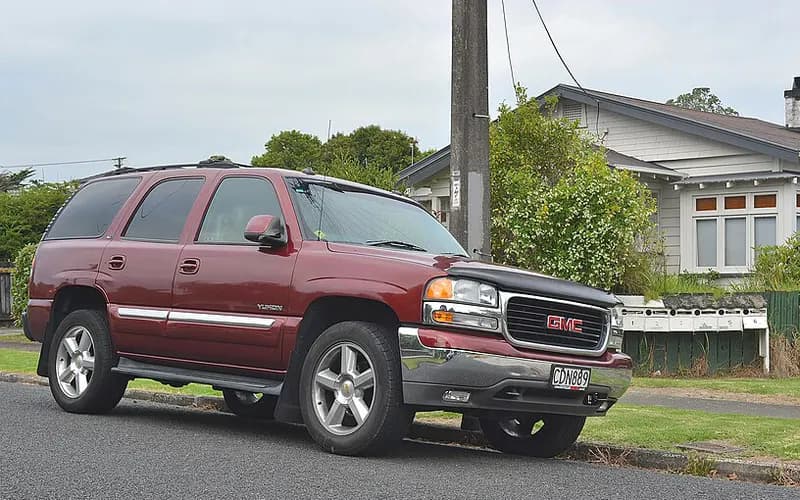
Common on this vehicle:Gauge or instrument faultNoiseWarning lightCorrosion or rustLeakReduced brakingAir conditioning or heaterVibration or shudder
Possible causes
22 causes not drawn
- Crankshaft position sensor may work intermittently or fail (8.1L V8) - recall 07V-5218.1L only0
- Throttle body carbon build-up: idle surge, reduced engine power, throttle DTCs (high mileage)0
- Front right-hand brake pipe contact with body cross sill - recall 00V-3450
- Stability System Disabled message and unwanted StabiliTrak activation (tire wear or mismatched tires)0
- ABS lamp with DTC C0265 (EBCM motor relay circuit) after EBCM replacement0
- Autoride (Z55) Service Ride Control / Service Suspension System message2
- Aluminum Wheel Bead Seat: corroded2
- Aftermarket part (not the vehicle as built): Federal-Mogul National / Carquest replacement wheel hub assembly retention nut - recall 07E-1062WD only1
- Rear door window inoperative (motor replacement)1
- Power Window: failed1
- Sunroof: failed1
- Service 4WD indicator and DTC B2725 (transfer case shift control switch)4WD / AWD only1
- 4WD/AWD lamps and system inoperative: "sleepy" New Venture Gear transfer case control module (reprogram the TCCM)4WD / AWD only1
- Transfer case service light, New Venture Gear transfer case (replace the encoder motor sensor and reprogram the TCCM)0
- Transfer Case Speed Sensor Wiring Harness: electrical fault1
- Rear HVAC ticking noise, no rear temperature or mode control, DTC B0434 / B3764 (revised auxiliary HVAC control module)1
- Seat Heater: overheated1
- No response when the OnStar button is pressed (DTC B2476): button assembly test values1
- Red OnStar LED and DTC B2455 after Canada upgrade bulletin 15-08-44-001 (audio and microphone drain wires shorted)1
- Instrument panel cluster gauges stick, flutter or stop working1
- CHECK OIL LEVEL message stays on after an oil change or top-off until the engine cools0
- Quadrasteer: rear wheels stay turned after the front wheels are straight (controlled re-centering after a fault, normal operation)1
Causes with no correction stated (23)
Causes the records name for which no check or repair is stated, in a technical document or in a record. Press one for the records that name it.
- Electrical, wiring and power
- ATC Fuse: electrical fault, failed (2)Bulb Socket: overheated (1)Powertrain Control Module: software (1)Intermittent no start with Service Stability, ABS light, 'Unknown Driver' and multiple DTCs / no module communication (0)
- Brakes
- Wheel Speed Sensor: failed (2)Service Stability message with DTC C0131, C0196, C0290 and/or C0292 (1)Anti-Lock Brake Motor: failed (1)Anti-Lock Brake Pump: failed (1)
- Airbags and seat belts
- Airbag: failed (1)Airbag Sensor: failed (1)
- Instruments and lighting
- Bulb: failed (1)Instrument Panel Cluster: failed (1)
- Heating and air conditioning
- Encoder Motor: electrical fault (1)
- Exhaust and emissions
- Evap Vent Valve: clogged or contaminated (1)Exhaust Manifold Bolt: broken (1)Secondary Air Injection Valve: corroded (1)
- Fuel system
- Fuel Tank: leaking (1)
- Audio and telematics
- OnStar System: failed (1)
- Body, doors and interior
- Seat Position Sensor: broken (1)
- Suspension, wheels and tires
- Shock: failed (1)
- Transmission and driveline
- Transmission: failed (1)Transmission Control Module: failed (1)Transmission Range Switch: failed (1)
The documents say what to doOnly records name itThe size of a node, the width of a link and the numbers are records matching this search, not likelihoods.
FaultCrate・GMC Yukon 2000–2006・Warning light
Candidate cause (the documents say what to do)
Rear bank knock sensor corrosion from water intrusion (P0332)
Applies to: 4.8L, 5.3L, 6.0L only
Customers may report mild to severe engine ping (spark knock), usually worse during acceleration, and/or an illuminated MIL.
The technician may find DTC P0332 set.
How to tell
P0327P0332Check engine / Service Engine Soon
What to do
- If P0327 and P0332 set at the same time, inspect for poor connections at the two-wire knock sensor harness located at the left rear side of the intake manifold near the top, just under the cover.
- Check the resistance of the knock sensors including the harness before reinstalling the intake manifold.
- Replace the rear bank knock sensor and build an RTV dam around the sensor to divert water away from it.
Caution: Do not form the RTV into a complete circle; leave the rear section open.
What is needed
- Parts and materials
- Rear bank knock sensor
- RTV (to build a dam around the sensor that diverts water)
- Labor time
- Not stated
- Special tools
- Not stated
- Scan tool
- Not stated
Only what the technical documents state. "Not stated" does not mean not needed.
In the records
No record states work done for this cause.
See the evidence (1 technical documents, 3 records)
Passages of the technical documents
The bulletin covers 1999-2002 Chevrolet and GMC C/K pickup and utility models, including Yukon, Yukon XL, Yukon Denali and Yukon Denali XL, with the 4.8L, 5.3L or 6.0L engine.
1999-2002 Chevrolet and GMC C/K Pickup and Utility Models (Avalanche, Silverado, Sierra, Tahoe, Suburban, Yukon, Yukon XL, Yukon Denali, Yukon Denali XL) with 4.8L, 5.3L or 6.0L Engine
General Motors (copy hosted by Corvette Action Center)
Customers may report mild to severe engine ping (spark knock), usually worse during acceleration, and/or an illuminated MIL.
Some customers may comment on a mild to severe engine ping (commonly referred to as spark knock), usually worse during acceleration and/or an illuminated MIL.
General Motors (copy hosted by Corvette Action Center)
The technician may find DTC P0332 set.
Upon investigation, the technician may find DTC P0332 set.
General Motors (copy hosted by Corvette Action Center)
The condition may result from corrosion of the rear bank knock sensor caused by water intrusion into the sensor cavity.
This condition may be the result of corrosion of the rear bank knock sensor due to water intrusion into the sensor cavity.
General Motors (copy hosted by Corvette Action Center)
A cause or a result a complaint states is the owner’s view or what a dealer told them, not an established fact.
Put together by FaultCrate from public records and technical documents. The cause and the repair are for the workshop to decide with the vehicle in front of it. Counts are records, not failure rates.