
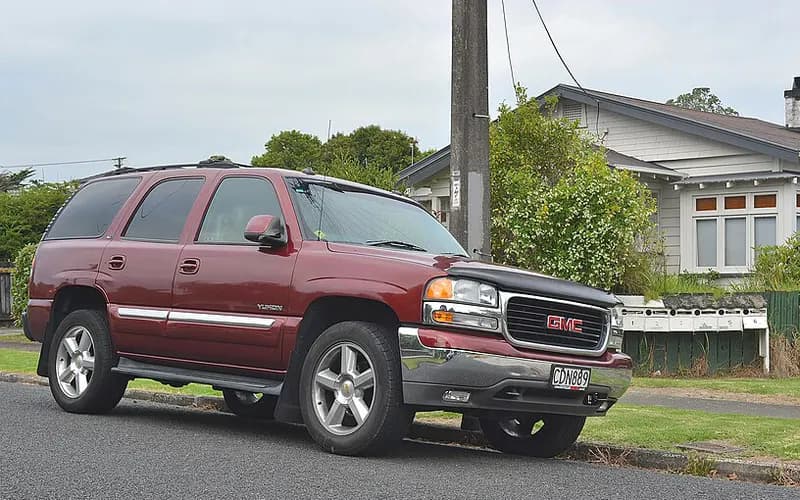
GMC Yukon 2000–2006
Common on this vehicle:Warning lightNoiseLeakMisfire or rough idleVibration or shudderAir conditioning or heaterReduced brakingCorrosion or rust
Record by record
10 records state a cause or a remedy. Each record is shown as short labels in the order fault → finding the cause → correction. Press a label to narrow to the records that state it.
A ribbon is as wide as the records that state both of its ends (only the commonest are drawn). A record that names several symptoms or components runs through each. Orange is records that say the fault came back or was not fixed. Results come from owners’ reports only; one that does not say is “result not stated”. None of this is a likelihood of a cause or a rate at which work succeeds.
Read the records one by one (6)
Known issuesAftermarket part (not the vehicle as built): Fram G3727 replacement fuel filter connector - recall 06E-0431
Recall2000 GMC YUKON ・ —
Fram Replacement Fuel Filters (P/N G3727) Recall
1Fault
- The connector on the fuel filter was not manufactured to specification, so the O-ring may not seat correctly on the fuel line; this may cause an inadequate seal, potentially leading to a fuel leak (wetting or dripping) and possible vehicle fire.
2Finding the cause
Steps to confirm (in the document’s order)
- The part number (G3727), country of origin (Mexico) and the date code (e.g., X60031) are located on the side of the fuel filter.
3Correction
Repair
- Honeywell will replace the subject fuel filters at no charge to the customer.
Read the sentences of the record
From the manufacturer’s document
- Applies to:This is an equipment recall of fuel filters manufactured by Interfil in Mexico and sold by Honeywell under the FRAM brand name, part number G3727, intended for aftermarket installation on the vehicle applications in the attached table.
- Applies to:Only filters with date codes X52911 through X60801 sequentially or X600141, and with a Mexico country of origin marking on the filter housing, are subject to the recall.
- Applies to:The application table lists YUKON 1992 - 2005, YUKON DENALI 2005, YUKON DENALI XL 2005, YUKON XL 1500 2000 - 2005 and YUKON XL 2500 2000 - 2005.
- Condition:The connector on the fuel filter was not manufactured to specification, so the O-ring may not seat correctly on the fuel line; this may cause an inadequate seal, potentially leading to a fuel leak (wetting or dripping) and possible vehicle fire.
- Confirm:The part number (G3727), country of origin (Mexico) and the date code (e.g., X60031) are located on the side of the fuel filter.
- Repair:Honeywell will replace the subject fuel filters at no charge to the customer.
- Cause
- CERTAIN REPLACEMENT FUEL FILTERS, FRAM BRAND NAME P/N G3727, WITH DATE CODES X52911 THROUGH X60801 SEQUENTIALLY OR X600141 AND A MEXICO COUNTRY OR ORIGIN MARKING ON THE FUEL FILTER HOUSING MANUFACTURED FROM OCTOBER 18, 2005, THROUGH MARCH 21, 2006, SOLD FOR USE ON THE VEHICLES LISTED ABOVE AND ON CERTAIN SCHOOL BUSES. (TO SEE THE SCHOOL BUS ENGINE SIZES, CLICK ON "DOCUMENT SEARCH" AND THEN "BUS APPLICATIONS"). THE CONNECTOR ON THE FUEL FILTER WAS NOT MANUFACTURED TO HONEYWELL'S SPECIFICATION. AS A RESULT, THE O-RING MAY NOT SEAT CORRECTLY ON THE FUEL LINE.
- Remedy
- HONEYWELL WILL NOTIFY OWNERS AND REPLACE THE FUEL FILTERS FREE OF CHARGE. THE RECALL BEGAN ON OCTOBER 18, 2006. OWNERS MAY CONTACT FRAM CUSTOMER SERVICE AT 1-800-890-2075 (OPTION 1).
- Consequence
- THIS CONDITION MAY CAUSE AN INADEQUATE SEAL AT THE CONNECTION, POTENTIALLY LEADING TO A FUEL LEAK. IN THE PRESENCE OF AN IGNITION SOURCE, A FIRE COULD OCCUR.
Known issuesConversion equipment (not the vehicle as built): Southern Comfort running board courtesy lights overheating - recall 03V-0941
Recall2000 GMC YUKON ・ 2003-07-03
Running board courtesy lights overheat or fire risk recall
1Fault
2Finding the cause
3Correction
Read the sentences of the record
- Cause
- CERTAIN PICKUP TRUCK, VAN, AND MINI VAN CONVERSIONS EQUIPPED WITH SOUTHERN COMFORT BUILT RUNNING BOARDS THAT CONTAIN CERTAIN COURTESY LIGHTS MANUFACTURED BY AMERICAN TECHNOLOGY COMPONENTS, INC. THESE UNITS CONTAIN A COURTESY LIGHT OR LIGHTS THAT MIGHT OVERHEAT WHEN THE WIRE HARNESS IS EXPOSED TO EXCESSIVE MOISTURE AND ROAD SALT.
- Remedy
- DEALERS WILL REPLACE THE WIRING HARNESS ON THESE RUNNING BOARDS. OWNER NOTIFICATION BEGAN MARCH 7, 2003. OWNERS WHO TAKE THEIR VEHICLES TO AN AUTHORIZED DEALER ON AN AGREED UPON SERVICE DATE AND DO NOT RECEIVE THE FREE REMEDY WITHIN A REASONABLE TIME SHOULD CONTACT SOUTHERN COMFORT AT 1-800-745-6096.
- Consequence
- THIS OVERHEATING CONDITION CAN CAUSE THE RUNNING BOARD TO MELT OR CAUSE A FIRE.
ENGINE AND ENGINE COOLING2
Manufacturer communication2000–2006 GMC YUKON DENALI ・ 2019-03-18
Diagnostic Tip: Using Smoke Machine and Ultrasonic Detector for Air Leaks
1Fault
- Leak
- Smoke or fire
- P0101
- P0137 (general documents only)
- P0138 (general documents only)
- P0140 (general documents only)
- P0141
- P0157 (general documents only)
- The SES light is on, and initial diagnosis may show fuel trim and/or O2 sensor related codes such as P0171, P0174, P0420 and P0430.
2Finding the cause
Steps to confirm (in the document’s order)
- If normal SI diagnostics do not resolve it and an intake vacuum leak or exhaust leak is suspected, the J41413-200 Evaporative System Tester smoke machine, the J-41416 ultrasonic leak tester, or soapy water with low pressure air into the tailpipe may help find the leak.
- For an intake leak, the smoke can be introduced into the brake booster hose or the oil dipstick tube.
- Soapy water can be sprayed near the gasket and seams and on all vacuum nipples.
- For an exhaust leak, a hose into the tailpipe carrying smoke or air, sealed with shop towels, is effective.
- Then spray soapy water around the seals, seams and bosses.
3Correction
Caution
- All of these tests are much more effective if the throttle body is covered/sealed.
Read the sentences of the record
From the manufacturer’s document
- Applies to:Applies to all 2000 - 2019 models with gasoline engines.
- Condition:The SES light is on, and initial diagnosis may show fuel trim and/or O2 sensor related codes such as P0171, P0174, P0420 and P0430.
- Confirm:If normal SI diagnostics do not resolve it and an intake vacuum leak or exhaust leak is suspected, the J41413-200 Evaporative System Tester smoke machine, the J-41416 ultrasonic leak tester, or soapy water with low pressure air into the tailpipe may help find the leak.
- Caution:All of these tests are much more effective if the throttle body is covered/sealed.
- Confirm:For an intake leak, the smoke can be introduced into the brake booster hose or the oil dipstick tube.
- Confirm:Soapy water can be sprayed near the gasket and seams and on all vacuum nipples.
- Confirm:For an exhaust leak, a hose into the tailpipe carrying smoke or air, sealed with shop towels, is effective.
- Confirm:Then spray soapy water around the seals, seams and bosses.
- Confirm:These methods are very good for finding small leaks around the O2 sensor bosses and slight cracks in an intake plenum or gasket.
Open the manufacturer’s document (PDF) ↗ The points above were read from this document.
- Remedy
- This preliminary information document communicates a tip on the way to diagnose possible induction or exhaust air leaks using the evaporative emission cart smoke machine and ultrasonic leak detector tools.
Manufacturer communication2000–2006 GMC YUKON DENALI ・ 2017-08-15(1 earlier editions of this document folded here)
Engine Check Lamp P0442 Evaporative Emissions System Notification
1Fault
- The service engine soon lamp (MIL) is on for DTC P0442, but a leak cannot be verified with the system test in the service information.
2Finding the cause
Steps to confirm (in the document’s order)
- With the scan tool, command the EVAP system CLOSED, start the engine and watch the tank pressure sensor value for about two minutes.
- If the tank pressure value changes (shows vacuum), remove the purge solenoid and pressurize its fuel tank side with the GE 41413-A / J 41413-A tester.
- If the tank pressure value does not change, install the CH-48096 adaptor between the purge line from the canister and the purge solenoid; use no other adaptor or pressurization method.
- With the EVAP system CLOSED, pressurize through the adaptor and let the system stabilize, watching the gauge for at least 5 minutes, then add smoke.
- Look for smoke or UV trace fluid at the purge solenoid, the engine side, the fuel cap or capless fill door, and the canister vent solenoid filter or fresh-air line.
3Correction
Repair
- If smoke passes through the purge solenoid, replace the purge solenoid.
Caution
- After verifying P0442, do not disturb any fuel system component before testing.
- Test pressure must not exceed 13 in H2O (0.5 PSI (= 3.45 kPa)); more can make components perform inaccurately and lead to misdiagnosis.
- A large temperature difference between vehicle, shop and tester seriously affects accuracy; let the vehicle adjust to shop temperature first.
Read the sentences of the record
From the manufacturer’s document
- Applies to:Applies to 2016 and prior passenger cars and trucks.
- Condition:The service engine soon lamp (MIL) is on for DTC P0442, but a leak cannot be verified with the system test in the service information.
- Caution:After verifying P0442, do not disturb any fuel system component before testing.
- Confirm:With the scan tool, command the EVAP system CLOSED, start the engine and watch the tank pressure sensor value for about two minutes.
- Confirm:If the tank pressure value changes (shows vacuum), remove the purge solenoid and pressurize its fuel tank side with the GE 41413-A / J 41413-A tester.
- Repair:If smoke passes through the purge solenoid, replace the purge solenoid.
- Confirm:If the tank pressure value does not change, install the CH-48096 adaptor between the purge line from the canister and the purge solenoid; use no other adaptor or pressurization method.
- Confirm:With the EVAP system CLOSED, pressurize through the adaptor and let the system stabilize, watching the gauge for at least 5 minutes, then add smoke.
- Confirm:Look for smoke or UV trace fluid at the purge solenoid, the engine side, the fuel cap or capless fill door, and the canister vent solenoid filter or fresh-air line.
- Confirm:If smoke testing finds nothing, the leak may exist only under vacuum: use the scan tool Purge/Seal function to pull a vacuum and watch the FTP sensor parameter for vacuum decay.
- Caution:Test pressure must not exceed 13 in H2O (0.5 PSI (= 3.45 kPa)); more can make components perform inaccurately and lead to misdiagnosis.
- Caution:A large temperature difference between vehicle, shop and tester seriously affects accuracy; let the vehicle adjust to shop temperature first.
Open the manufacturer’s document (PDF) ↗ The points above were read from this document.
- Remedy
- This Preliminary Information communication provides information to the technician about vehicles that have a Service Engine Soon Malfunction Indicator Lamp. Technician may find Diagnostic Trouble Code P0442. Technician will need to review Techlink article from May 2013 titled "Using the Evaporative Emissions System Tester" Technician will need to follow these steps to help diagnose the issue. First after the P0442 has been verified do not disturb any of the fuel system components. The technician now can use the scan tool to close the Evaporative Emissions System. If possible change the tank pressure sensor units from inch_H2O to milimeter_Hg for better resolution. Now the vehicle can be stared to monitor the tank pressure sensor output value for approximately two minutes. If the tank pressure sensor value does change, pressurize the fuel tank side of the purge solenoid with the GE 41413-A / J 41413-A and the necessary adaptors. Now add smoke and allow pressure to stabilize for 2 minutes. If smoke is allowed to pass through the purge solenoid, replace the purge solenoid. If the tank pressure sensor value does not change, then install CH-48096 adaptor between the purge line from the canister and the purge solenoid. With the Evaporative Emissions System closed, pressurize the system through the CH-48096 adaptor and allow the system to completely stabilize, by observing the Press / Vac Gauge for a minimum of 5 minutes. Now add smoke to the system with GE 41413-A / J 41413-A after system stabilization. Now inspect the purge solenoid, engine side, fuel cap, canister vent solenoid filter and any line quick connects. When the leak is unable to be located, test under a vacuum condition. his type of leak may be detected by using the scan tool Purge/Seal function to create a vacuum in the Evaporative Emissions System and then observe the FTP sensor parameter for vacuum decay.
ELECTRICAL SYSTEM1
Owner complaint2000 GMC YUKON ・ 2002-03-29
Battery positive terminal cracked and pulled out, acid leak
1Fault
2Finding the cause
3Correction
Not stated
Read the sentences of the record
- Fault
- BATTERY POSITIVE TERMINAL CRACKED AND PULLED OUT OF BATTERY CAUSING ACID TO LEAK AND COULD HAVE CAUSED A FIRE.
EQUIPMENT1
Manufacturer communication2000–2006 GMC YUKON DENALI ・ 2018-06-11(3 earlier editions of this document folded here)
GM Products for Eliminating Vehicle Odors
1Fault
- GM Vehicle Care Odor Eliminator has been shown to greatly reduce or remove mold and mildew smells resulting from vehicle water leaks, as well as customer created odors such as smoke.
2Finding the cause
Steps to confirm (in the document’s order)
- First confirm that all water leaks have been repaired and determine which areas were water soaked or wet; components with visible mold/mildew staining should be replaced.
3Correction
Repair
- If the interior is removed, treat the floor pan and primed/painted surfaces with a bleach/soap solution, rinse with clean water and dry.
- For hard surfaces, add 8 oz. of GM Vehicle Care Odor Eliminator (1 cup) to dish soap in a spray bottle and top off the bottle with tap water.
- Treat all carpeting and upholstered seats lightly to moderately with the formula at full strength, using a wide fan spray setting.
- For the ventilation system, start the vehicle, turn the fan on high cool (not the A/C setting), and spray the formula (10 trigger pulls) into the outside fresh air intake vent at the cowl.
Parts
- Part number 88861431 (in Canada, 88861436): GM Vehicle Care Odor Eliminator, 32 oz (946 mL) non-aerosol bottle.
Part numbers printed in the document
88861431Odor Eliminator, Spray Acdelco 32OzLook up at RockAuto (aftermarket candidates) ↗Search the web ↗
Discontinued (no successor stated)as stated by GMPartsGiant (checked 2026-10-06) ↗
88861436Look up at RockAuto (aftermarket candidates) ↗Search the web ↗
The numbers are as the document prints them. The name and the replacing number are what the pages of GMPartsGiant, a reseller of genuine parts and not GM, state. Aftermarket equivalents are not checked here (the links only search by number). Confirm the fit for the vehicle (VIN) before ordering.
Caution
- Do not let the product come into contact with vinegar or any acidic substance.
Read the sentences of the record
From the manufacturer’s document
- Applies to:Applies to 2015 and prior GM passenger cars and trucks.
- Condition:GM Vehicle Care Odor Eliminator has been shown to greatly reduce or remove mold and mildew smells resulting from vehicle water leaks, as well as customer created odors such as smoke.
- Caution:Do not let the product come into contact with vinegar or any acidic substance.
- Confirm:First confirm that all water leaks have been repaired and determine which areas were water soaked or wet; components with visible mold/mildew staining should be replaced.
- Repair:If the interior is removed, treat the floor pan and primed/painted surfaces with a bleach/soap solution, rinse with clean water and dry.
- Repair:For hard surfaces, add 8 oz. of GM Vehicle Care Odor Eliminator (1 cup) to dish soap in a spray bottle and top off the bottle with tap water.
- Repair:Treat all carpeting and upholstered seats lightly to moderately with the formula at full strength, using a wide fan spray setting.
- Repair:For the ventilation system, start the vehicle, turn the fan on high cool (not the A/C setting), and spray the formula (10 trigger pulls) into the outside fresh air intake vent at the cowl.
- Parts:Part number 88861431 (in Canada, 88861436): GM Vehicle Care Odor Eliminator, 32 oz (946 mL) non-aerosol bottle.
Open the manufacturer’s document (PDF) ↗ The points above were read from this document.
- Remedy
- This informational bulletin provides information on what products GM has to aid in the eliminating unwanted odors in a vehicle.
Showing 6 of the 10 you can open. Narrow the search to see the rest.