
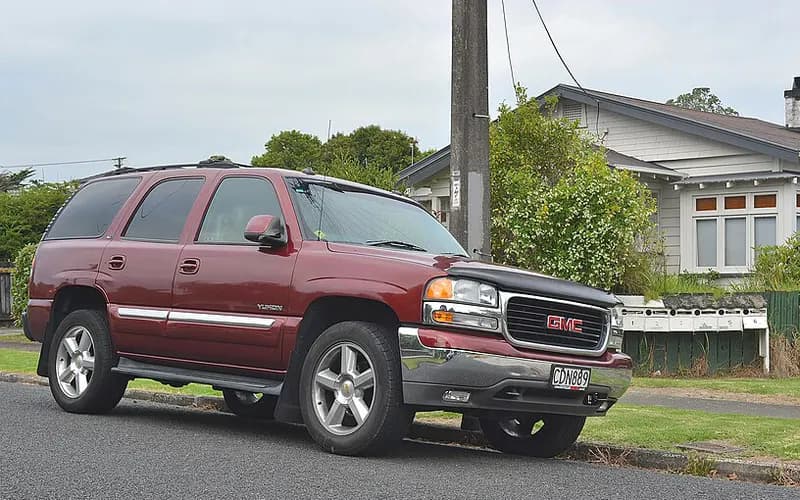
GMC Yukon 2000–2006
Common on this vehicle:Warning lightCorrosion or rustLeakNoiseParking brake
Record by record
12 records state a cause or a remedy. Each record is shown as short labels in the order fault → finding the cause → correction. Press a label to narrow to the records that state it.
Component named as the cause
Work done
A ribbon is as wide as the records that state both of its ends (only the commonest are drawn). A record that names several symptoms or components runs through each. Orange is records that say the fault came back or was not fixed. Results come from owners’ reports only; one that does not say is “result not stated”. None of this is a likelihood of a cause or a rate at which work succeeds.
Read the records one by one (7)
TIRES3
Manufacturer communication2003–2006 GMC YUKON DENALI ・ 2022-06-13
Tire Pressure Service Information
1Fault
- Ride, handling and road noise concerns may be caused by improperly adjusted tire pressure.
- During cold weather the Tire Pressure Monitor (TPM) indicator (a yellow horseshoe with an exclamation point) may illuminate.
2Finding the cause
Steps to confirm (in the document’s order)
- The first step in diagnosing these concerns is to verify that the tires are inflated to the correct pressures.
- The tire placard is on the driver's side front or rear door edge, the center pillar, or the rear compartment lid.
- Generally a 5.6°C (10°F) temperature change equals a 6.9 kPa (1 psi) tire pressure change.
- A "cold" tire is one that has sat for at least 3 hours or been driven no more than 1.6 km (1 mi).
3Correction
Repair
- If the indicator goes off after the tires warm up, reset the pressure to placard pressure at the cold temperature.
Caution
- The recommended inflation pressure is not the pressure printed on the tire sidewall.
- Always inspect and adjust the pressure when the tires are cold.
- Vehicles with different front and rear pressures need to be adjusted after tire rotation.
- To prevent electrostatic discharge damage to the Tire Pressure Monitoring Sensor (TPMS), the technician should be statically discharged before checking or filling tires.
Read the sentences of the record
From the manufacturer’s document
- Applies to:Applies to 2022 and prior GM passenger cars and light duty trucks.
- Condition:Ride, handling and road noise concerns may be caused by improperly adjusted tire pressure.
- Confirm:The first step in diagnosing these concerns is to verify that the tires are inflated to the correct pressures.
- Confirm:The tire placard is on the driver's side front or rear door edge, the center pillar, or the rear compartment lid.
- Caution:The recommended inflation pressure is not the pressure printed on the tire sidewall.
- Confirm:Generally a 5.6°C (10°F) temperature change equals a 6.9 kPa (1 psi) tire pressure change.
- Confirm:A "cold" tire is one that has sat for at least 3 hours or been driven no more than 1.6 km (1 mi).
- Caution:Always inspect and adjust the pressure when the tires are cold.
- Condition:During cold weather the Tire Pressure Monitor (TPM) indicator (a yellow horseshoe with an exclamation point) may illuminate.
- Repair:If the indicator goes off after the tires warm up, reset the pressure to placard pressure at the cold temperature.
- Caution:Vehicles with different front and rear pressures need to be adjusted after tire rotation.
- Caution:To prevent electrostatic discharge damage to the Tire Pressure Monitoring Sensor (TPMS), the technician should be statically discharged before checking or filling tires.
Open the manufacturer’s document (PDF) ↗ The points above were read from this document.
- Remedy
- This service bulletin provides information for accurate tire pressures that ensure the safe handling and appropriate ride characteristics of GM cars and trucks.
Manufacturer communication2004–2006 GMC YUKON ・ 2006-05-03
Aftermarket Wheels/Tire Pressure Monitor/FMVSS 138
1Fault
2Finding the cause
Not stated
3Correction
SERVICE VME - AFTERMARKET WHEELS/TIRE PRESSURE MONITOR/FMVSS 138. *TT
Read the sentences of the record
- Remedy
- SERVICE VME - AFTERMARKET WHEELS/TIRE PRESSURE MONITOR/FMVSS 138. *TT
Manufacturer communication2004–2005 GMC YUKON ・ 2004-12-04
Slow Tire Leak or Low Tire Pressure Warning Message
1Fault
2Finding the cause
Not stated
3Correction
Read the sentences of the record
- Remedy
- SLOW TIRE LEAK OR LOW TIRE PRESSURE WARNING MESSAGE. *EH
No component category1
Manufacturer communication2004–2005 GMC FULL-SIZE UTILITY TRUCKS (YUKON) ・ 2005-05-01
Tire Pressure Monitor system: messages, diagnosis and sensor relearn
1Fault
- The Passenger Door Module (PDM) is the receiver in the full-size utility truck; the receiver module varies by vehicle platform.
- "Check Tire Pressure" message: a sensor that detects a 1.6 psi (11 kPa) change in pressure transmits in re-measure mode; if the system detects a significant loss of pressure in any tire, the message is displayed on the DIC and the low tire pressure indicator is illuminated on the IPC.
- "Service Tire Monitor" message: if the PDM detects a malfunction in the TPM system, it causes the DIC to display this message.
2Finding the cause
Steps to confirm (in the document’s order)
- The "Service Tire Monitor" message is not normal system operation; DTCs should be set when it is displayed.
- Always check and adjust the tire pressures cold; as a rule of thumb, tire pressure changes one psi for every 10° F (6.9 kPa for every 5.6° C).
3Correction
Repair
- Both the message and the indicator can be cleared by adjusting the tire pressure to the recommended pressure.
- The tire pressure sensor relearn procedure must be performed after every PDM replacement, every sensor replacement and every tire rotation.
- J-46079 TPM Diagnostic Tool method: turn the ignition ON with the engine OFF and set the parking brake, then put the PDM in TPM learn mode by cycling the parking lamps ON and OFF 4 times within 4 seconds; the horn chirps and the low tire pressure indicator begins to flash.
- Proceed in the order left front, right front, right rear, left rear: starting with the left front tire, hold the antenna of the J-46079 against the tire sidewall close to the wheel rim at the valve stem and momentarily press the activate button.
Caution
- A "Check Tire Pressure" message does not set system codes; it is normal operation, meant to alert the driver to check and adjust tire pressure.
- Always relearn the system before replacing a suspect sensor.
Read the sentences of the record
From the manufacturer’s document
- Applies to:A Tire Pressure Monitor (TPM) system was added to certain GMC and Chevrolet full-size utility trucks for model year 2004 and continues for 2005.
- Condition:The Passenger Door Module (PDM) is the receiver in the full-size utility truck; the receiver module varies by vehicle platform.
- Condition:"Check Tire Pressure" message: a sensor that detects a 1.6 psi (11 kPa) change in pressure transmits in re-measure mode; if the system detects a significant loss of pressure in any tire, the message is displayed on the DIC and the low tire pressure indicator is illuminated on the IPC.
- Caution:A "Check Tire Pressure" message does not set system codes; it is normal operation, meant to alert the driver to check and adjust tire pressure.
- Repair:Both the message and the indicator can be cleared by adjusting the tire pressure to the recommended pressure.
- Condition:"Service Tire Monitor" message: if the PDM detects a malfunction in the TPM system, it causes the DIC to display this message.
- Confirm:The "Service Tire Monitor" message is not normal system operation; DTCs should be set when it is displayed.
- Confirm:Always check and adjust the tire pressures cold; as a rule of thumb, tire pressure changes one psi for every 10° F (6.9 kPa for every 5.6° C).
- Caution:Always relearn the system before replacing a suspect sensor.
- Repair:The tire pressure sensor relearn procedure must be performed after every PDM replacement, every sensor replacement and every tire rotation.
- Repair:J-46079 TPM Diagnostic Tool method: turn the ignition ON with the engine OFF and set the parking brake, then put the PDM in TPM learn mode by cycling the parking lamps ON and OFF 4 times within 4 seconds; the horn chirps and the low tire pressure indicator begins to flash.
- Repair:Proceed in the order left front, right front, right rear, left rear: starting with the left front tire, hold the antenna of the J-46079 against the tire sidewall close to the wheel rim at the valve stem and momentarily press the activate button.
Open this issue of GM TechLink ↗ The points above are read from an article of TechLink, GM’s monthly publication for dealership technicians. The article itself is not reproduced here.
- Remedy
- Tire Pressure Monitor A Tire Pressure Monitor (TPM) system was added to certain GMC and Chevrolet full-size utility trucks for model year 2004 and continues for 2005. The PDM is the receiver in the full-size utility truck. The receiver module varies by vehicle platform. “Check Tire Pressure” message -- If a sensor detects a 1.6 psi (11 kPa) change in pressure, it transmits in re-measure mode. If the system detects a significant loss of tire pressure in any tire, the Check Tire Pressure message is displayed on the DIC and the low tire pressure indicator is illuminated on the IPC. TIP: A “Check Tire Pressure” message will not set system codes. This is normal operation of the system. The purpose of this message is to alert the driver to check and adjust tire pressure. TIP: Both the message and indicator can be cleared by adjusting the tire pressure to the recommended pressure. “Service Tire Monitor” message -- If the PDM detects a malfunction in the TPM system, it will cause the DIC to display the Service Tire Monitor message. TIP: The “Service Tire Monitor” message is not a normal system operation. DTCs should be set when this message is displayed. - Always check and adjust the tire pressures COLD. As a rule of thumb, tire pressure will change one psi for every 10° F (6.9 kPa for every 5.6° C). - Always ‘relearn’ the system before replacing a suspect sensor. The tire pressure sensor relearn procedure must be performed after every PDM replacement, every sensor replacement, and every tire rotation. J-46079 TPM Diagnostic Tool Method -- Turn the ignition ON with the engine OFF, and set the parking brake. Place the PDM in TPM learn mode by cycling the parking lamps ON and OFF 4 times within 4 seconds. The horn will chirp and the low tire pressure indicator will begin to flash. Proceed in this order: left front, right front, right rear, left rear. Starting with the left front tire, hold the antenna of the J-46079 against the tire sidewall close to the wheel rim at the valve stem, and momentarily press the activate button.
ELECTRICAL SYSTEM1
Manufacturer communication2000–2006 GMC YUKON ・ 2024-10-25(4 earlier editions of this document folded here)
Tire Pressure Monitor and Diagnostic Tools Software Update
1Fault
- The process for reaching the GM Tools site has changed.
2Finding the cause
Not stated
3Correction
Read the sentences of the record
From the manufacturer’s document
- Applies to:All brands and models, model years 1995 - 2025.
- Condition:The process for reaching the GM Tools site has changed.
Open the manufacturer’s document (PDF) ↗ The points above were read from this document.
- Remedy
- This Preliminary Information communicates to the dealer the process for downloading or updating operating software for the Tire Pressure Monitor, Active Fuel Injector tester, multi media tester, PICO Scope, GR8 starting/charging tester  and Vehicle Data Recorder tools, giving website address and step by step instructions to complete the update.
EQUIPMENT1
Manufacturer communication2005–2006 GMC YUKON DENALI ・ 2019-12-16(1 earlier editions of this document folded here)
Aluminum wheel bead seat cleaning and resurfacing procedure
1Fault
- A tire slowly loses air pressure over a period of days or weeks.
2Finding the cause
Possible causes
- Abrasive elements may intrude between the tire and wheel at the bead seat, and the relative motion between tire and wheel lets the particles wear the wheel and tire materials.
Steps to confirm (in the document’s order)
- The corrosion may be on the inboard or outboard bead seating surface and is not visible until the tire is dismounted from the wheel.
- After a water dunk tank leak test, if the source of the leak is around the bead seat of the wheel, dismount the tire to examine the bead seat.
- Bead seat corrosion looks like blistering of the wheel finish, giving a rough or uneven surface on which the tire has difficulty keeping a proper seal.
- For vehicles with 32,186 km (20,000 mi) or less, the total combined linear area of repairable corrosion is 100 mm (4 in) or less; beyond that the wheel should be replaced.
- For vehicles that have exceeded 32,186 km (20,000 mi), the total combined linear area of repairable corrosion is 200 mm (8 in) or less.
3Correction
Repair
- Use a clean-up (fine cut) sanding disc or biscuit to remove the corrosion and any flaking paint, back to material that is stable and firmly bonded to the wheel.
- Once the corrosion is eliminated, coat the repaired area with a commercially available tire sealant such as Patch Brand Bead Sealant or equivalent.
Parts
- Part number 16118, Patch Bead Sealer (1 Quart (= 0.946 L)).
Caution
- Do not replace a wheel for slow air loss unless the wheel has been evaluated and/or repair has been tried with this procedure.
Read the sentences of the record
From the manufacturer’s document
- Applies to:Applies to 2005-2020 GM passenger cars and light duty trucks.
- Condition:A tire slowly loses air pressure over a period of days or weeks.
- Cause:Abrasive elements may intrude between the tire and wheel at the bead seat, and the relative motion between tire and wheel lets the particles wear the wheel and tire materials.
- Confirm:The corrosion may be on the inboard or outboard bead seating surface and is not visible until the tire is dismounted from the wheel.
- Caution:Do not replace a wheel for slow air loss unless the wheel has been evaluated and/or repair has been tried with this procedure.
- Confirm:After a water dunk tank leak test, if the source of the leak is around the bead seat of the wheel, dismount the tire to examine the bead seat.
- Confirm:Bead seat corrosion looks like blistering of the wheel finish, giving a rough or uneven surface on which the tire has difficulty keeping a proper seal.
- Confirm:For vehicles with 32,186 km (20,000 mi) or less, the total combined linear area of repairable corrosion is 100 mm (4 in) or less; beyond that the wheel should be replaced.
- Confirm:For vehicles that have exceeded 32,186 km (20,000 mi), the total combined linear area of repairable corrosion is 200 mm (8 in) or less.
- Repair:Use a clean-up (fine cut) sanding disc or biscuit to remove the corrosion and any flaking paint, back to material that is stable and firmly bonded to the wheel.
- Repair:Once the corrosion is eliminated, coat the repaired area with a commercially available tire sealant such as Patch Brand Bead Sealant or equivalent.
- Parts:Part number 16118, Patch Bead Sealer (1 Quart (= 0.946 L)).
Open the manufacturer’s document (PDF) ↗ The points above were read from this document.
- Remedy
- This technical bulletin provides a procedure on how to clean and resurface aluminum wheel bead seats for vehicles that have the condition of Tire Slowly Goes Flat, Tire Air Loss, Low Tire Pressure Warning Light Illuminated, Aluminum Wheel Bead Seat Corrosion.
SUSPENSION1
Manufacturer communication2004–2005 GMC YUKON ・ 2005-11-08
Tire Slowly Loses Air and Low Tire Pressure Warning
1Fault
2Finding the cause
Not stated
3Correction
Read the sentences of the record
- Remedy
- TIRE SLOWLY LOSES AIR, LOW TIRE PRESSURE WARNING LIGHT ON, CHECK TIRE PRESSURE MESSAGE DISPLAYED. *TT
Showing 7 of the 12 you can open. Narrow the search to see the rest.