
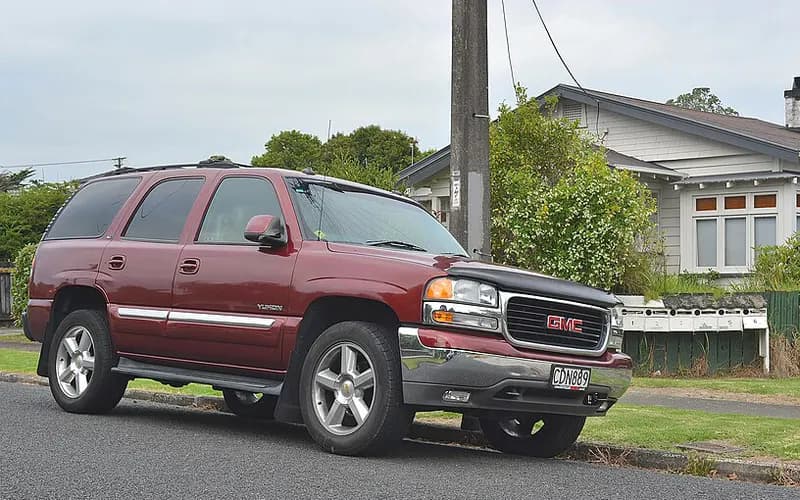
GMC Yukon 2000–2006
Common on this vehicle:Warning lightMisfire or rough idleLoss of engine power, no accelerationLeakNoiseGauge or instrument faultHard start or long crankDoes not start
Possible causes
15 causes not drawn
- Oil pump pickup (screen) O-ring cut: engine tick / lifter noise4.8L, 5.3L, 6.0L only0
- P0300 after engine repairs: injector connectors crossed (cylinders 5-7 / 6-8)0
- Rear bank knock sensor corrosion from water intrusion (P0332)4.8L, 5.3L, 6.0L only0
- Throttle body carbon build-up: idle surge, reduced engine power, throttle DTCs (high mileage)0
- Fuel pressure regulator buzz / hum after replacement (check fuel pump feed voltage drop and connector crimps)4.8L, 5.3L, 6.0L only0
- DTC P0446 set with the SES lamp on (replace the EVAP vent solenoid, not the canister)0
- Engine compartment noise with A/C on and A/C inoperative (auxiliary rear A/C: suction hose and compressor)0
- HVAC actuator clicking / ticking noises (recalibrate the HVAC control module, do not replace actuators)0
- Rear HVAC ticking noise, no rear temperature or mode control, DTC B0434 / B3764 (revised auxiliary HVAC control module)0
- Tire recall (not the vehicle as built): Firestone Wilderness LE tread separation - recall 01T-0011500 only0
- Power steering pump whine between idle and 2000 rpm0
- Steering intermediate shaft clunk0
- Tire scrub noise on low speed turns (steering rod / centerlink installed backwards)0
- Aftermarket part (not the vehicle as built): Federal-Mogul National / Carquest replacement wheel hub assembly retention nut - recall 07E-1062WD only0
- Creak or squeak noise from the rear lower control arm bushings (do not replace the propshaft)0
The documents say what to doOnly records name itThe size of a node, the width of a link and the numbers are records matching this search, not likelihoods.
FaultCrate・GMC Yukon 2000–2006・Noise, Check engine / Service Engine Soon
Candidate cause (the documents say what to do)
Engine knock on cold start (carbon on piston)
Applies to: 4.8L, 5.3L, 6.0L only
The noise is usually more noticeable on initial start-up below 10°C (50°F) and may be more pronounced on the first cold start after a long trip.
The noise may be caused by an interaction between carbon formed on the piston, the piston motion and the cylinder wall.
What to do
No technical document states a check or a repair.
Caution: GM Powertrain Engineering confirmed the noise is not detrimental to the performance, reliability or durability of the engine.
What is needed
- Parts and materials
- Not stated
- Labor time
- Not stated
- Special tools
- Not stated
- Scan tool
- Not stated
Only what the technical documents state. "Not stated" does not mean not needed.
In the records
No record states work done for this cause.
See the evidence (1 technical documents, 0 records)
Passages of the technical documents
The bulletin covers 1999-2006 Chevrolet and GMC C/K pickup and utility models.
1999-2006 Chevrolet and GMC C/K Pickup and Utility Models
General Motors (filed with NHTSA) 2016-04-01
It applies to the 4.8L, 5.3L, 6.0L or 6.2L gas engine.
Equipped with 4.8L, 5.3L, 6.0L or 6.2L Gas Engine
General Motors (filed with NHTSA) 2016-04-01
The noise is usually more noticeable on initial start-up below 10°C (50°F) and may be more pronounced on the first cold start after a long trip.
The noise is usually more noticeable on the initial start-up when the temperature is below 10°C (50°F) and may be more pronounced on the first cold start following a long trip.
General Motors (filed with NHTSA) 2016-04-01
The noise may be caused by an interaction between carbon formed on the piston, the piston motion and the cylinder wall.
This noise may be caused by an interaction between carbon that has formed on the piston, the piston motion and the cylinder wall.
General Motors (filed with NHTSA) 2016-04-01
A cause or a result a complaint states is the owner’s view or what a dealer told them, not an established fact.
Put together by FaultCrate from public records and technical documents. The cause and the repair are for the workshop to decide with the vehicle in front of it. Counts are records, not failure rates.