
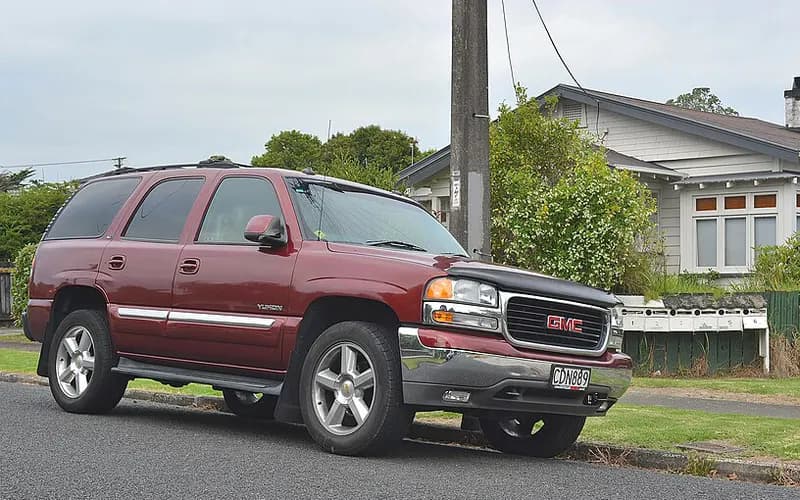
GMC Yukon 2000–2006
Common on this vehicle:Warning light
Record by record
1 records state a cause or a remedy. Each record is shown as short labels in the order fault → finding the cause → correction. Press a label to narrow to the records that state it.
Read the records one by one (1)
No component category1
Manufacturer communication2005 GMC FULL SIZE PICK AND UTILITIES (YUKON) ・ 2004-09-01
Regulated Voltage Control (RVC) charging system: operation and diagnosis
1Fault
- The purpose of the RVC system is to keep the battery state-of-charge at 80% or above and support vehicle loads.
- On full-size trucks the generator battery control module, rather than the PCM/ECM, controls the generator through the generator L-terminal control circuit.
- The Generator Battery Control Module communicates with the PCM, IPC and BCM for RVC operation; it is a serviceable component connected to the negative battery cable at the battery, and it directly controls the generator field control circuit input to the generator.
- Start Up Mode: after the engine has started, the control module sets a targeted generator output voltage of 14.5 volts for 30 seconds.
- Battery Sulfation Mode: entered when the battery voltage is less than 13.2 volts for 45 minutes; the generator battery control module then sets a targeted output voltage between 13.9 and 15.5 volts for 5 minutes.
2Finding the cause
Steps to confirm (in the document’s order)
- If a charging system error is suspected, first check for related charging system and low voltage DTCs set in the control module.
- Diagnose P codes first, as these DTCs set if there is a generator or control circuit failure.
- If no DTCs are present, refer to the Charging System test in the service manual.
- For L-terminal diagnostics, set the DVOM to monitor frequency; in normal operation the duty cycle reads 5-95%, depending on the mode the system is in and the battery SOC.
3Correction
Read the sentences of the record
From the manufacturer’s document
- Applies to:The table of vehicles lists 2005 Full Size Pick and Utilities under 8600 GVW as Generation IV, with Charge, Fuel Economy, Voltage Reduction, Start Up and Battery Sulfation modes; the key components are the Generator Battery Control Module and the ECM/PCM.
- Condition:The purpose of the RVC system is to keep the battery state-of-charge at 80% or above and support vehicle loads.
- Condition:On full-size trucks the generator battery control module, rather than the PCM/ECM, controls the generator through the generator L-terminal control circuit.
- Condition:The Generator Battery Control Module communicates with the PCM, IPC and BCM for RVC operation; it is a serviceable component connected to the negative battery cable at the battery, and it directly controls the generator field control circuit input to the generator.
- Condition:Start Up Mode: after the engine has started, the control module sets a targeted generator output voltage of 14.5 volts for 30 seconds.
- Condition:Battery Sulfation Mode: entered when the battery voltage is less than 13.2 volts for 45 minutes; the generator battery control module then sets a targeted output voltage between 13.9 and 15.5 volts for 5 minutes.
- Confirm:If a charging system error is suspected, first check for related charging system and low voltage DTCs set in the control module.
- Confirm:Diagnose P codes first, as these DTCs set if there is a generator or control circuit failure.
- Confirm:If no DTCs are present, refer to the Charging System test in the service manual.
- Confirm:For L-terminal diagnostics, set the DVOM to monitor frequency; in normal operation the duty cycle reads 5-95%, depending on the mode the system is in and the battery SOC.
Open this issue of GM TechLink ↗ The points above are read from an article of TechLink, GM’s monthly publication for dealership technicians. The article itself is not reproduced here.
- Remedy
- Regulated Voltage Control 2005 Full Size Pick and Utilities under 8600 GVW Generation IV Charge Mode, Fuel Economy Mode, Voltage Reduction Mode, Start Up Mode, Battery Sulfation Mode Generator Battery Control Module, ECM/PCM The purpose of the RVC system is to maintain the battery state-of-charge at 80% or above and support vehicle loads. The PCM/ECM (generator battery control module on full-size trucks) controls the generator through the generator L-terminal control circuit. Generator Battery Control Module -- It communicates with the PCM, IPC and BCM for RVC operation. It is a serviceable component that is connected to the negative battery cable at the battery. It directly controls the generator field control circuit input to the generator. Start Up Mode -- After the engine has started, the control module sets a targeted generator output voltage of 14.5 volts for 30 seconds. Battery Sulfation Mode -- The control module enters this mode when the battery voltage is less than 13.2 volts for 45 minutes. Once in this mode, the generator battery control module will set a targeted output voltage between 13.9 to 15.5 volts for 5 minutes. If you feel there is a charging system error, first check for related charging system and low voltage DTCs set in the control module. TIP: Diagnose P codes first, as these DTC will set if there is a generator or control circuit failure. If no DTCs are present, refer to the Charging System test in the service manual. For L-terminal diagnostics, set your DVOM to monitor frequency. When the system is operating normally, you should read a duty cycle of 5-95% depending on which mode the system is in and also the battery SOC.