Suspension, wheels and tiresModel years 1999–2006Manufacturer
Vehicle body tilt or lean left / right (torsion bar front suspension)
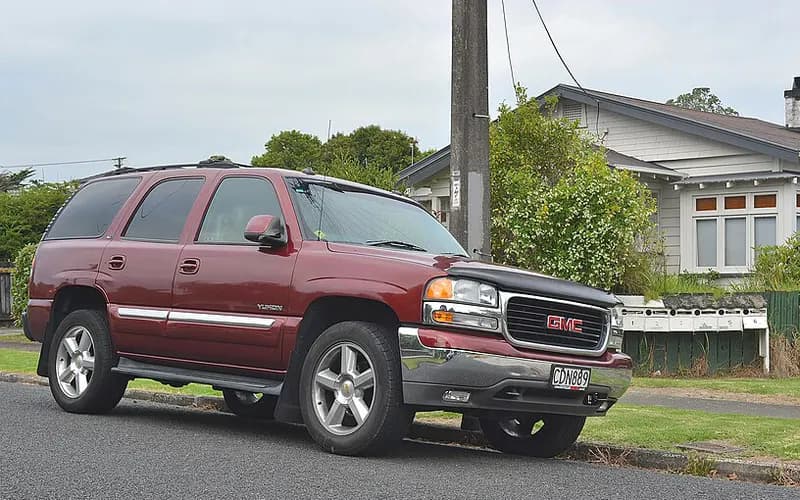
GMC Yukon Models 1999 - 2006 with torsion bar front suspension (and Escalade, Avalanche, Silverado Classic, Suburban, Tahoe, Sierra Classic, HD models)
FaultCrate・Vehicle body tilt or lean left / right (torsion bar front suspension)
The procedure addresses complaints of the vehicle leaning left or right.
What to do
- Measure fender wheel-opening heights, front and rear, to quantify the lean.
- Make sure the vehicle is on a level surface such as an alignment rack.
- The front wheel-opening height is known as P height, and the rear wheel-opening height is known as R height.
- P height and R height are the distance from the ground to the highest point on the wheel-opening, going through the center of the wheel.
- Before measuring, check the fuel level and add weight if necessary to simulate a full tank.
- Check Z height and D height; see Trim Height Inspection Procedure.
- Before measuring, set the tire pressures to the pressure shown on the certification label.
- If the left-to-right difference in P and/or R height is 1/2 inch (12 mm) or less, the vehicle is within specification and no repair is suggested.
- Generally the stance can be adjusted with the torsion bar adjuster bolts.
- If Z height is out of spec and the D height delta is greater than 1/2 inch (12 mm), adjust Z height until it is within spec and the P and R height deltas are less than 1/2 inch (12 mm).
- When Z height is within spec but the D height delta is greater than 1/2 inch (12 mm), adjust Z height within its tolerance to bring the P and R height deltas under 1/2 inch (12 mm). If this is not possible, check the front eye of the rear leaf spring for matching color-coded tape or paint; both sides should be the same color. If not, switch springs side to side; if so, replace the leaf spring on the lower side only.
- If this is not possible, shim the body and/or pick-up box until the P and R height deltas are less than 1/2 inch (12 mm).
- After all adjustments are done, perform a front-end alignment and check headlight aim.
What is needed
- Parts and materials
- Rear leaf spring (lower side only; when Z height adjustment cannot correct it and both springs carry the same color code)
- Labor time
- Not stated
- Special tools
- Not stated
- Scan tool
- Not stated
Only what the technical documents state. "Not stated" does not mean not needed.
Caution
- The P and R heights are not set at the factory, and no specification is given for them.
Applies to
- The bulletin lists GMC Yukon Models 1999 - 2006.
- It applies to vehicles with torsion bar front suspension.
See the evidence (4 documents, 17 passages)
| Document | Publisher | Date |
|---|---|---|
| [1]PIT3098G: Diagnostic Tips: Vehicle Body Tilt or Lean ↗ | ManufacturerGeneral Motors (published by NHTSA) | 2019-03-22 |
| [2]PIT3098G Diagnostic Tips: Vehicle Body Tilt or Lean ↗ | ManufacturerGeneral Motors | — |
| [3]PIT3098F Diagnostic Tips: Vehicle Body Tilt or Lean ↗ | ManufacturerGeneral Motors | — |
| [4]PIT3098E Diagnostic Tips: Vehicle Body Tilt Or Lean ↗ | ManufacturerGeneral Motors | — |
Applies toThe bulletin lists GMC Yukon Models 1999 - 2006.
GMC Yukon Models 1999 - 2006 All All All All— [1] Models
Applies toIt applies to vehicles with torsion bar front suspension.
With Torsion Bar Front Suspension— [1] Models
First signsThe procedure addresses complaints of the vehicle leaning left or right.
This procedure should be followed to diagnose and correct customer complaints of vehicle leaning left or right.— [1] Condition
RepairGenerally the stance can be adjusted with the torsion bar adjuster bolts.
Generally the vehicle's stance can be adjusted with the torsion bar adjuster bolts.— [1] Condition
How to confirmMeasure fender wheel-opening heights, front and rear, to quantify the lean.
Measure fender wheel-opening heights, front and rear, to quantify vehicle lean.— [1] Recommendations
How to confirmMake sure the vehicle is on a level surface such as an alignment rack.
Make sure the vehicle is on a level surface, such as an alignment rack.— [1] Recommendations
How to confirmThe front wheel-opening height is known as P height, and the rear wheel-opening height is known as R height.
The front wheel-opening height is known as P height, and the rear wheel-opening height is known as R height.— [2]
How to confirmP height and R height are the distance from the ground to the highest point on the wheel-opening, going through the center of the wheel.
They are the distance from the ground to the highest point on their respective wheel-opening, going through the center of their respective wheel.— [2]
How to confirmBefore measuring, check the fuel level and add weight if necessary to simulate a full tank.
Check the fuel level. Add additional weight if necessary to simulate a full tank.— [2]
How to confirmCheck Z height and D height; see Trim Height Inspection Procedure.
Check Z height and D height. See Trim Height Inspection Procedure.— [2]
How to confirmBefore measuring, set the tire pressures to the pressure shown on the certification label.
Set the tire pressures to the pressure shown on the certification label.— [3]
How to confirmIf the left-to-right difference in P and/or R height is 1/2 inch (12 mm) or less, the vehicle is within specification and no repair is suggested.
If the difference left to right, P and or R height is 1/2 inch (12 mm) or less no repairs are suggested as the vehicle is within specification.— [3]
RepairIf Z height is out of spec and the D height delta is greater than 1/2 inch (12 mm), adjust Z height until it is within spec and the P and R height deltas are less than 1/2 inch (12 mm).
If Z height is out of spec and D height delta is greater than 1/2 inch (12 mm), adjust Z height until it is within spec and P and R height deltas are less than 1/2 inch (12 mm).— [2]
RepairWhen Z height is within spec but the D height delta is greater than 1/2 inch (12 mm), adjust Z height within its tolerance to bring the P and R height deltas under 1/2 inch (12 mm). If this is not possible, check the front eye of the rear leaf spring for matching color-coded tape or paint; both sides should be the same color. If not, switch springs side to side; if so, replace the leaf spring on the lower side only.
1.3. If Z height is within spec but D height delta is greater than 1/2 inch (12 mm), adjust Z height to reduce P and R height deltas to less than 1/2 inch (12mm), staying within the Z height tolerance. If this is not possible, check front eye of rear leaf spring for matching color-coded tape or paint. Both sides should be the same color. If not, switch springs side to side. If so, replace leaf spring on lower side only.— [2]
RepairIf this is not possible, shim the body and/or pick-up box until the P and R height deltas are less than 1/2 inch (12 mm).
If this is not possible, shim body and/or pick-up box until P and R height deltas less than 1/2 inch (12 mm).— [2]
RepairAfter all adjustments are done, perform a front-end alignment and check headlight aim.
After all adjustments are done, perform a front-end alignment and check headlight aim.— [2]
CautionThe P and R heights are not set at the factory, and no specification is given for them.
The P and R heights are not set at the factory, nor is a specification given for them.— [4]
Put together by FaultCrate from public records and technical documents. The cause and the repair are for the workshop to decide with the vehicle in front of it. Counts are records, not failure rates.
List the records (3 that can be opened)
Records whose recall number, document number or text matches. Each line says why it matched.
- Vehicle Lean Adjustment Preliminary InformationManufacturer communication 2019-04-08・document number matches
- Vehicle Lean Adjustment Preliminary InformationManufacturer communication 2018-03-12・text contains "vehicle lean"
- Vehicle Lean Preliminary InformationManufacturer communication 2017-08-15・text contains "vehicle lean"