GMC Yukon XL 2000–2006
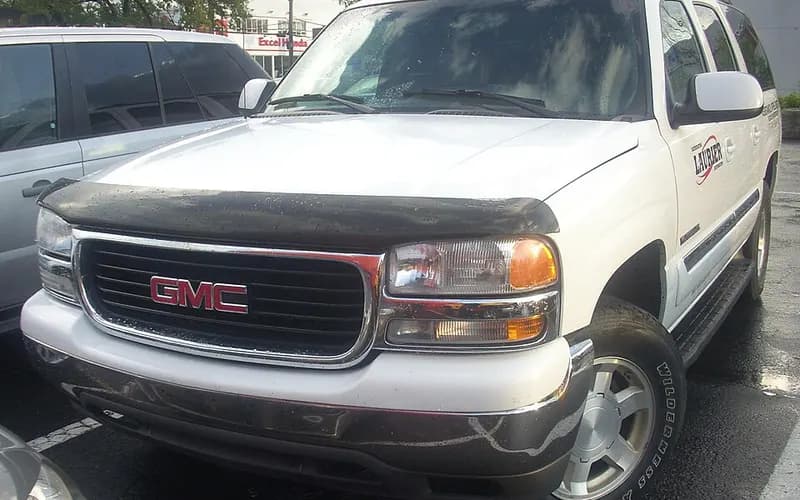
Common on this vehicle:Warning lightLeakVibration or shudderNoiseGauge or instrument faultMisfire or rough idleCorrosion or rustAir conditioning or heater
Possible causes
41 causes not drawn
- Castech cylinder head porosity crack (gradual coolant loss)4.8L, 5.3L only1
- Intake manifold gasket leak (cold idle misfire, lean codes)1
- Higher than expected oil consumption at 8600 GVW and above (accepted rate and consumption test)1
- P0300 after engine repairs: injector connectors crossed (cylinders 5-7 / 6-8)1
- Slight roughness at idle with no DTCs (possible characteristic)1
- OnStar Module: electrical fault1
- Grease seen at front hub bearing seals (normal purge, do not replace)1
- Creak or squeak noise from the rear lower control arm bushings (do not replace the propshaft)1
- Upper control arm bracket alignment (dowel) pin missing at front end alignment1
- Vehicle body tilt or lean left / right (torsion bar front suspension)1
- Reduced Engine Power from throttle body connector crimp, broken wire or grounds1
- Engine Control Module: software1
- HVAC blower motor resistor module / connector overheating3
- No passenger compartment air filter (not available from the 2003 model year; normal)2
- HVAC actuator clicking / ticking noises (recalibrate the HVAC control module, do not replace actuators)1
- Rear HVAC ticking noise, no rear temperature or mode control, DTC B0434 / B3764 (revised auxiliary HVAC control module)1
- Climate Control Module: software1
- Speedometer needle appears inaccurate (specification +/- 2 MPH)3
- Voltmeter fluctuates between 12 and 14 volts (Regulated Voltage Control, normal)2
- Speedometer: failed1
- Power Folding Mirror: failed2
- Bench seat (RPO AE7) center console armrest hinges broken (replace the lid, not the console assembly)1
- Door sags or is hard to open or close (worn or corroded hinge pins and bushings)1
- Front seat adjuster switch knob loose or missing (replace only the switch cover)1
- Mirror Glass: loose or misadjusted1
- Engine fuel rail pulse damper retainer clip may fracture (8.1L V8) - recall 06V-289 / Transport Canada 20061958.1L only2
- Fuel gauge reads low or drops to empty in Park / Neutral (normal characteristic)1
- 4L60-E slip or no forward engagement right after input housing replacement (service part 17803687)1
- 4L80-E / 4L85-E planetary gear whine in first and second gear1
- Electronic transfer case stops shifting with no DTC (shift abuse lock out mode, normal)1
- Transfer case speed sensor connector locks bend on disconnect (improved connector)1
- 4L60-E / 4L65-E clunk on 2-3 upshift or 3-2 downshift (normal condition)1
- Differential: failed1
- Power steering pump whine between idle and 2000 rpm1
- Steering intermediate shaft clunk1
- Pitman Arm: design or manufacturing1
- Pitman Arm Shaft Seal: leaking1
- SIR lamp on and inside mirror temperature/compass display inoperative (open air bag fuse, circuit 1139 shorted to ground)1
- Seat Belt Buckle: failed1
- Seat Belt Warning Light: failed1
- Tire and loading information label lists inaccurate vehicle capacity weight (FMVSS 110) - recall 05V-5521
Causes with no correction stated (15)
Causes the records name for which no check or repair is stated, in a technical document or in a record. Press one for the records that name it.
- Heating and air conditioning
- HVAC temperature doors default to full hot or defrost cannot be obtained (1)
- Transmission and driveline
- Axle Differential Seal: leaking (1)Locking Rear Differential (1)Pinion Seal: leaking (1)
- Other
- Bolt: broken (1)
- Electrical, wiring and power
- Emergency Light Relay (1)Fuse: failed (1)
- Exhaust and emissions
- Exhaust Manifold Bolt: broken (1)
- Body, doors and interior
- Frame: corroded (1)Keypad: failed (1)Seat Position Sensor: broken (1)Sunroof (1)
- Fuel system
- Fuel Line: broken (1)
- Audio and telematics
- XM Travel Link: failed (1)
The documents say what to doOnly records name itThe size of a node, the width of a link and the numbers are records matching this search, not likelihoods.
FaultCrate・GMC Yukon XL 2000–2006・2006
Candidate cause (the documents say what to do)
Brake pipe (brake line) corrosion and rupture
The pipes' steel-copper construction is vulnerable to galvanic corrosion if exposed to the environment.
NHTSA found the failures came with general excessive corrosion over most of the pipe assembly and appear to be expected wear-out of the coating in severe-corrosion states.
How to tell
Brake warning / Service Brake System
What to do
- In the joint inspections, scaling or flaking corrosion was taken as indicating the onset of metal loss and given the second lowest ranking (2); a leaking or previously repaired pipe was the lowest (1).
- GM noted that pipes with excessive flaking corrosion can only be fully evaluated, including remaining service life, by removing them, cleaning off the corrosion and sectioning them to assess remaining wall thickness.
- The inspections found no specific location where corrosion was visually more severe and no pattern between vehicles.
- Service records of incident vehicles also indicate that repairs are not isolated to a specific location or brake pipe.
- GM recommends replacing the entire set of pipes whenever any pipe leaks or is corroded enough to need replacement.
- On June 28, 2013 GM released 66 new part numbers for servicing brake pipes in 1999-2007 GMT800 pickups and utility vehicles.
Caution: Analysis of repair records indicates that consumers often elect to repair only the failed circuit.
What is needed
- Parts and materials
- The entire set of brake pipes (whenever any pipe leaks or is corroded enough to need replacement; GM's recommendation)
- GM brake pipe kit (a complete set of pre-formed and pre-flared pipes, for when the entire brake pipe assembly is replaced)
- Labor time
- Kit procedure: 4.5 to 6.0 hours, depending on the vehicle's configuration (labor time guideline of the October 2014 TSB)
- Forming and flaring replacement tubing to fit the vehicle: approximately 8.5 hours (base time estimate)
- Special tools
- Not stated
- Scan tool
- Not stated
Only what the technical documents state. "Not stated" does not mean not needed.
In the records
- Brake Line: replaced 3(result not stated: 3)
- Brake Fluid: cleaned 1(result not stated: 1)
- Brake Rotor: replaced 1(result not stated: 1)
See the evidence (1 technical documents, 8 records)
Passages of the technical documents
NHTSA's investigation covered 1999-2003 GM C/K pickups and SUVs in salt-belt states.
Products: 1999-2003 GM C/K pickup trucks and SUVs in Salt Belt states
NHTSA ODI 2015-04-08
The GMT800 platform includes 1999-2007 Silverado and Sierra 1500, 2500 and 3500 pickup trucks; 2000-2006 Suburban, Tahoe and Yukon; and 2002-2006 Escalade and Avalanche.
The GMT800 platform includes the following vehicles: 1999-2007 Chevrolet Silverado and GMC Sierra 1500, 2500 and 3500 series pick-up trucks; 2000-2006 Chevrolet Suburban, Chevrolet Tahoe and GMC Yukon sport utility vehicles; and 2002-2006 Cadillac Escalade and Chevrolet Avalanche sport-utility vehicles.
NHTSA ODI 2015-04-08
Corroded brake lines may rupture during a brake application, reducing brake effectiveness.
Brake line corrosion may result in rupture during brake application, resulting in reduced brake effectiveness.
NHTSA ODI 2015-04-08
The pipes' steel-copper construction is vulnerable to galvanic corrosion if exposed to the environment.
The steel-copper construction is vulnerable to galvanic corrosion if exposed to the environment.
NHTSA ODI 2015-04-09
Records
- Brake pedal felt unusual, vehicle would not stop, brake fluid leak from burst brake line Owner complaint 2014-07-01
A cause or a result a complaint states is the owner’s view or what a dealer told them, not an established fact.
Put together by FaultCrate from public records and technical documents. The cause and the repair are for the workshop to decide with the vehicle in front of it. Counts are records, not failure rates.