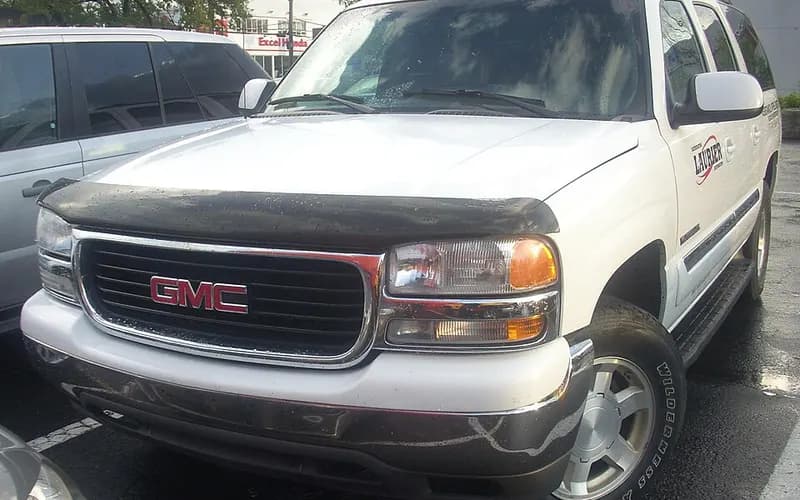
Suspension, wheels and tiresModel years 2001–2006Manufacturer
Autoride (Z55) Service Ride Control / Service Suspension System message
GMC Yukon, Yukon XL, Yukon Denali, Yukon Denali XL with RPO Z55 or Z95 (GM PIT4954C lists 2001-2013; condition 1 is for 2009 or prior vehicles). C0580 bulletin 03-03-11-001 is indexed by NHTSA for Yukon 2001-2003.
FaultCrate・Autoride (Z55) Service Ride Control / Service Suspension System message
On 2009 or earlier vehicles a Service Suspension System message may appear and the rear ride height may be incorrect.
The Electronic Suspension Control module will have DTC C0696 or C0711 set.
Customers may also report that the rear ride height is low under a heavy payload.
Condition 3: a loose hose hangs down at the left rear of the vehicle; the hose may be damaged or disconnected from the air inlet filter of the auto leveling suspension air compressor.
Condition 4: the automatic level control compressor no longer performs a self test (running for a few seconds) at start up.
The cause can be the automatic level control pressure sensor wiring shorted to ground.
An internal fault in the level control pressure sensor may be caused by moisture getting into the sensor.
What to do
- The compressor assembly may need to be removed to see whether the wiring is pinched between the compressor and the frame.
- The module checks level-system pressure at start-up and runs the compressor to add air to the shocks if it is below 10 psi (69 kPa).
- Repair the damaged or shorted circuits and reposition the wiring so it is not damaged again when the compressor is installed.
- The sensor is not serviced separately; install a complete air filter, dryer and sensor assembly.
- For a Service Ride Control message with DTC C0580, replace the right front shock absorber solenoid connector and install new A/C suction and auxiliary evaporator hoses.
- The jumper harness is included with the complete air filter, dryer, and sensor assembly PN 22964558; vehicles built in May, 2012 and later do not require the jumper harness and use PN 22941807.
- For condition 3, do not replace the complete air compressor assembly; replace the auto leveling compressor air inlet filter and hose assembly (PN 22197160).
What is needed
- Parts and materials
- Air filter, dryer and sensor assembly PN 22964558 (includes the jumper harness)
- Right front shock absorber solenoid connector (for a Service Ride Control message with C0580)
- New A/C suction and auxiliary evaporator hoses (for a Service Ride Control message with C0580)
- Auto leveling compressor air inlet filter and hose assembly PN 22197160 (for condition 3)
Part numbers printed in the document
22964558Filter Assembly, Auto Level Control Air CompressorLook up at RockAuto (aftermarket candidates) ↗Search the web ↗
Discontinued (no successor stated)(replaces 20982305 / 22197161)as stated by GMPartsGiant (checked 2026-10-06) ↗
22941807Filter Assembly, Auto Level Control Air CompressorLook up at RockAuto (aftermarket candidates) ↗Search the web ↗
Discontinued (no successor stated)as stated by GMPartsGiant (checked 2026-10-06) ↗
22197160Look up at RockAuto (aftermarket candidates) ↗Search the web ↗
The numbers are as the document prints them. The name and the replacing number are what the pages of GMPartsGiant, a reseller of genuine parts and not GM, state. Aftermarket equivalents are not checked here (the links only search by number). Confirm the fit for the vehicle (VIN) before ordering.
- Labor time
- Not stated
- Special tools
- Not stated
- Scan tool
- Not stated
Only what the technical documents state. "Not stated" does not mean not needed.
Caution
- Do not replace the complete air compressor assembly for this concern.
- Route the sensor wiring carefully under and around the air filter, dryer, and sensor assembly to prevent damage along the vehicle frame.
- The automatic level system normally will not, or will only very infrequently, cycle the compressor at key up.
In the records
- Air Compressor: repaired 1
- Air Filter Dryer and Sensor Assembly: replaced 1
- Auto Leveling Compressor Air Inlet Filter and Hose Assembly: replaced 1
Applies to
- The GM preliminary information covers 2001-2013 GMC Yukon, Yukon XL, Yukon Denali and Yukon Denali XL with RPO Z55 or Z95.
See the evidence (3 documents, 18 passages)
| Document | Publisher | Date |
|---|---|---|
| [1]PIT4954C: Suspension DTCs C0696 or C0711, Incorrect Trim Height, Compressor Inlet Hose Loose, or Compressor Self Test Inoperative ↗ | ManufacturerGeneral Motors (filed with NHTSA as SB-10052488) | 2013-06-01 |
| [2]Service Ride Control message, DTC C0580 ↗ | ManufacturerNHTSA manufacturer-communications index (NHTSA's one-line summary of a GM bulletin; not the bulletin text) | 2003-07-01 |
| [3]PIT4954D Suspension DTCs C0696 Or C0711 - Incorrect Trim Height - Compressor Inlet Hose Loose Or Compressor Self Test Inoperative ↗ | ManufacturerGeneral Motors | — |
Applies toThe GM preliminary information covers 2001-2013 GMC Yukon, Yukon XL, Yukon Denali and Yukon Denali XL with RPO Z55 or Z95.
2001-2013 GMC Yukon, Yukon XL LD, Yukon Denali, Yukon Denali XL With RPO Z55 or Z95— [1] p.1
First signsOn 2009 or earlier vehicles a Service Suspension System message may appear and the rear ride height may be incorrect.
Some customers of 2009 or prior vehicles, may comment of a Service Suspension System message on the DIC and the rear suspension ride height is incorrect.— [1] Condition 1
First signsThe Electronic Suspension Control module will have DTC C0696 or C0711 set.
When checking for DTCs the Electronic Suspension Control (ESC) module will have DTC C0696 or C0711 set.— [1] Condition 1
Why it happensThe cause can be the automatic level control pressure sensor wiring shorted to ground.
This concern could be caused by the wiring to the automatic level control (ALC) pressure sensor being shorted to ground, as shown below.— [1] Condition 1
How to confirmThe compressor assembly may need to be removed to see whether the wiring is pinched between the compressor and the frame.
The air compressor assembly may need to be removed from the vehicle to determine if the wiring is possibly pinched between the compressor assembly and frame.— [1] Condition 1
CautionDo not replace the complete air compressor assembly for this concern.
DO NOT replace the complete air compressor assembly for this concern.— [1] Recommendation, condition 1
RepairRepair the damaged or shorted circuits and reposition the wiring so it is not damaged again when the compressor is installed.
Repair any damaged or shorted circuits and then reposition the wiring so it does not get damaged again during the compressor assembly installation.— [1] Recommendation, condition 1
First signsCustomers may also report that the rear ride height is low under a heavy payload.
may also comment that the rear suspension ride height may be low under a heavy payload.— [1] Condition 2
Why it happensAn internal fault in the level control pressure sensor may be caused by moisture getting into the sensor.
This concern may be caused by an internal fault in the automatic level control (ALC) pressure sensor. This may occur due to moisture getting into the sensor.— [1] Condition 2
RepairThe sensor is not serviced separately; install a complete air filter, dryer and sensor assembly.
The sensor is no longer serviced separately. For sensor replacement, install a complete air filter, dryer, and sensor assembly.— [1] Recommendation, condition 2
How to confirmThe module checks level-system pressure at start-up and runs the compressor to add air to the shocks if it is below 10 psi (69 kPa).
The Electronic Suspension Control module checks the automatic level system pressure at start up. If the pressure is below 10 psi (69 kpa) then the system will operate the compressor to add air to the shocks as a replenishment cycle.— [1] Condition 4
RepairFor a Service Ride Control message with DTC C0580, replace the right front shock absorber solenoid connector and install new A/C suction and auxiliary evaporator hoses.
SERVICE RIDE CONTROL MESSAGE DISPLAYED DIAGNOSTIC TROUBLE CODE C0580 SET REPLACE RIGHT FRONT SHOCK ADSORBER SOLENOID CONNECTOR AND INSTALL NEW AC SUCTION HOSE AND AUXILIARY AC EVAPORATOR HOSE.— [2]
First signsCondition 3: a loose hose hangs down at the left rear of the vehicle; the hose may be damaged or disconnected from the air inlet filter of the auto leveling suspension air compressor.
CONDITION #3: Some customers may comment of a loose hose hanging down in the left rear of the vehicle. Upon inspection it may be determined that the hose is damaged or has become disconnected from the air inlet filter of the auto leveling suspension air compressor.— [3]
First signsCondition 4: the automatic level control compressor no longer performs a self test (running for a few seconds) at start up.
CONDITION #4: Some customers may comment that the automatic level control compressor is no longer performing a self test (compressor activating for a few seconds) at start up.— [3]
RepairThe jumper harness is included with the complete air filter, dryer, and sensor assembly PN 22964558; vehicles built in May, 2012 and later do not require the jumper harness and use PN 22941807.
The jumper harness is included with complete air filter, dryer, and sensor assembly, PN 22964558. Vehicles built in May, 2012 and later do not require the jumper harness, and use PN 22941807.— [3]
RepairFor condition 3, do not replace the complete air compressor assembly; replace the auto leveling compressor air inlet filter and hose assembly (PN 22197160).
CONDITION #3: Note: Do NOT replace the complete air compressor assembly for this concern. Replace the auto leveling compressor air inlet filter and hose assembly (PN 22197160), shown below.— [3]
CautionRoute the sensor wiring carefully under and around the air filter, dryer, and sensor assembly to prevent damage along the vehicle frame.
Ensure the sensor wiring (1) is routed carefully under and around the air filter, dryer, and sensor assembly to prevent damage along the vehicle frame— [3]
CautionThe automatic level system normally will not, or will only very infrequently, cycle the compressor at key up.
The automatic level system normally will not or very infrequently cycle the compressor at key up.— [3]
Put together by FaultCrate from public records and technical documents. The cause and the repair are for the workshop to decide with the vehicle in front of it. Counts are records, not failure rates.
List the records (3 that can be opened)
Records whose recall number, document number or text matches. Each line says why it matched.
- Service Suspension System message and rear suspension ride height issuesManufacturer communication 2017-08-15・text contains "Service Suspension"
- Service Suspension System Message and Rear Suspension Ride Height IssuesManufacturer communication 2017-08-15・text contains "Service Suspension"
- Service Suspension System Display - Trim Height/Compressor IssueManufacturer communication 2013-08-06・document number matches