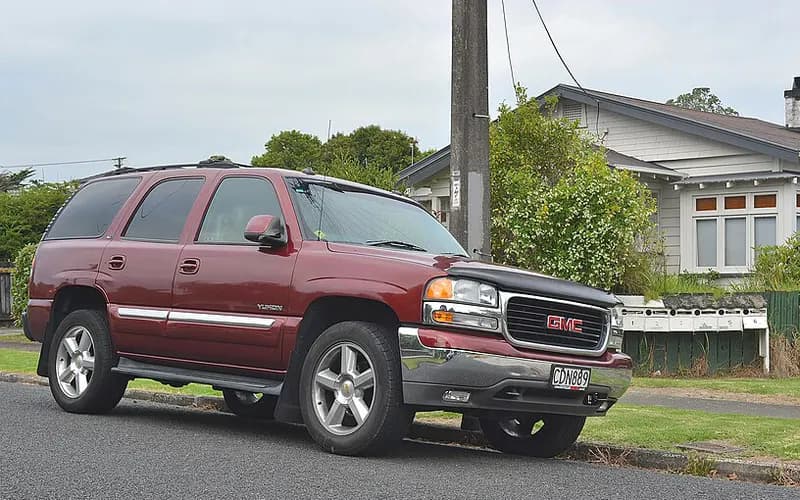
GMC Yukon 2000–2006
Common on this vehicle:NoiseWarning lightCorrosion or rustLeakMisfire or rough idleAir conditioning or heaterReduced brakingLights (headlights, turn signals)
Possible causes
50 causes not drawn
- Hydro-boost brake assist and power steering share one hydraulic supply (four campaigns)1
- DIC “Reduced Brake Power” message and reduced vacuum boost1
- Stability System Disabled message and unwanted StabiliTrak activation (tire wear or mismatched tires)1
- ABS lamp with DTC C0265 (EBCM motor relay circuit) after EBCM replacement1
- Rear bank knock sensor corrosion from water intrusion (P0332)4.8L, 5.3L, 6.0L only3
- Accessory drive belt whine (power steering pump pulley repositioned)1500 only1
- Castech cylinder head porosity crack (gradual coolant loss)4.8L, 5.3L only1
- Higher than expected engine oil consumption (PCV valve replacement)4.8L, 5.3L, 6.0L only1
- P0300 after engine repairs: injector connectors crossed (cylinders 5-7 / 6-8)1
- Slight roughness at idle with no DTCs (possible characteristic)1
- Electronic transfer case stops shifting with no DTC (shift abuse lock out mode, normal)1
- Transfer case speed sensor connector locks bend on disconnect (improved connector)1
- Grind / ratchet noise when shifting into Park in 4LO (characteristic)1
- Center console lid hard to open or close (lubricate the latch)2
- Door manual lock lever disengages from the door trim panel (lock lever replacement)2
- Rattle from the center of the dash (cowl insulator clip)1
- Door sags or is hard to open or close (worn or corroded hinge pins and bushings)1
- Front seat adjuster switch knob loose or missing (replace only the switch cover)1
- Headliner or roof rattle (roof drain channel)1
- Stains on the rear bumper step pad (treat with Armor-Dillo, do not replace)1
- Broken latch of the rear cupholder in the center console (replace the latch only)1
- Second-row rearward folding head restraint pinch points - recall 02V-2531
- Side access door noise (door check link replacement)1
- Door Manual Lock Lever: loose or misadjusted3
- Ground Ring Terminal: loose or misadjusted3
- Trailer brakes applied whenever headlamps or park lamps are on (brake controller jumper harness)2
- Intermittent battery drain from a sticking A/C compressor relay1
- Poor radio reception from a loose radio antenna mast1
- Radio shows a disc error when a media disc is inserted (unsupported disc format or damaged disc)1
- Rear wiper jumps when the fog lamps are turned on (auxiliary ground to rear washer pump)1
- Conversion equipment (not the vehicle as built): Southern Comfort running board courtesy lights overheating - recall 03V-0941
- Turn signal flashes fast (export flasher relay installed)1
- Wiring: corroded, electrical fault2
- DTC P0446 set with the SES lamp on (replace the EVAP vent solenoid, not the canister)3
- Out of fuel with the gauge reading above empty, cranks but no start, stall (replace the fuel sensor, not the sender module)2
- Fuel pressure regulator buzz / hum after replacement (check fuel pump feed voltage drop and connector crimps)4.8L, 5.3L, 6.0L only2
- Aftermarket part (not the vehicle as built): Fram G3727 replacement fuel filter connector - recall 06E-0431
- Fuel gauge reads low or drops to empty in Park / Neutral (normal characteristic)1
- Fuel Line: corroded2
- OnStar System: failed, software2
- Digital Radio Receiver: failed1
- CD Player: software1
- OnStar Hardware: software1
- A/C blows warm at extended idle (6.0L: auxiliary electric cooling fan)6.0L only1
- Loss of HVAC mode or temperature control (wiring harness rerouted)1
- Air Conditioning Compressor: failed2
- Seat Belt Buckle: clogged or contaminated, failed2
- Air bag (SIR) lamp on with DTC B1001 after BCM or SDM replacement1
- Seat Belt Warning Light: failed1
- CHECK OIL LEVEL message stays on after an oil change or top-off until the engine cools1
Causes with no correction stated (33)
Causes the records name for which no check or repair is stated, in a technical document or in a record. Press one for the records that name it.
- Suspension, wheels and tires
- Tire: broken, design or manufacturing (7)Automatic Level Control: clogged or contaminated (1)Rear Axle Retainer Button: broken (1)
- Airbags and seat belts
- Seat Belt: failed, loose or misadjusted (5)Seat Belt Retractor: failed (1)
- Transmission and driveline
- Transfer Case: failed (3)Locking Rear Differential (2)Transmission Oil Cooler Line: corroded, loose or misadjusted (2)Axle Differential Seal: leaking (1)
- Electrical, wiring and power
- ATC Fuse: electrical fault, failed (2)Powertrain Control Module: electrical fault (1)
- Fuel system
- Fuel Injector: clogged or contaminated, corroded (2)Fuel Tank Filler: design or manufacturing (2)
- Body, doors and interior
- Head Restraint: design or manufacturing (2)Button: failed (1)Center Console Lock: failed (1)Glass: design or manufacturing (1)Handle: design or manufacturing (1)
- Heating and air conditioning
- Air Conditioning Control Head: failed (1)Air Conditioning Low Pressure Switch: design or manufacturing (1)Blower Motor: failed (1)
- Instruments and lighting
- Bulb: failed (1)Information Center Screen: failed (1)Instrument Panel Cluster: failed (1)Rearview Mirror Courtesy Lamp: broken (1)
- Exhaust and emissions
- Evap Vent Valve: clogged or contaminated (1)Exhaust Manifold Heat Shield: loose or misadjusted (1)
- Steering
- Idler And Pitman Arm: worn (1)
- Audio and telematics
- Tweeter Speaker: loose or misadjusted (1)Voice Recognition System: software (1)
The documents say what to doOnly records name itThe size of a node, the width of a link and the numbers are records matching this search, not likelihoods.
FaultCrate・GMC Yukon 2000–2006・2002
Candidate cause (the documents say what to do)
Brake pipe (brake line) corrosion and rupture
The pipes' steel-copper construction is vulnerable to galvanic corrosion if exposed to the environment.
NHTSA found the failures came with general excessive corrosion over most of the pipe assembly and appear to be expected wear-out of the coating in severe-corrosion states.
How to tell
Brake warning / Service Brake System
What to do
- In the joint inspections, scaling or flaking corrosion was taken as indicating the onset of metal loss and given the second lowest ranking (2); a leaking or previously repaired pipe was the lowest (1).
- GM noted that pipes with excessive flaking corrosion can only be fully evaluated, including remaining service life, by removing them, cleaning off the corrosion and sectioning them to assess remaining wall thickness.
- The inspections found no specific location where corrosion was visually more severe and no pattern between vehicles.
- Service records of incident vehicles also indicate that repairs are not isolated to a specific location or brake pipe.
- GM recommends replacing the entire set of pipes whenever any pipe leaks or is corroded enough to need replacement.
- On June 28, 2013 GM released 66 new part numbers for servicing brake pipes in 1999-2007 GMT800 pickups and utility vehicles.
Caution: Analysis of repair records indicates that consumers often elect to repair only the failed circuit.
What is needed
- Parts and materials
- The entire set of brake pipes (whenever any pipe leaks or is corroded enough to need replacement; GM's recommendation)
- GM brake pipe kit (a complete set of pre-formed and pre-flared pipes, for when the entire brake pipe assembly is replaced)
- Labor time
- Kit procedure: 4.5 to 6.0 hours, depending on the vehicle's configuration (labor time guideline of the October 2014 TSB)
- Forming and flaring replacement tubing to fit the vehicle: approximately 8.5 hours (base time estimate)
- Special tools
- Not stated
- Scan tool
- Not stated
Only what the technical documents state. "Not stated" does not mean not needed.
In the records
- Brake Line: replaced 7(says it was fixed: 1, result not stated: 6)
- Brake Fluid: replaced 1(result not stated: 1)
- Brake Line: repaired 1(result not stated: 1)
See the evidence (1 technical documents, 36 records)
Passages of the technical documents
NHTSA's investigation covered 1999-2003 GM C/K pickups and SUVs in salt-belt states.
Products: 1999-2003 GM C/K pickup trucks and SUVs in Salt Belt states
NHTSA ODI 2015-04-08
The GMT800 platform includes 1999-2007 Silverado and Sierra 1500, 2500 and 3500 pickup trucks; 2000-2006 Suburban, Tahoe and Yukon; and 2002-2006 Escalade and Avalanche.
The GMT800 platform includes the following vehicles: 1999-2007 Chevrolet Silverado and GMC Sierra 1500, 2500 and 3500 series pick-up trucks; 2000-2006 Chevrolet Suburban, Chevrolet Tahoe and GMC Yukon sport utility vehicles; and 2002-2006 Cadillac Escalade and Chevrolet Avalanche sport-utility vehicles.
NHTSA ODI 2015-04-08
Corroded brake lines may rupture during a brake application, reducing brake effectiveness.
Brake line corrosion may result in rupture during brake application, resulting in reduced brake effectiveness.
NHTSA ODI 2015-04-08
The pipes' steel-copper construction is vulnerable to galvanic corrosion if exposed to the environment.
The steel-copper construction is vulnerable to galvanic corrosion if exposed to the environment.
NHTSA ODI 2015-04-09
Records
- Brake line failure recurring within 12 months Owner complaint 2016-07-16
- Brake pedal went to floor and brake line failure during braking in traffic Owner complaint 2017-02-07
- Brake failure due to corroded and fractured brake lines at 65,000 miles Owner complaint 2014-11-17
A cause or a result a complaint states is the owner’s view or what a dealer told them, not an established fact.
Put together by FaultCrate from public records and technical documents. The cause and the repair are for the workshop to decide with the vehicle in front of it. Counts are records, not failure rates.