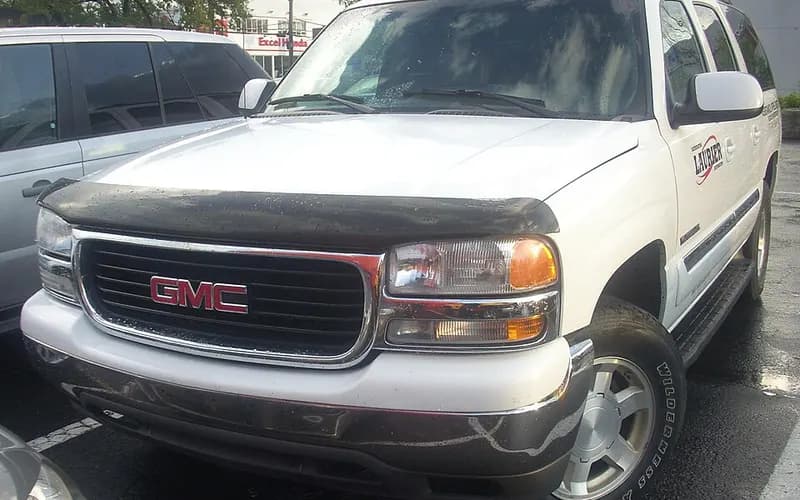
GMC Yukon XL 2000–2006
Common on this vehicle:Loss of engine power, no accelerationWarning lightReduced brakingCorrosion or rustGauge or instrument faultLeakDoes not startStalls or shuts off
Possible causes
Causes with no correction stated (2)
Causes the records name for which no check or repair is stated, in a technical document or in a record. Press one for the records that name it.
The documents say what to doOnly records name itThe size of a node, the width of a link and the numbers are records matching this search, not likelihoods.
FaultCrate・GMC Yukon XL 2000–2006・Leak, Stability control message (StabiliTrak)
Candidate cause (the documents say what to do)
Brake pipe (brake line) corrosion and rupture
The pipes' steel-copper construction is vulnerable to galvanic corrosion if exposed to the environment.
NHTSA found the failures came with general excessive corrosion over most of the pipe assembly and appear to be expected wear-out of the coating in severe-corrosion states.
How to tell
Brake warning / Service Brake System
What to do
- In the joint inspections, scaling or flaking corrosion was taken as indicating the onset of metal loss and given the second lowest ranking (2); a leaking or previously repaired pipe was the lowest (1).
- GM noted that pipes with excessive flaking corrosion can only be fully evaluated, including remaining service life, by removing them, cleaning off the corrosion and sectioning them to assess remaining wall thickness.
- The inspections found no specific location where corrosion was visually more severe and no pattern between vehicles.
- Service records of incident vehicles also indicate that repairs are not isolated to a specific location or brake pipe.
- GM recommends replacing the entire set of pipes whenever any pipe leaks or is corroded enough to need replacement.
- On June 28, 2013 GM released 66 new part numbers for servicing brake pipes in 1999-2007 GMT800 pickups and utility vehicles.
Caution: Analysis of repair records indicates that consumers often elect to repair only the failed circuit.
What is needed
- Parts and materials
- The entire set of brake pipes (whenever any pipe leaks or is corroded enough to need replacement; GM's recommendation)
- GM brake pipe kit (a complete set of pre-formed and pre-flared pipes, for when the entire brake pipe assembly is replaced)
- Labor time
- Kit procedure: 4.5 to 6.0 hours, depending on the vehicle's configuration (labor time guideline of the October 2014 TSB)
- Forming and flaring replacement tubing to fit the vehicle: approximately 8.5 hours (base time estimate)
- Special tools
- Not stated
- Scan tool
- Not stated
Only what the technical documents state. "Not stated" does not mean not needed.
In the records
No record states work done for this cause.
See the evidence (1 technical documents, 1 records)
Passages of the technical documents
NHTSA's investigation covered 1999-2003 GM C/K pickups and SUVs in salt-belt states.
Products: 1999-2003 GM C/K pickup trucks and SUVs in Salt Belt states
NHTSA ODI 2015-04-08
The GMT800 platform includes 1999-2007 Silverado and Sierra 1500, 2500 and 3500 pickup trucks; 2000-2006 Suburban, Tahoe and Yukon; and 2002-2006 Escalade and Avalanche.
The GMT800 platform includes the following vehicles: 1999-2007 Chevrolet Silverado and GMC Sierra 1500, 2500 and 3500 series pick-up trucks; 2000-2006 Chevrolet Suburban, Chevrolet Tahoe and GMC Yukon sport utility vehicles; and 2002-2006 Cadillac Escalade and Chevrolet Avalanche sport-utility vehicles.
NHTSA ODI 2015-04-08
Corroded brake lines may rupture during a brake application, reducing brake effectiveness.
Brake line corrosion may result in rupture during brake application, resulting in reduced brake effectiveness.
NHTSA ODI 2015-04-08
The pipes' steel-copper construction is vulnerable to galvanic corrosion if exposed to the environment.
The steel-copper construction is vulnerable to galvanic corrosion if exposed to the environment.
NHTSA ODI 2015-04-09
Records
- Brake pedal went to floor with loss of braking power when pulling away from hill Owner complaint 2014-06-20
A cause or a result a complaint states is the owner’s view or what a dealer told them, not an established fact.
Put together by FaultCrate from public records and technical documents. The cause and the repair are for the workshop to decide with the vehicle in front of it. Counts are records, not failure rates.