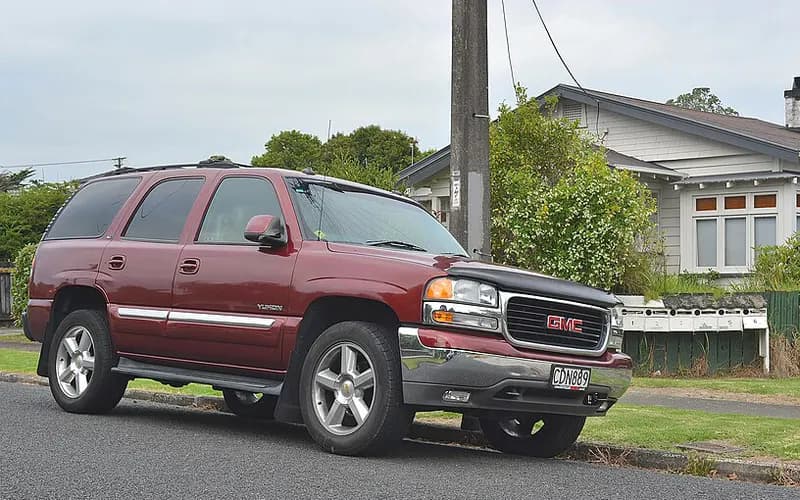
EngineModel years 1999–2002ManufacturerGovernment
Increased accelerator pedal effort / throttle body sticks (clean and adjust, do not replace)
Bulletin 02-06-04-054A lists 1999-2002 GMC Yukon, XL with the 4.8L or 5.3L V8 (RPOs LR4, LM7, L59); the Fix It Right row is worded by class: 1999-2002 Fullsize Pickups and Utilities.
FaultCrate・Increased accelerator pedal effort / throttle body sticks (clean and adjust, do not replace)
The throttle valve may intermittently stick in the closed position. The extra pedal force applied to open it may open the throttle more than intended and accelerate the engine and vehicle more than the driver expects.
The 59 crashes counted generally occurred during close-quarter maneuvers such as pulling into a parking space or inching forward in bumper-to-bumper traffic.
The investigation found two factors that may cause the defect: TB manufacturing process problems, and accumulation of deposits (a PCV system by-product) on or around the throttle valve and bore.
TBs used in MY 1999 and some MY 2000 vehicles may have deformed housings and bores, which may make the valve tight in the closed position, and may have been made with insufficient closed throttle valve angles, which can also cause stiction.
GM states that the TB deposits come from engine oil compounds that enter the intake manifold through the engine PCV system. The deposits accumulate gradually with vehicle usage.
The 2-degree throttle body design brought reduced clearances between the circumference of the closed valve and the bore of the TB.
GM notes that the fixed orifice PCV valve reduces the volume of engine oil entering the PCV system and the TB, which inhibits the formation of deposits in the TB. It was incorporated into engine production from November 2001.
What to do
- The last five digits of the TB part number and the manufacturing date are stamped into the TB mounting flange. The date code has the format 'dddy': day of the year (001 to 365) followed by the last digit of the year (9 = 1999, 0 = 2000).
- VRTC compared opening force measured at the accelerator pedal with force measured directly at the throttle cable crank (TB shaft); this confirmed the TB as the source of atypical stiction and eliminated the throttle cable and pedal linkage.
- VRTC measured the maximum pedal force needed to open the throttle from closed (typically about 5.0 lbf on a normal vehicle) and the force needed to hold it just off closed (typically about 4.5 lbf). The difference between the two is the throttle stiction force.
- A stiction force of about one half (.5) lbf is considered typical; anything greater than .5 lbf is considered atypical.
- The correction named in the subject is to clean the throttle body and adjust the blade.
- Clean the throttle body, adjust the blade and insert plugs.
- After confirming that a fixed orifice PCV valve was installed, the technician was instructed to first clean the TB bore and then eliminate the air bypass hole in the throttle valve using a specially developed plug. Using GM service diagnostic tools, the technician then adjusts the shipping air setscrew to increase the closed throttle valve angle, compensating for lost bypass air.
- The setscrew adjustment increases the clearance between the throttle valve and the bore, which makes it harder for engine deposits to accumulate.
What is needed
- Parts and materials
- Specially developed plug (to eliminate the air bypass hole in the throttle valve)
- Labor time
- Not stated
- Special tools
- GM service diagnostic tools (used to adjust the shipping air setscrew)
- Scan tool
- Not stated
Only what the technical documents state. "Not stated" does not mean not needed.
If left
- Some interviewed owners reported that their vehicle had been serviced for the condition but the symptoms returned; none of those repair attempts used the TSB 02-06-04-054 process.
Caution
- Do not replace the throttle body; the reference is bulletin 02-06-04-054B.
- According to GM, 4.8L and 5.3L service replacement TBs have had the bypass hole in the valve eliminated since the October 2003 design change, which further increases the closed valve angle.
- ODI concluded that GM's TB is defective but did not find that the defect poses an unreasonable risk to safety: the pedal force needed to open a stuck throttle valve is negligible and the valve does not stick in the open position.
- This engineering analysis (EA02-015) will be closed at this time; the closing does not constitute a finding by NHTSA that a safety-related defect does not exist.
Applies to
- Bulletin 02-06-04-054A, which replaces 02-06-04-054, covers increased accelerator pedal effort on 1999-2002 Chevrolet Silverado, Suburban, Tahoe, Avalanche and GMC Sierra, Yukon, XL with the 4.8L or 5.3L V8 engine (RPOs LR4, LM7, L59).
- Row for 1999-2002 Fullsize Pickups and Utilities: throttle body sticks.
- This investigation involves the GM throttle body (TB) used in MY 1999-2002 Silverado, Sierra, Tahoe, Suburban, Avalanche and Yukon with 4.8L, 5.3L and 6.0L engines.
- Throttle bodies manufactured since November 1999 apparently are not affected by these manufacturing issues.
- For vehicles with the 6.0L engine, GM intended to publish a bulletin addressing throttle stiction in a similar manner (TB cleaning, then plugging the bypass hole and adjusting the shipping air screw), with release set for quarter one 2004.
- GM no longer uses the subject TB; from MY 2003 production it used an electronic throttle control (ETC) based component with no throttle cable.
See the evidence (3 documents, 26 passages)
| Document | Publisher | Date |
|---|---|---|
| [1]GM TechLink, April 2003 ↗ | ManufacturerGeneral Motors | 2003-04-01 |
| [2]GM TechLink, October 2003 ↗ | ManufacturerGeneral Motors | 2003-10-01 |
| [3]ODI investigation EA02015: Throttle sticking closed ↗ | GovernmentNHTSA ODI | 2004-01-12 |
Applies toBulletin 02-06-04-054A, which replaces 02-06-04-054, covers increased accelerator pedal effort on 1999-2002 Chevrolet Silverado, Suburban, Tahoe, Avalanche and GMC Sierra, Yukon, XL with the 4.8L or 5.3L V8 engine (RPOs LR4, LM7, L59).
02-06-04-054A; replaces 02-06-04-054; Increased Accelerator Pedal Effort (Clean Throttle Body and Adjust Blade); 1999-2002 Chevrolet Silverado, Suburban, Tahoe, Avalanche, GMC Sierra, Yukon, XL with 4.8L or 5.3L V8 Engine (NIVs V, T, Z -- RPOs LR4, LM7, L59)— [1]
Applies toRow for 1999-2002 Fullsize Pickups and Utilities: throttle body sticks.
1999-2002 Fullsize Pickups and Utilities – Throttle Body Sticks— [2]
RepairThe correction named in the subject is to clean the throttle body and adjust the blade.
Increased Accelerator Pedal Effort (Clean Throttle Body and Adjust Blade)— [1]
RepairClean the throttle body, adjust the blade and insert plugs.
Clean throttle body adjust blade and insert plugs— [2]
CautionDo not replace the throttle body; the reference is bulletin 02-06-04-054B.
Don’t replace throttle body 02-06-04-054B— [2]
Applies toThis investigation involves the GM throttle body (TB) used in MY 1999-2002 Silverado, Sierra, Tahoe, Suburban, Avalanche and Yukon with 4.8L, 5.3L and 6.0L engines.
This investigation involves the General Motors Corporation (GM) throttle body (TB) utilized in model year (MY) 1999-2002 Silverado, Sierra, Tahoe, Suburban, Avalanche and Yukon (subject vehicle(s)) with 4.8L, 5.3L, and 6.0L engines.— [3]
First signsThe throttle valve may intermittently stick in the closed position. The extra pedal force applied to open it may open the throttle more than intended and accelerate the engine and vehicle more than the driver expects.
The TB valve may intermittently stick in a closed position. In such a situation, an operator may apply additional accelerator pedal force to increase engine speed. The application of additional accelerator pedal force, to open a stuck throttle valve, may open the throttle valve more than intended and, in turn, accelerate the engine and vehicle more than intended and reasonably expected by the driver.— [3]
First signsThe 59 crashes counted generally occurred during close-quarter maneuvers such as pulling into a parking space or inching forward in bumper-to-bumper traffic.
The 59 crashes referred to in Table 4 generally occurred while operators were attempting to maneuver their vehicle in close quarter situations such as pulling into a parking space, or inching forward in bumper-to-bumper traffic.— [3]
Why it happensThe investigation found two factors that may cause the defect: TB manufacturing process problems, and accumulation of deposits (a PCV system by-product) on or around the throttle valve and bore.
The investigation revealed that two factors may cause the defect: 1) TB manufacturing process problems; and 2) accumulation of deposits (a PCV system by-product) on or around the TB throttle valve and bore.— [3]
Why it happensTBs used in MY 1999 and some MY 2000 vehicles may have deformed housings and bores, which may make the valve tight in the closed position, and may have been made with insufficient closed throttle valve angles, which can also cause stiction.
This TSB addresses higher than normal accelerator pedal effort caused by the manner in which TB's, used in MY 1999 and some MY 2000 subject vehicles, were manufactured. The manufacturing methods used in producing those TBs may have resulted in deformed TB housings and bores which may cause the TB valve to become tight in the closed position. Additionally, those TBs may have been manufactured with insufficient closed throttle valve angles, which can also cause throttle stiction.— [3]
Applies toThrottle bodies manufactured since November 1999 apparently are not affected by these manufacturing issues.
Throttle bodies manufactured since November 1999 apparently are not affected by these manufacturing issues.— [3]
Why it happensGM states that the TB deposits come from engine oil compounds that enter the intake manifold through the engine PCV system. The deposits accumulate gradually with vehicle usage.
GM states that the TB deposits are the result of engine oil compounds that enter the intake manifold through the engine PCV system. The engine deposits accumulate gradually with vehicle usage.— [3]
Why it happensThe 2-degree throttle body design brought reduced clearances between the circumference of the closed valve and the bore of the TB.
With the 2-degree design change came reduced clearances between the circumference of the closed valve and the bore of the TB.— [3]
How to confirmThe last five digits of the TB part number and the manufacturing date are stamped into the TB mounting flange. The date code has the format 'dddy': day of the year (001 to 365) followed by the last digit of the year (9 = 1999, 0 = 2000).
The last five digits of the TB's GM part number and manufacturing date are identified by codes stamped into the TB mounting flange, as depicted in Figure 1 below. The Julian Date code follows the format 'dddy' where 'ddd' represents the day of the year (001 to 365) and 'y' represents the digit value of the year (9 = 1999, 0 = 2000, etc).— [3]
How to confirmVRTC compared opening force measured at the accelerator pedal with force measured directly at the throttle cable crank (TB shaft); this confirmed the TB as the source of atypical stiction and eliminated the throttle cable and pedal linkage.
Body force refers to opening force measurements taken directly at the throttle cable crank (TB shaft). A comparison of the pedal and body force measurements confirmed in each inspection that the TB was the source of atypical stiction, i.e., this eliminated the throttle cable and or pedal linkage as atypical stiction sources.— [3]
How to confirmVRTC measured the maximum pedal force needed to open the throttle from closed (typically about 5.0 lbf on a normal vehicle) and the force needed to hold it just off closed (typically about 4.5 lbf). The difference between the two is the throttle stiction force.
To determine the throttle stiction force, VRTC first measured the maximum pedal force required to open the throttle from the closed position (typically about 5.0 pounds force (lbf). on a 'normal' vehicle). VRTC then measured the force required to maintain the throttle in an open state just off the closed throttle position (typically about 4.5 lbf on a 'normal' vehicle). The difference between these two measurements represents the throttle stiction force.— [3]
How to confirmA stiction force of about one half (.5) lbf is considered typical; anything greater than .5 lbf is considered atypical.
A difference of about one half (.5) lbf is considered typical, anything greater than .5 lbf is considered atypical.— [3]
RepairAfter confirming that a fixed orifice PCV valve was installed, the technician was instructed to first clean the TB bore and then eliminate the air bypass hole in the throttle valve using a specially developed plug. Using GM service diagnostic tools, the technician then adjusts the shipping air setscrew to increase the closed throttle valve angle, compensating for lost bypass air.
After confirming a fixed orifice PCV valve was installed, the technician was instructed to first clean the TB bore and then to eliminate the air bypass hole in the throttle valve using a specially developed plug, as shown in Figure 3 below. Using GM service diagnostic tools, the technician then adjusts the shipping air setscrew to increase the closed throttle valve angle, thus compensating for lost bypass air.— [3]
RepairThe setscrew adjustment increases the clearance between the throttle valve and the bore, which makes it harder for engine deposits to accumulate.
The setscrew adjustment increases the clearance between the throttle valve and bore, making it more difficult for engine deposits to accumulate and thereby reducing the likelihood of throttle stiction occurring.— [3]
Applies toFor vehicles with the 6.0L engine, GM intended to publish a bulletin addressing throttle stiction in a similar manner (TB cleaning, then plugging the bypass hole and adjusting the shipping air screw), with release set for quarter one 2004.
GM intends to publish a TSB for subject vehicles equipped with 6.0L engine that will address throttle stiction in a similar manner as described in TSB #3 (TB cleaning, then plugging the bypass hole and adjusting the shipping air screw). The future release of this TSB is set for quarter one 2004.— [3]
Why it happensGM notes that the fixed orifice PCV valve reduces the volume of engine oil entering the PCV system and the TB, which inhibits the formation of deposits in the TB. It was incorporated into engine production from November 2001.
GM notes that the fixed orifice PCV valve reduces the volume of engine oil entering the PCV system and the TB. Reduced oil entry inhibits the formation of deposits in the TB. GM further advised that the fixed orifice PCV valve was incorporated into subject vehicle engine production commencing in November 2001, coincident with other TB changes (see Design Changes Section).— [3]
CautionAccording to GM, 4.8L and 5.3L service replacement TBs have had the bypass hole in the valve eliminated since the October 2003 design change, which further increases the closed valve angle.
According to GM, the October 2003 design change to eliminate the bypass hole in the valve for 4.8L and 5.3L service replacement TB's results in a further increase in the closed valve angle position.— [3]
Applies toGM no longer uses the subject TB; from MY 2003 production it used an electronic throttle control (ETC) based component with no throttle cable.
GM no longer uses the subject TB in its vehicles. GM utilized an electronic throttle control (ETC) based component that does not utilize a throttle cable commencing with MY 2003 production.— [3]
If leftSome interviewed owners reported that their vehicle had been serviced for the condition but the symptoms returned; none of those repair attempts used the TSB 02-06-04-054 process.
Some of those interviewed reported their vehicle had been serviced for the condition but the symptoms returned. However, none of these repair attempts involved application of the TSB #02-06-04-054 process.— [3]
CautionODI concluded that GM's TB is defective but did not find that the defect poses an unreasonable risk to safety: the pedal force needed to open a stuck throttle valve is negligible and the valve does not stick in the open position.
Although GM's TB is defective, based on the evidence gathered, ODI has not found that the defect poses an unreasonable risk to safety. The accelerator pedal force required to open a stuck throttle valve is negligible, and the throttle valve does not stick in the open position.— [3]
CautionThis engineering analysis (EA02-015) will be closed at this time; the closing does not constitute a finding by NHTSA that a safety-related defect does not exist.
Therefore this engineering analysis (EA02-015) will be closed at this time. The closing of this investigation does not constitute a finding by NHTSA that a safety-related defect does not exist.— [3]
Put together by FaultCrate from public records and technical documents. The cause and the repair are for the workshop to decide with the vehicle in front of it. Counts are records, not failure rates.
Records under this issue 5
Owner complaint 1Manufacturer communication 4
Look into the records of this issue (5)List the records (5 that can be opened)
Records whose recall number, document number or text matches. Each line says why it matched.
- Throttle body sticks: clean the throttle body instead of replacing itManufacturer communication 2003-10-01・document number matches
- Increased Accelerator Pedal Effort, Idle InstabilityManufacturer communication 2003-04-25・text contains "ACCELERATOR PEDAL EFFORT"
- Increased Accelerator Pedal EffortManufacturer communication 2003-04-04・text contains "ACCELERATOR PEDAL EFFORT"
- Increased accelerator pedal effort: clean throttle body and adjust bladeManufacturer communication 2003-04-01・document number matches
- Power windows not working and throttle pedal sticks and moreOwner complaint 2004-03-30・text contains "THROTTLE PEDAL STICKS"