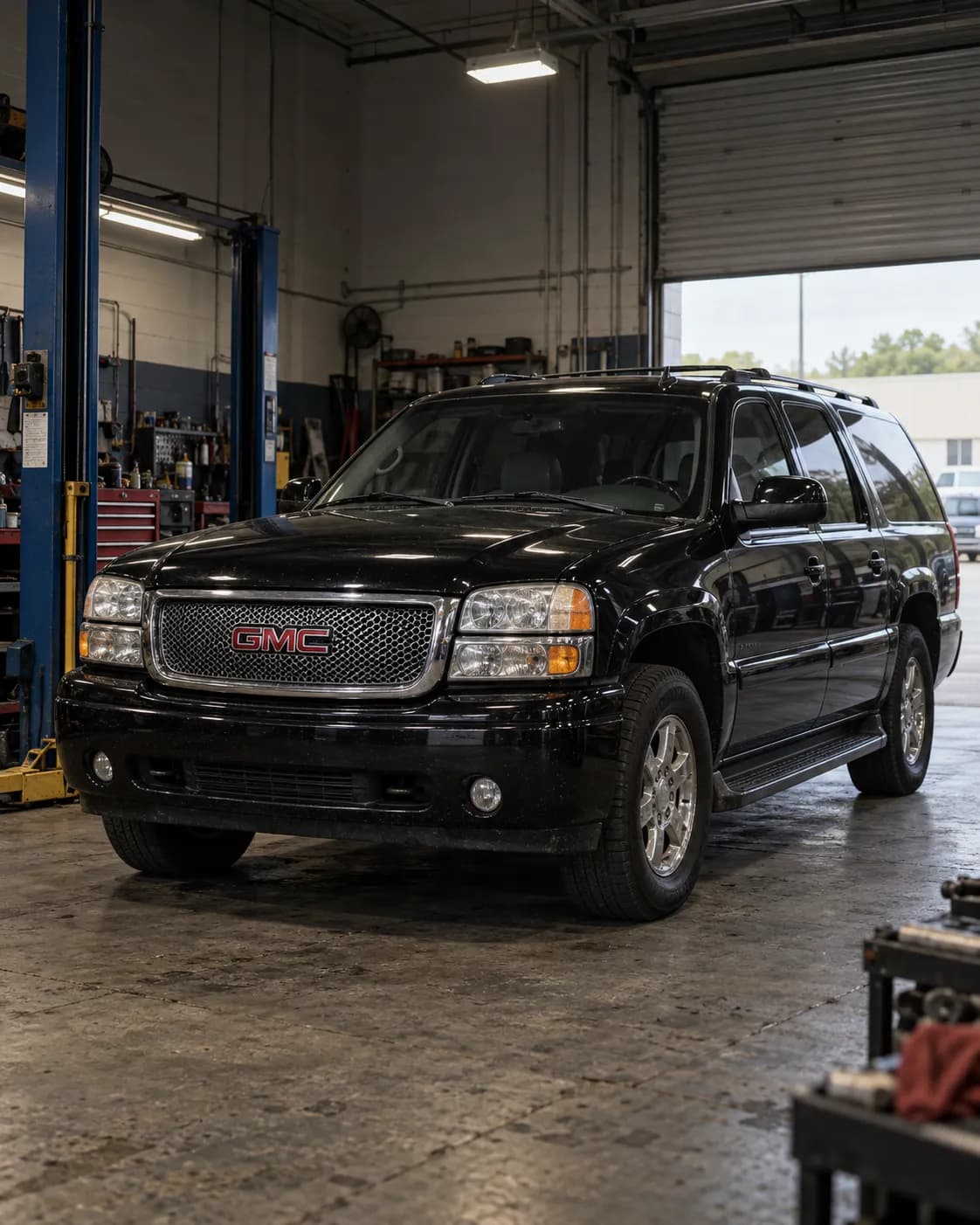
Source reference 10133147
Manufacturer communication — 2006 GMC YUKON DENALI XL
Relation to the target vehicle
- The source's vehicle field includes the trim.
- Model year
- Match 2006 — Source vehicle field
- Model
- Match YUKON DENALI XL — Source vehicle field
- Trim
- Match Denali — Source vehicle field
What the manufacturer’s document says
00-03-10-006I ・ fault and correction ・ for GM vehicles in general
Applies to
Applies to 2013 and prior GM passenger cars and light duty trucks.
the passage
2013 and Prior GM Passenger Cars and Light Duty Trucks
Fault
The most common ride concern involving tire radial force variation is a shake on smooth roads at highway speed, 105-115 km/h (65-70 mph).
the passage
The most common ride concern involving tire radial force variation is highway speed (105-115 km/h (65-70 mph) shake on smooth roads.
Finding the cause
Possible causes
Tire related smooth road highway speed shake has three causes - imbalance, out of round and tire force variation - which are not necessarily related; all three must be addressed.
the passage
Tire related smooth road highway speed shake can be caused by three conditions: imbalance, out of round and tire force variation. These three conditions are not necessarily related. All three conditions must be addressed.
Steps to confirm (in the document’s order)
With the vehicle raised, centre the wheels on the hub: loosen all wheel nuts, hand-tighten them while shaking the wheel, then torque to specification with a torque wrench, not a torque stick.
the passage
With the vehicle raised, ensure the wheels are centered on the hub by loosening all wheel nuts and hand-tightening all nuts first by hand while shaking the wheel, then torque to specifications using a torque wrench, NOT a torque stick.
On the EVA, 35 to 50 Hz typically indicates a first order propshaft vibration (see bulletin 08-07-30-044); 10 to 20 Hz generally indicates a tire/wheel vibration.
the passage
A reading of 35 to 50 Hz typically indicates a first order propshaft vibration. If this is the situation, refer to the latest version of Corporate Bulletin Number 08-07-30-044. Generally, a reading between 10 and 20 Hz indicates a tire/wheel vibration and if this is the reading obtained, continue using this bulletin.
Flat-spotting vibration may come and go above 72 km/h (45 mph) during the first 10 minutes; if vibration continues after 10 minutes of driving above 72 km/h (45 mph), flat-spotting can be ruled out.
the passage
Tire flat-spotting vibration may come and go at any speed over 72 km/h (45 mph) during the first 10 minutes of operation, if vibration continues after 10 minutes of driving at speeds greater than 72 km/h (45 mph), tire flat-spotting can be ruled out as the cause for vibration.
Check each assembly on a calibrated off-car dynamic balancer; if any assembly calls for more than 1/4 ounce on either rim flange, remove all weights and rebalance as close to zero as possible.
the passage
If any assembly calls for more than ¼ ounce on either rim flange, remove all balance weights and rebalance to as close to zero as possible.
Guide values for assembly radial force variation: P-Metric tires on light trucks 24 lbs (11 kg) or less, LT-tires on light trucks 35 lbs (16 kg) or less.
the passage
P-Metric tires on light trucks 24 lbs (11 kg) or less LT-tires on light trucks 35 lbs (16 kg) or less
Correction
Repair
If the radial runout of an assembly exceeds 0.040 in (1.02 mm), match mount the tire to the wheel to get below 0.040 in (1.02 mm).
the passage
If one or more of the tire/wheel assemblies are more than 0.040 in (1.02 mm), match mount the tire to the wheel to get below 0.040 in (1.02 mm).
If match mounting on in-spec wheels still gives values above the guide, tire replacement may be necessary; replacing tires at lower values probably condemns good tires.
the passage
If match mounting tires to in-spec wheels produces assembly values higher than these, tire replacement may be necessary. Replacing tires at lower values will probably mean good tires are being condemned.
Caution
Before measuring tires on force variation equipment, the vehicle must be driven at least 24 km (15 mi) to remove any flat-spotting.
the passage
Before measuring tires on GM approved tire force variation measurement equipment, the vehicle MUST be driven a minimum of 24 km (15 mi) to ensure removal of any flat-spotting.
On the balancer, always centre the wheel on the pilot bore with the proper cone/collet; never use the hub-cap bore, which is not a precision machined surface.
the passage
Be sure to choose the proper cone/collet for the wheel, and always use the pilot bore for centering. Never center the wheel using the hub-cap bore since it is not a precision machined surface.
Compiled by reading the full text of the document; each point stands on the passage shown. Check the document itself, linked below, before working on a vehicle.
Stated content
Communication summary
本情報公開は、タイヤ放射方向力変動に関する情報を提供します。 Machine translation (unreviewed)
This informational bulletin provides information on tire radial force variation.
Go to this passage in the original
Source
- Source
- NHTSA Manufacturer Communications
- Source reference
- 10133147
- Received by source
- 2018-04-16
- Incident date
- Unknown
Open original text and sourceOpen the provider's page (external)