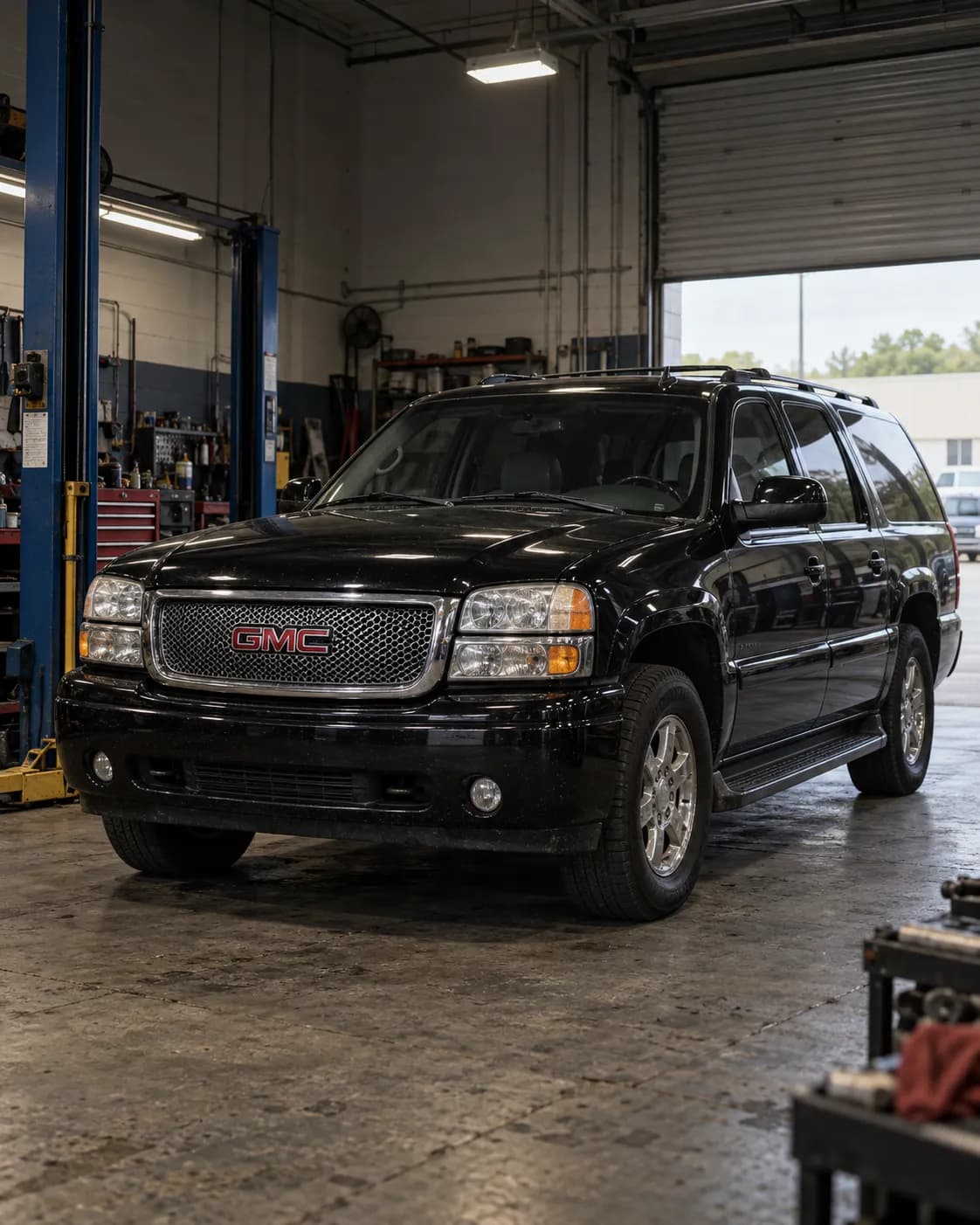
Source reference 10116537
Manufacturer communication — 2006 GMC YUKON DENALI XL
Relation to the target vehicle
- The source's vehicle field includes the trim.
- Model year
- Match 2006 — Source vehicle field
- Model
- Match YUKON DENALI XL — Source vehicle field
- Trim
- Match Denali — Source vehicle field
What the manufacturer’s document says
08-03-10-006F ・ fault and correction ・ for GM vehicles in general
Applies to
Applies to 2005-2018 GM passenger cars and light duty trucks.
the passage
2005-2018 GM Passenger Cars and Light Duty Trucks
Fault
A tire slowly loses air pressure over a period of days or weeks.
the passage
Some customers may comment on a tire that slowly loses air pressure over a period of days or weeks.
Finding the cause
Possible causes
As wear between tire and wheel at the bead seat continues, corrosive media from the environment may intrude at the tire/wheel interface; eventually a path for air develops and a slow leak may follow.
the passage
As the wear continues, there may also be intrusion at the tire/wheel interface by corrosive media from the environment. Eventually a path for air develops and a 'slow' leak may ensue.
Steps to confirm (in the document’s order)
After a water dunk tank leak test, if the air leak is around the bead seat of the wheel, dismount the tire to examine the bead seat.
the passage
After a water dunk tank leak test, if you determine the source of the air leak to be around the bead seat of the wheel, dismount the tire to examine the bead seat.
Bead seat corrosion looks like blistering of the wheel finish, leaving a rough or uneven surface on which the tire has difficulty keeping a proper seal.
the passage
Bead seat corrosion is identified by what appears like blistering of the wheel finish, causing a rough or uneven surface that is difficult for the tire to maintain a proper seal on.
On vehicles with 32,186 km (20,000 mi) or less, repairable corrosion may total 100 mm (4 in) or less in combined length; beyond that the wheel should be replaced.
the passage
For vehicles with 32,186 km (20,000 mi) or less, the total allowable combined linear area of repairable corrosion is 100 mm (4 in) or less. If the total area(s) of corrosion exceed these dimensions, the wheel should be replaced.
On vehicles that have exceeded 32,186 km (20,000 mi), repairable corrosion may total 200 mm (8 in) or less in combined length; beyond that the wheel should be replaced.
the passage
For vehicles that have exceeded 32,186 km (20,000 mi), the total allowable combined linear area of repairable corrosion is 200 mm (8 in) or less. If the total area(s) of corrosion exceed these dimensions, the wheel should be replaced.
Correction
Repair
Remove the corrosion and any flaking paint with a clean-up (fine cut) sanding disc or biscuit.
the passage
In order to correct the wheel leak, use a clean-up (fine cut) sanding disc or biscuit to remove the corrosion and any flaking paint.
Once the corrosion is removed, coat the repaired area with a commercially available bead sealant; the black rubber-like coating permanently fills and seals the resurfaced bead seat.
the passage
Once the corrosion has been eliminated, you should coat the repaired area with a commercially available tire sealant such as Patch Brand Bead Sealan or equivalent. Commercially available bead sealants are black rubber-like coatings that will permanently fill and seal the resurfaced bead seat.
Parts
Part number 16118: Patch Bead Sealer (1 Quart (= 0.946 L)).
the passage
16118 Patch Bead Sealer (1 Quart)
Caution
Do not replace a wheel for slow air loss unless the wheel has been evaluated and/or a repair with this procedure has been tried.
the passage
DO NOT replace a wheel for slow air loss unless you have evaluated and/or tried to repair the wheel with the procedure below.
If any loose coating or corrosion extends to the visible surfaces on the face of the wheel, the wheel must be replaced.
the passage
If any loose coatings or corrosion extend to the visible surfaces on the FACE of the wheel, that wheel must be replaced.
Compiled by reading the full text of the document; each point stands on the passage shown. Check the document itself, linked below, before working on a vehicle.
Stated content
Communication summary
このテクニカルブレティンは、タイヤがゆっくり空気が抜ける、タイヤ空気漏れ、低タイヤ圧警告灯点灯、アルミニウムホイールビードシート腐食の状態を有する車両に対して、ホイールビードシートを清掃および研磨する手順を提供します。 Machine translation (unreviewed)
This technical bulletin provides a procedure on how to clean and resurface wheel bead seats. for vehicles that have the condition of Tire Slowly Goes Flat, Tire Air Loss, Low Tire Pressure Warning Light Illuminated, Aluminum Wheel Bead Seat Corrosion (Clean and Resurface Wheel Bead Seat)
Go to this passage in the original
Source
- Source
- NHTSA Manufacturer Communications
- Source reference
- 10116537
- Received by source
- 2017-08-31
- Incident date
- Unknown
Open original text and sourceOpen the provider's page (external)